The introduction of MultiTech's new Niagara Driver represents a notable advancement in integrating LoRaWAN (Long Range Wide Area Network) IoT sensors into Niagara-based building automation systems (BAS). Unlike previous approaches that treated wireless sensors as an external overlay, this driver embeds LoRaWAN devices directly within the Niagara Framework, strengthening interoperability between LoRaWAN networks and core BAS operations.
This development offers system integrators, facility managers, and OEMs a more efficient route to scaling sensor deployments. It impacts commissioning processes, energy performance initiatives, and long-term data strategies for commercial portfolios.
Niagara, LoRaWAN, and the Drive for Interoperable Building Data
Tridium's Niagara Framework is active in over one million deployments across hundreds of thousands of projects globally[1], positioning it as a standard integration layer for many commercial buildings and campuses. In parallel, LoRaWAN has become a leading low-power wide-area network (LPWAN) option for sensor retrofits.
The LoRa Alliance states that, as of late 2025, more than 125 million LoRaWAN end devices are deployed worldwide[2], with smart buildings highlighted as a major growth area. LoRaWAN's long range and low-power attributes match key building automation requirements:
- Large sites and campuses where wired sensor installation is impractical or costly
- Retrofitting occupied buildings with minimal tenant disruption
- Creating dense networks of low-bandwidth sensors such as temperature, CO₂, occupancy, water leak, and vibration units
Typical LoRaWAN installations achieve urban communication ranges of 1-3 km and up to 15 km in rural areas, enabling multi-year battery operation-often between 5 and 15 years depending on payload and duty cycle[3]. This profile makes LoRaWAN well-suited for monitoring and supervisory control, rather than fast field-level control.
Facility teams expect new sensor data to be accessible in the same supervisory platforms that manage BACnet and Modbus devices. The MultiTech Niagara Driver is designed to meet this demand.
What the MultiTech Niagara Driver Changes
MultiTech introduced its Niagara Driver at the Tridium Niagara Summit on April 7-9, 2026, in National Harbor, Maryland[4]. The driver functions as a software integration layer within Niagara, managing LoRaWAN sensors alongside traditional BAS devices.
Previous Integration: Gateways and Protocol Translation
Historically, LoRaWAN integration with Niagara required:
- Configuring LoRaWAN devices and security on a standalone IoT gateway
- Mapping sensor payloads to BACnet/IP or Modbus registers
- Presenting these as BACnet/Modbus points to Niagara, mimicking standard controllers
According to MultiTech's guidelines, LoRaWAN data appeared as BACnet/IP objects ingestible by Niagara without custom drivers.[5] However, this method involved:
- Managing both gateway and Niagara interfaces
- Handling data-type translations and middleware
- Navigating separate security protocols on each layer
In large or multi-vendor deployments, such added complexity increased commissioning times and ongoing support requirements.
New Pattern: Direct LoRaWAN Sensor Onboarding in Niagara
The MultiTech Niagara Driver shifts the integration logic into Niagara itself rather than relying solely on gateway-side mapping.
According to MultiTech's release:
- The driver operates as a Niagara software module.
- Building teams configure LoRaWAN sensors directly within Niagara's existing management tools.
- Sensor data is presented as normalized points ready for control logic, alarms, scheduling, and analytics.[4]
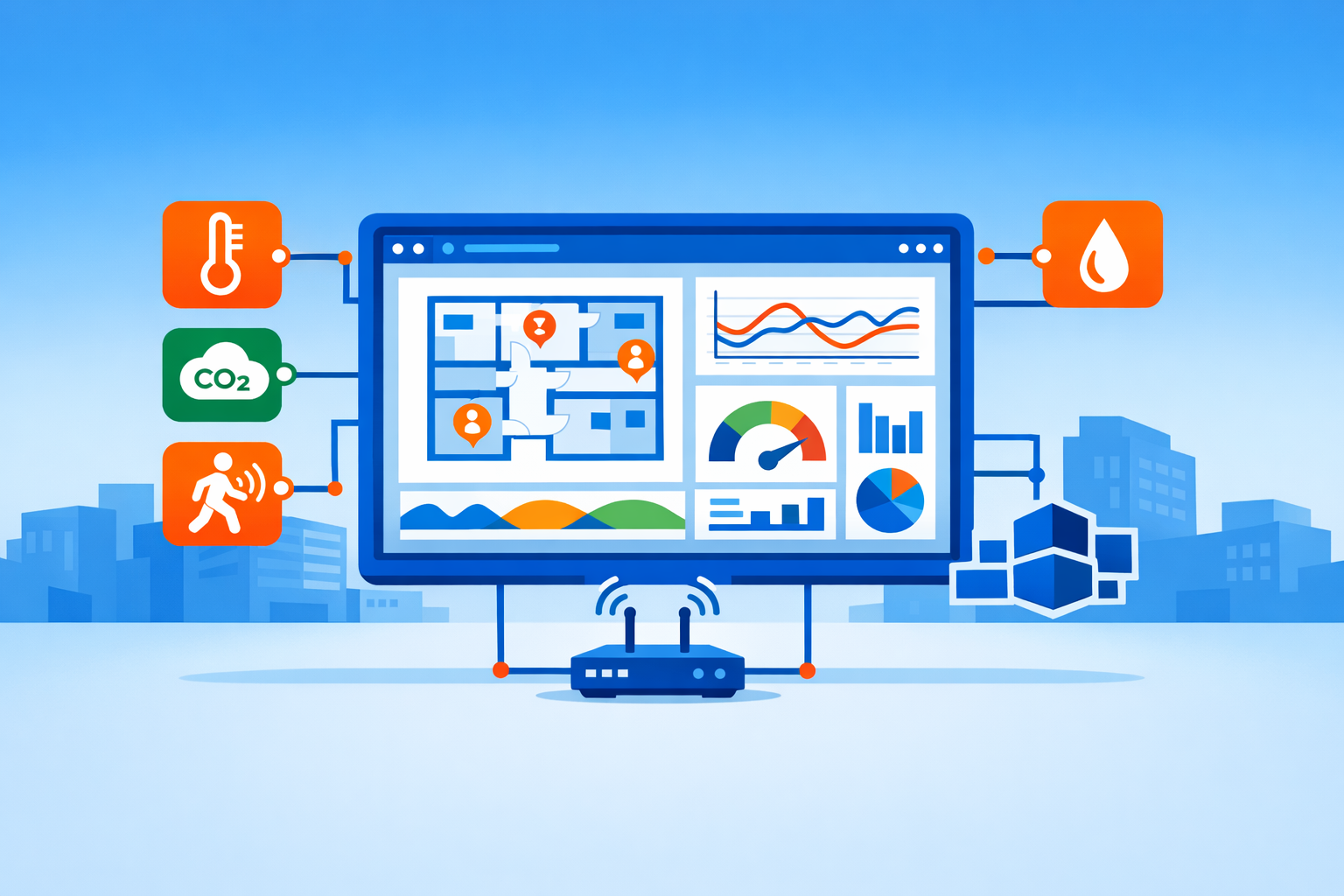
MultiTech confirms that with the driver, sensors can be onboarded directly in Niagara, bypassing the need for prior configuration on the MultiTech gateway[4]. Live demonstrations at the Niagara Summit 2026 showcased drag-and-drop onboarding and unified dashboards.[4]
The driver is slated to become available as a free download from the Niagara Marketplace after the Summit[4], offering accessible integration for current Niagara implementations.
This architecture strengthens the connection between LoRaWAN networks, gateways, and the Niagara supervisory layer, with implications for interoperability and lifecycle management.
Interoperability Implications for BAS, IoT, and Analytics
LoRaWAN complements BACnet and Modbus in commercial BAS environments; it does not replace them. Niagara maintains its central role as a protocol-agnostic integration and data normalization platform.[1] Integrators must decide how best to integrate LoRaWAN within this stack.
Complementary Integration with BACnet and Modbus
| Integration pattern | Field network | Integration into BAS | Best suited for | Key limitations |
|---|---|---|---|---|
| Native BACnet/Modbus devices | BACnet MS/TP, BACnet/IP, Modbus RTU/TCP | Niagara direct drivers | Core HVAC, plant, critical control | Higher cable installation costs, less flexible for dispersed points |
| LoRaWAN via BACnet/Modbus gateway | LoRaWAN to gateway; BACnet/Modbus to BMS | Gateway translates to BACnet/Modbus | Pilot LoRaWAN sites, small point counts | Multiple toolchains, extra mappings, complex support, fragmented security |
| LoRaWAN via MultiTech Niagara Driver | LoRaWAN via MultiTech gateway | Native Niagara driver | Large-scale wireless sensor fleets, unified analytics | Driver lifecycle management, coordinated Niagara/gateway updates |
Where Niagara is already the integration backbone, the new pattern narrows the gap between wireless IoT sensors and traditional BAS points. This enables:
- Unified metadata and tagging for both wired and wireless devices
- Cross-system dashboards that merge occupancy, air quality, and system status
- Single-point data export to analytics and AI tools
However, consolidating integration also demands strong configuration management, thorough testing, and robust cybersecurity measures.
Operational and ROI Implications for Stakeholders
While the MultiTech Niagara Driver does not guarantee specific ROI, it alters the cost structure and effort profile of LoRaWAN projects in ways relevant for stakeholders.
System Integrators and MEP Consultants
Direct LoRaWAN integration via Niagara offers several benefits:
- Less context switching: Teams focus on Niagara tools, reducing vendor-specific gateways.
- Consistent workflows: Sensor points follow established naming, tagging, alarm, and trend-log practices.
- Template-based deployment: Common LoRaWAN devices can be rapidly cloned portfolio-wide.
This can accelerate design and commissioning, especially in expansive, multi-site Niagara deployments.
Facility Managers and Energy Teams
For facilities, rapid connection of new data streams supports strategies for energy and comfort:
- Occupancy-based control: People-counting sensors inform real-time space utilization.
- Environmental monitoring: CO₂, temperature, humidity, and VOC sensors track indoor air quality and guide demand-controlled ventilation.
- Asset monitoring: Wireless sensors enable monitoring without extensive cabling.
Studies show occupancy-driven HVAC control can yield 15-30% energy savings versus timer-based schedules with accurate occupancy data[6]. Direct LoRaWAN integration in Niagara may facilitate such strategies by simplifying sensor deployment in existing buildings.
OEMs and Solution Providers
For smart-building OEMs, Niagara-native LoRaWAN facilitates:
- Simplified market deployment across diverse building portfolios
- Reduced need for custom gateway integration per client
- Easier data exposure to third-party analytics or energy management via Niagara APIs
This may support the development of replicable building optimization solutions.
Risk, Cybersecurity, and Lifecycle Considerations
Blending BAS and IoT networks under Niagara introduces technical and organizational risks that require careful planning.
Network Design and Latency
LoRaWAN's technical profile brings distinct limitations:
- Uplink intervals measured in seconds to minutes
- Limited downlink capacity in dense networks
- Compliance with regulatory duty cycles on sub-GHz bands
LoRaWAN is best reserved for monitoring, alarms, and supervisory adjustments, not rapid control loops. Critical or fast-responding control should remain with local BACnet/Modbus or similar real-time fieldbus systems. Teams should document points monitored via LoRaWAN and confirm suitability for intended use through testing.
Cybersecurity for Heterogeneous Networks
LoRaWAN employs network/application-level security keys; Niagara uses its own controls and encryption.[7] Integrating these via the MultiTech driver calls for clear segregation of responsibilities:
- Gateway layer: Manage join keys, update firmware, secure devices.
- Niagara layer: Manage role-based access, encrypted connections, audit trails.
- Network layer: Segment BAS/OT from IT and guest networks; secure gateways and Niagara servers.
The driver consolidates logical integration within Niagara and policy steps should reflect this shift.
Driver Updates and BAS Continuity
Drivers embedded in the building data flow require disciplined lifecycle management:
- Test driver and gateway updates in staging environments
- Schedule maintenance windows during low occupancy
- Define rollback procedures to rapidly restore working configurations
Coordinating Niagara supervisors, JACE controllers, gateways, and LoRaWAN firmware reduces risks of outages or data loss.
Next Steps for Niagara-Based Portfolios
Organizations invested in Niagara and considering LoRaWAN can act on several priorities.
1. Target Suitable Use Cases
Prioritize applications where LoRaWAN and Niagara integration are synergistic:
- Space utilization and occupancy analytics
- IAQ monitoring in dense, regulated, or sensitive environments
- Leak detection in critical or inaccessible spaces
- Sub-metering and environmental tracking in distributed facilities
Define required data intervals, latency, and criticality for each use case to ensure alignment.
2. Map Existing BAS and Network Topology
Clarify how Niagara interfaces with networks and infrastructure:
- Catalog BACnet, Modbus, and proprietary drivers in current use
- Plan gateway placement and connectivity
- Establish VLAN, routing, and firewall configurations for LoRaWAN/BAS traffic
Topology mapping aids in deployment planning and risk management.
3. Standardize Data Models and Tagging
To maximize value, standardize metadata approaches before scaling:
- Align LoRaWAN point names with BACnet/Modbus conventions
- Agree on tagging schema (e.g., Haystack or Brick ontologies)
- Harmonize trend-log intervals and data retention policies
Such alignment simplifies downstream analytics.
4. Pilot with a Representative Scope
Pilot projects allow technical refinement:
- Select buildings with varied spaces
- Deploy a controlled set of sensor types via the driver
- Assess commissioning, alarms, data quality, and operator experience
Refine processes based on pilot outcomes before scaling up.
5. Define Governance and Training
Clarify and assign responsibilities:
- Management of gateways and keying
- Ownership of driver configuration and maintenance
- Incident escalation and response procedures
Train Niagara engineers and operators on LoRaWAN fundamentals, sensor operations, and driver functionality to build in-house capability.
Frequently Asked Questions
How does the MultiTech Niagara Driver differ from LoRaWAN-to-BACnet gateways?
LoRaWAN-to-BACnet gateways translate sensor data into BACnet, which Niagara ingests using its BACnet driver. Configuration and troubleshooting are split between gateway and Niagara platforms. In contrast, the MultiTech Niagara Driver integrates LoRaWAN directly into Niagara, presenting sensor data as native points and reducing integration complexity, particularly for larger sensor deployments.
Is LoRaWAN suitable for mission-critical HVAC and lighting control?
No. LoRaWAN supports low-bandwidth, long-range communication with extended battery life, not high-speed control. Its typical intervals are seconds to minutes, with duty-cycle rules further restricting frequency. Fast or safety-critical control loops should remain with real-time networks such as BACnet or Modbus. LoRaWAN is best suited for monitoring, alarms, or supervisory inputs.
Which commercial building types benefit most from Niagara-integrated LoRaWAN sensors?
LoRaWAN integration is advantageous where new sensor points are dispersed or difficult to wire, including:
- Multi-tenant offices with legacy cabling or changing layouts
- Healthcare and education sites where retrofits are disruptive
- Large warehouses and logistics centers
- Mixed-use campuses with multiple structures
Direct Niagara integration streamlines deployments for energy, comfort, and maintenance in these settings.
What is the cybersecurity impact of this integration?
Integrating LoRaWAN data into Niagara shifts, but does not remove, cybersecurity requirements. Clear division of responsibilities for gateway security, Niagara controls, and network segmentation is essential. Best practices include strict authentication, encryption, network segmentation, and integrating LoRaWAN events into incident management protocols.
What skills do integration teams need for the MultiTech Niagara Driver?
Effective deployment requires proficiency in:
- Niagara framework, drivers, tagging, and data histories
- LoRaWAN concepts: device classes, joins, regulatory constraints
- IP networking and OT network segmentation
- Lifecycle management for firmware and drivers
With these skills, teams can treat the driver as another Niagara integration option, enabling robust wireless IoT deployments within enterprise BAS environments.