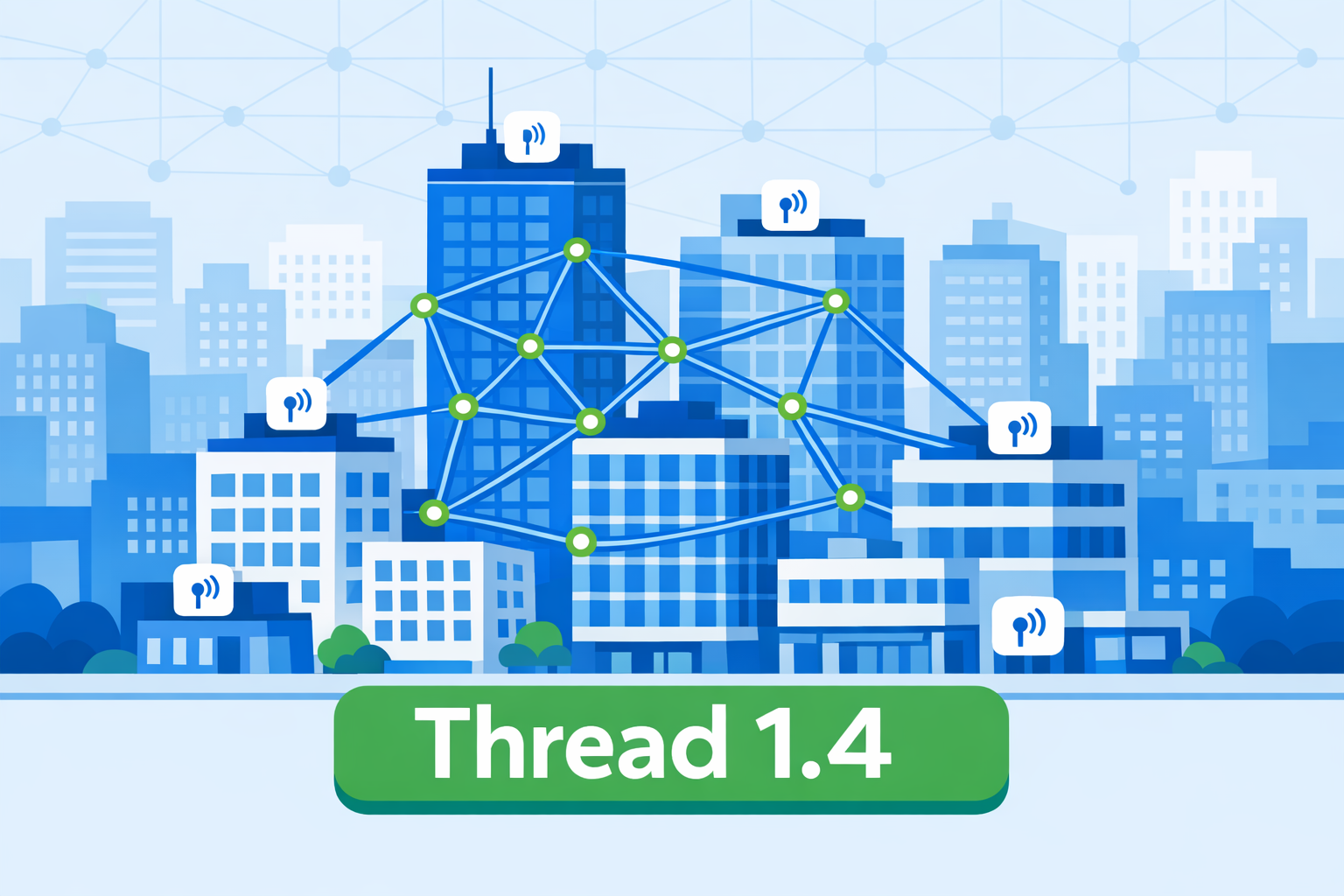
The Thread Group's enforcement of Thread 1.4 as the sole certified Border Router standard, effective January 1, 2026, is accelerating vendor-agnostic smart building deployments. Municipal programs and commercial real estate operators are pivoting toward open mesh networking to reduce lock-in and simplify integration with legacy infrastructure.
Background
Smart building IoT deployments have long been constrained by proprietary mesh silos, where devices from one manufacturer's ecosystem could not join networks controlled by another. Each Thread network worked only with devices from the same brand - a Google mesh connected only Google devices, and the same applied to Amazon and Apple. This limitation persisted through Thread 1.3, released in 2022.
The municipal and commercial procurement landscape has shifted in parallel. Open standards are increasingly viewed as essential to combat market fragmentation and vendor lock-in, enabling enterprises to select solutions based on performance, security, and cost rather than manufacturer affiliation. Industry coalitions have formalized this position: the Coalition for Smarter Buildings (C4SB), now the C4SB Foundation under the Linux Foundation, focuses on breaking down data silos and developing connection profiles and semantic tagging to standardize data exchange across platforms and vendors.
Regulatory pressure has reinforced the trend. The EU's recast Energy Performance of Buildings Directive and member-state legislation such as Germany's Building Energy Act now require documented cross-system, cross-manufacturer communication in large non-residential buildings - criteria that closed, proprietary protocols structurally cannot meet.
Details
As of January 1, 2026, Thread 1.4 became the Thread Group's sole specification available for Border Router certification, with Thread 1.3 certification applications for border routers closing on December 31, 2025. Under Thread 1.4, all devices can join a single mesh regardless of whether they are made by Amazon, Apple, Google, Samsung, or any other manufacturer in the Thread consortium.
The specification introduces several capabilities directly relevant to commercial and campus deployments. Thread's commissioning-at-scale feature simplifies wirelessly onboarding pre-installed devices in hard-to-reach locations such as ceilings or walls. Instead of scanning physical install codes, commissioning can be performed over TLS with certificates and executed in proximity using a mobile device over Bluetooth Low Energy (LE), making it suitable for professional commercial installation. Thread over Infrastructure enhancements allow Border Routers to use Wi-Fi and Ethernet connections to extend the Thread mesh, simplifying the addition and relocation of devices while keeping configurations synchronized - with Thread devices installable in far-reaching corners or even on building exteriors.
Built on open IP standards, Thread serves as a network layer agnostic to application technologies, including DALI+, KNX IoT, and Matter - a characteristic that facilities managers cite as critical for integrating new IoT nodes with incumbent building automation systems running BACnet or Modbus.
"There's been an exponential increase of Thread-certified devices in homes and smart buildings globally since the major smart home platforms adopted Thread," said Vividh Siddha, President of Thread Group. Tom Sciorilli, Director of Certification for Thread Group, noted "unprecedented interest in the 1.4 enhancements" and stated that members are eager to roll benefits out to "those responsible for smart building deployments."
In the professional segment, companies such as ABB, Maco, and Warema have brought Thread-enabled products to market, while Samsung has equipped a growing number of its devices with a Thread Border Router. A Thread Group white paper highlights that using the same technology across environments delivers advantages in economies of scale, increased component capacity, lower product prices, and a widening choice of manufacturing sources.
Despite the milestone, ecosystems are moving at different speeds. Apple has Thread 1.4 support rolling into tvOS 26, while Google, Amazon, and Samsung are at varying stages of testing and rollout - meaning true cross-brand interoperability could remain months away for some deployments.
Outlook
The Interoperable Building (IB) Box, a Linux-based device developed under the C4SB Foundation framework, is set to serve as a key component enabling cloud-native connectivity and data exchange within buildings. Real-world applications are already being demonstrated for improved energy efficiency and data-driven decision-making. For building operators, procurement teams should now require explicit Thread 1.4 certification for any new Border Router specification, verify firmware upgrade paths for installed 1.3 devices, and align data governance policies with the open-credential sharing model that Thread 1.4 introduces across multi-vendor site deployments.