Executive summary. AI is transitioning from pilot phases to portfolio-scale deployments in commercial buildings, fundamentally altering energy, comfort, and maintenance management. As algorithms begin to influence setpoints and safety-critical decisions, governance concerns regarding architecture, data privacy, model risk, and operator responsibilities are becoming as critical as technical performance and return on investment (ROI).
This article examines the evolving governance landscape for AI in smart buildings, the comparison of edge and cloud deployment models, the ROI profile for energy optimization and predictive maintenance, and outlines steps for facility teams to enable trustworthy, compliant, operator-focused AI programs.
1. AI in Smart Buildings: From Pilots to Operational Infrastructure
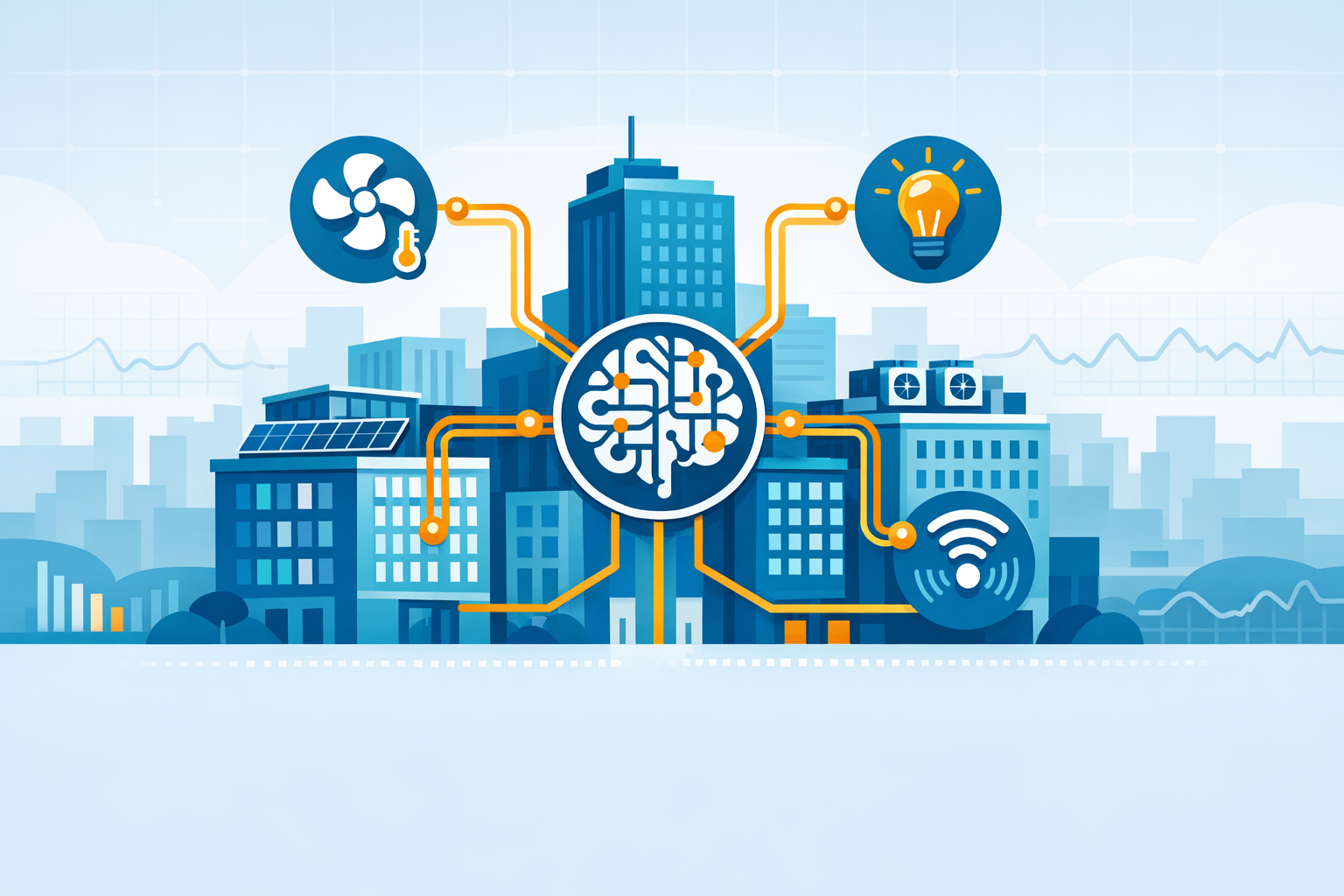
AI is now widely integrated into building management systems (BMS) to optimize HVAC, lighting, space utilization, and maintenance workflows.
Recent market analyses indicate that nearly 46% of smart building initiatives are primarily motivated by energy optimization, and roughly 28% already rely on AI analytics to support energy-saving operations.[1] This trend aligns with surging energy costs, decarbonization efforts, and increasing regulatory demands.
Beyond energy, AI is now a core element in intelligent building management systems (IBMS):
- Around 48% of large retail complexes now deploy occupancy analytics to improve space utilization by more than 20%.[2]
- More than 10,000 large building projects worldwide have already implemented smart energy management systems.[3]
- Field deployments of AI-based HVAC optimization in commercial buildings have demonstrated electricity savings ranging from about 9% to more than 25% in real projects.[4]
These statistics illustrate that AI is moving from experimentation to the operational core of campus-scale and multi-site portfolios. Governance frameworks, however, often lag behind this adoption.
2. The ROI Equation: Energy, Maintenance, and Operational Performance
2.1 Energy optimization and comfort
Energy remains the leading justification for AI adoption in buildings. Studies indicate that advanced control, model predictive control (MPC), and reinforcement learning achieve greater savings than rule-based BMS.
- A review of smart building projects reports typical whole-building energy savings in the 10-25% range from advanced control and analytics overlays.
- Specific AI optimization projects in commercial offices have reported annual electricity savings of around 9-26%, corresponding to hundreds of thousands of kWh and substantial CO₂ reductions.[4]
- Dynamic setpoint optimization helps reduce peak demand charges and enhances thermal comfort stability compared to static schedules.[5]
This approach yields:
- Direct operational expense reduction through lowered energy use
- Improved occupant comfort and fewer complaints
- Demonstrable progress toward ESG and green-building certification targets
2.2 Predictive maintenance and asset health
Predictive maintenance (PdM) is also a significant ROI driver. By leveraging equipment telemetry, fault detection and diagnostics (FDD), and digital twins, operators move from reactive to condition-based maintenance.
A recent HVAC-focused study on commercial complexes found that an AI-enabled predictive maintenance framework with digital twins achieved a payback period of around 2.3 years, while meeting ASHRAE and ISO 52120 efficiency benchmarks.[6]
Industry whitepapers further report that AI-based PdM recovers investment through energy and maintenance savings in roughly one to two years.[7]
Typical benefits include:
- Less unplanned downtime and fewer service calls
- Prolonged equipment lifespan through earlier fault detection
- More predictable maintenance budgeting
2.3 Hidden costs and risks
ROI analysis now factors in governance-related costs:
- Integrating data from legacy BMS, meters, and IoT sensors
- Ongoing model monitoring, retraining, and validation
- Cybersecurity for both IT and operational technology (OT) networks
- Compliance with GDPR and the EU AI Act
Underestimating these costs can result in optimistic payback projections or stalled projects. Early governance planning reduces the risk of "AI fatigue" and failed scaling initiatives.
3. Edge vs Cloud: Architectural Choices for AI-Enabled BMS
Determining where AI executes-on edge devices, in the cloud, or via a hybrid model-is central to governance, safety, and cost management.
3.1 Latency and control criticality
Cloud platforms provide large-scale analytics and portfolio optimization, but wide-area network latency limits real-time control.
Empirical studies in industrial environments consistently find that edge computing delivers significantly lower and more deterministic latency than cloud-based processing because it eliminates round-trip network delays.[8]
For safety- or mission-critical functions such as pressure relief, smoke control, or elevator interlocks, governance best practices keep the primary control path local via controllers or edge platforms. Cloud systems then serve supervisory optimization and analytics roles.
3.2 Data sovereignty and privacy
AI models using occupancy analytics, access logs, or video feeds raise data residency and privacy issues.
- Edge processing can anonymize or aggregate data locally before forwarding to the cloud.
- Cloud platforms require careful evaluation for data localization, encryption, and safeguards-especially in EU portfolios governed by GDPR and the Data Privacy Framework.[9]
Deployment choices directly affect legal obligations regarding personal data processing and cross-border transfers.
3.3 Cost, scalability, and lifecycle management
- Edge: Higher upfront hardware and on-site maintenance, reduced bandwidth, and greater resilience to network outages.
- Cloud: Lower initial costs and centralized updates; recurring fees, network dependency.
- Hybrid: Frequently adopted, combining edge for critical controls and cloud for global optimization and analytics.
3.4 Comparison: Edge, Cloud, and Hybrid for Smart Building AI
| Criterion | Edge AI in Building | Cloud AI Platform | Hybrid Edge-Cloud |
|---|---|---|---|
| Latency for control | Very low; suitable for fast loops | Higher; not suitable for sub-100 ms safety loops | Critical control at edge; supervisory logic in cloud |
| Resilience to WAN outages | High | Low-medium | High for core functions |
| Bandwidth consumption | Lower (local pre-processing) | Higher (raw/near-raw telemetry) | Moderate; compressed insights upstream |
| Data sovereignty & privacy | Easier to keep data on-prem | Depends on cloud region and contracts | Sensitive data can stay local |
| Change management & updates | Distributed, more complex | Centralized, simpler | Requires coordinated processes |
| Suitable use cases | Safety-critical control, real-time FDD, local optimization | Portfolio benchmarking, portfolio forecasting, fleet model training | Most commercial portfolios; blend of both |
Architectural decisions define where governance controls-approvals, logging, access reviews-must be implemented.
4. Regulatory and Privacy Landscape: GDPR and the EU AI Act
4.1 Data privacy and occupancy analytics
Smart buildings use badge data, Wi-Fi logs, desk sensors, and imaging sensors to infer occupancy and behavior. These data types often constitute personal data under the EU General Data Protection Regulation (GDPR).
Key governance requirements include:
- Establishing a lawful processing basis (legitimate interest or consent, based on use case)
- Data minimization (e.g., using anonymous counts instead of identifiable video)
- Transparency to occupants about monitoring and automated decisions
- Data protection impact assessments (DPIAs) for high-risk monitoring or profiling[9]
4.2 EU AI Act: high-risk AI in building operations
The EU Artificial Intelligence Act introduces risk-based AI system classification and corresponding obligations.
AI systems used in the management and operation of critical infrastructure are explicitly cited as potential high-risk applications under the EU AI Act.[10] High-risk provisions-including risk management, technical documentation, logging, and human oversight-are scheduled to apply fully from August 2026, with extraterritorial reach to non-EU providers serving EU users.[11]
For building portfolios, AI used for energy reporting may be considered lower risk, while AI influencing life-safety systems (e.g., smoke control, emergency ventilation) is more likely to be high-risk and subject to stricter governance.
Key obligations for high-risk AI include:[12]
- Documented risk and quality management systems
- Use of high-quality, relevant training data
- Logging and traceability of AI behaviors
- Clear human oversight responsibilities
- Conformity assessment and, where relevant, CE marking
These requirements make formal AI governance essential for large commercial estates in Europe.
5. Model and Data Governance for Building AI
Sound AI governance ensures compliance, operational stability, and safety. Concepts from AI risk-management frameworks and ModelOps are increasingly central in building operations.[13]
5.1 Data quality, lineage, and observability
Many underperforming building AI pilots result from data-not algorithmic-failures.
Robust practices include:
- Defined data schemas and naming conventions for BMS and IoT data
- Documented data lineage, tracking transformation from sensor to model
- Automated detection of sensor drift, missing data, and outlier values
- Versioned datasets for training, with clear cut-offs and exclusions
Research on AI governance highlights model drift detection, telemetry monitoring, and evidence-based verification as core controls for maintaining stable AI behavior in production.[14]
5.2 Model lifecycle and version control
Well-governed smart-building stacks treat models as managed assets:
- Model versioning, including associated data, parameters, and code
- Pre-deployment validation using holdout data and live building scenarios
- Staged rollouts before portfolio-wide deployment
- Periodic re-training based on climate, usage, or system changes
ModelOps practices help standardize workflows, approvals, and rollback mechanisms.
5.3 Audit trails, explainability, and override mechanisms
AI actions require explainability and reversibility for compliance and risk management.
Common mechanisms:
- Action logs tracing model recommendations and associated confidence scores
- Change logs linking setpoint changes to outcomes
- Human-in-the-loop workflows for high-risk actions
- Manual override procedures, ensuring operators can revert to baseline logic safely
These controls support compliance and foster trust between facility teams and AI systems.
6. Evolving Operator Roles in AI-Enabled Facilities
AI adoption is reshaping responsibilities in building operations.
6.1 From BMS operator to data-centric facility professional
Traditional roles focused on alarm monitoring and setpoint adjustment. In AI-enabled contexts, responsibilities now include:
- Interpreting AI recommendations, including confidence levels and trade-offs
- Prioritizing actions by risk, comfort, and budget constraints
- Providing feedback when AI recommendations are impractical or unsafe
6.2 New and hybrid roles
Larger portfolios are establishing roles such as:
- Data engineer/integration specialist: Managing data pipelines and ensuring data quality
- Model validator/AI governance lead: Reviewing model performance, bias, and coordinating compliance
- Energy and sustainability manager: Using AI-driven insights for retrofit planning and carbon strategies
- Field technicians and contractors: Verifying AI-driven predictions and providing feedback for continuous improvement
6.3 RACI-style clarity for governance
Many organizations formalize RACI (Responsible, Accountable, Consulted, Informed) matrices for workflows such as:
- Deploying new optimization models
- Adjusting AI-suggested comfort parameters
- Managing AI-generated maintenance tickets
- Manual overrides during incidents
Clear accountability is especially critical for high-risk AI cases under the EU AI Act.
7. Practical Roadmap: Near-Term Steps for Facility and Energy Teams
For organizations expanding AI from pilots to portfolios, the following steps provide a structured approach.
7.1 Begin with high-value, bounded use cases
Typical early focus areas:
- HVAC and chiller plant optimization
- Air-handling unit FDD and filter replacement prediction
- Occupancy-driven ventilation and lighting control
These areas deliver measurable savings and have well-established operational requirements.
7.2 Establish a data foundation
- Audit current sensors, meters, and BMS points for reliability.
- Standardize naming, units, and time synchronization.
- Implement dashboards to monitor data quality.
7.3 Decide on an edge-cloud reference architecture
- Classify use cases by latency and safety criticality.
- Keep control loops for life-safety functions local.
- Use cloud solutions for analytics that leverage fleet-wide data.
7.4 Define AI governance policies and procedures
- Create an AI inventory of models, data sources, and affected systems.
- Classify use cases by risk per the EU AI Act.
- Document processes for validation, change management, and incident response.
7.5 Integrate privacy-by-design for occupant data
- Prefer non-identifying occupancy sensors where feasible.
- Anonymize or aggregate data before external transfer.
- Conduct DPIAs when inferring behavior from multiple data sources.
7.6 Build operator capability
- Train teams to interpret AI dashboards, confidence metrics, and recommendations.
- Run joint workshops for end-to-end workflow understanding.
7.7 Measure and communicate outcomes
- Track KPIs such as energy intensity, comfort metrics, and downtime.
- Compare AI-enabled zones with control groups to confirm impact.
- Report results in formats suitable for both technical and financial stakeholders.
Frequently Asked Questions
1. Which AI use cases in smart buildings typically deliver the fastest ROI?
Energy-focused use cases leveraging existing BMS infrastructure-such as HVAC optimization, chiller sequencing, and basic FDD-offer the quickest returns. Research suggests well-implemented AI optimization and predictive maintenance programs can often achieve payback in roughly 1-3 years, with energy savings in the 10-25% range depending on building type and baseline performance.[15]
2. When is edge computing mandatory versus optional for building AI?
Edge processing is required when AI handles safety-critical or rapid control loops and sub-second response is necessary. Local controllers or edge platforms should host core logic. For slower analytics-such as benchmarking, long-term forecasting, and planning-cloud-based AI is typically sufficient and more scalable.
3. How should facility managers address GDPR when using AI for occupancy analytics?
GDPR requires clear processing purposes, data minimization, and transparency to occupants. Operators should:
- Favor anonymous or aggregated occupancy sensing when possible
- Avoid collecting identifiable data unless essential for building operations
- Document activity, conduct DPIAs for higher-risk use cases, and ensure provider contracts comply with EU data locality and international transfer standards[9]
4. How can operators reduce the risk of AI models overfitting to short-term building conditions?
Key actions include:
- Training with multi-season datasets and varied operating conditions
- Validating models on holdout periods and separate buildings
- Monitoring ongoing performance and triggering re-training as needed
- Enforcing safety and comfort boundaries that supersede model predictions[16]
5. What KPIs should be tracked to evaluate AI in smart building operations?
Important KPIs include:
- Energy and emissions: kWh/m², kWh per workstation, peak demand, CO₂e emissions
- Comfort and IAQ: hours within comfort bands, CO₂ concentrations
- Maintenance and reliability: mean time between failures (MTBF), unplanned downtime, maintenance backlog
- Financial performance: payback period, net present value (NPV) of savings, deferred capital expenses
Measuring these KPIs before and after AI deployment-and across both AI and non-AI areas-supports ROI assessments and provides evidence for regulatory compliance in evolving AI governance frameworks.