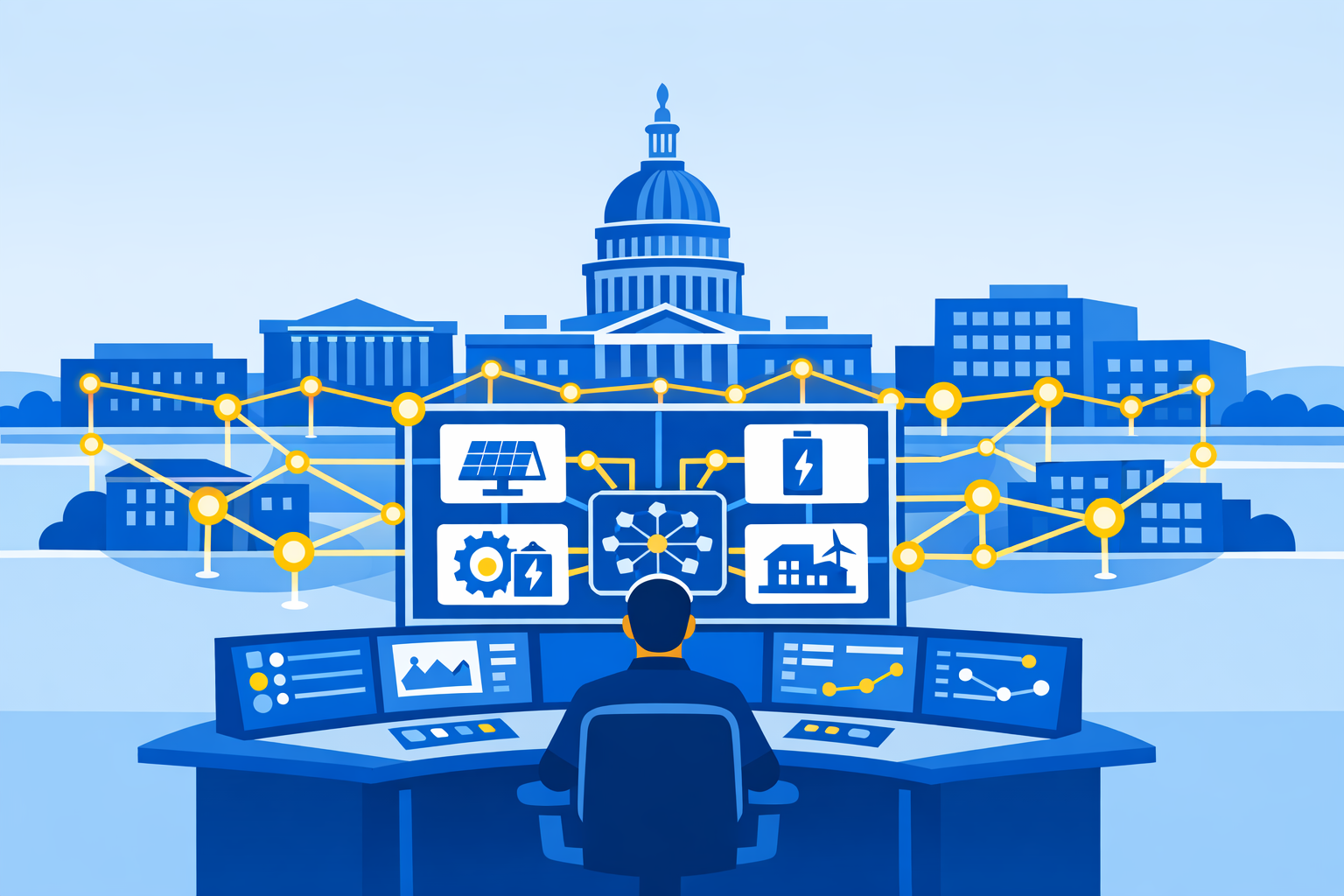
Commercial buildings are moving beyond data collection into fully autonomous operations, with AI-driven platforms now adjusting HVAC, lighting, and energy systems in real time - a shift generating measurable efficiency gains while exposing unresolved gaps in cybersecurity, interoperability, and governance.
Early deployments across university campuses, hospitals, and critical infrastructure facilities demonstrate both the upside and the risk. As more devices come online, regulators, standards bodies, and facility operators face a narrowing window to align on open interfaces, layered security requirements, and auditable decision trails before fragmented vendor ecosystems lock the industry into proprietary dead ends.
Background
Buildings account for approximately 30% of total global final energy consumption and 37% of global carbon dioxide emissions, making the sector a central target of decarbonization policy. Traditional building automation systems (BAS) have historically relied on reactive "if-then" logic programmed into building management systems (BMS), offering limited adaptability to changing conditions.
The emergence of intelligent digital twins (IDTs) - live virtual models integrating AI, IoT sensor streams, and physics-based simulation - is redefining what BAS can achieve. Digital twin adoption in commercial building portfolios surged an estimated 300-400% year-over-year in 2025, according to industry tracking data, with analyst firm Gartner ranking digital twins as the top strategic technology trend for building owners and operators. The global digital twin market in architecture, engineering, construction, and operations is forecast to reach between $35 billion and $48 billion by 2026, with commercial buildings representing the largest segment, according to Technavio and MarketsandMarkets projections.
HVAC systems typically account for 40-50% of a building's total energy consumption, making them the primary target for autonomous optimization. Research literature covering 2024-2025 deployments shows that AI-based controls, adaptive setpoints, and variable refrigerant flow (VRF) systems are delivering HVAC energy reductions in the range of 20-40% in documented case studies.
Operational Deployments and Technical Architecture
Autonomous control platforms now ingest real-time data from pricing APIs, weather forecasts, occupancy sensors, and historical usage patterns to execute multi-step optimization plans - a fundamentally different approach from rule-based predecessors. In one documented deployment, WillowTwin's digital twin installed at a commercial tower in Sydney achieved a 29% whole-building energy reduction in the first 18 months and runs more than 2,000 automated optimizations per month, according to a Willow case study.
For model predictive control (MPC) - where a digital twin must issue commands back to physical systems - automatic, bidirectional online data exchange is required, distinguishing it from fault detection and diagnostics applications that may rely on periodic manual data imports. Researchers at the Austrian Institute of Technology (AIT) and AutomationX demonstrated this approach through the DIGIBatch project, applying digital twin technology to heat pump optimization and achieving reliable adaptive setpoint selection, reaching a Technology Readiness Level (TRL) of 5, indicating proximity to commercial viability.
Buildings integrated with grid-interactive systems are also moving toward active demand response (DR) participation. OpenADR, now a national smart grid standard in the United States and gaining international adoption, enables automated communication of electricity price and grid reliability signals, allowing facilities to automate their demand response, according to Lawrence Berkeley National Laboratory. The U.S. Department of Energy's National Roadmap for Grid-Interactive Efficient Buildings projects that such facilities could deliver between $100 billion and $200 billion in savings to the U.S. power system and cut CO₂ emissions by 80 million tons per year by 2030.
Cybersecurity and Standards Pressure Points
Autonomous systems significantly expand the attack surface. Research firm Claroty found that 75% of organizations have BMS devices with known exploited vulnerabilities, while legacy protocols including BACnet and Modbus - designed before cybersecurity was a consideration - lack native encryption and authentication. The Royal Institution of Chartered Surveyors (RICS) warned that many buildings still operate on end-of-life operating systems such as Windows 7, which no longer receive security patches.
Regulators are responding. In August 2025, the U.S. Cybersecurity and Infrastructure Security Agency (CISA) released its Foundations for OT Cybersecurity: Asset Inventory Guidance for Owners and Operators, applicable across operational technology (OT) environments including building control systems. In the European Union, the EU Cyber Resilience Act (CRA) introduces mandatory security-by-design requirements for all connected products, while the Radio Equipment Directive (RED) updated mandatory cybersecurity safeguards effective August 1, 2025.
NIST is collaborating with the Coalition for Smarter Buildings (C4SB) under the Linux Foundation to develop a Digital Building Profile (DBP) - an industry-driven initiative to specify interoperable, open-standard approaches for next-generation digital buildings, with a dedicated Cybersecurity Working Group drawing on the NIST Cybersecurity Framework, NIST Risk Management Framework, and ISA/IEC 62443. The ISA/IEC 62443 series remains the primary open standard for cybersecurity in building automation and industrial control systems. BACnet Secure Connect (BACnet/SC), an addendum to the widely adopted BACnet protocol, provides an encrypted, IP-native communications layer aligned with current IT security infrastructure requirements.
Smart building technologies lack uniform security protocols across vendors, making comprehensive cybersecurity strategies across heterogeneous systems difficult to implement without a shared framework. Analysts note that without open standards, building systems operate in silos, and vendor lock-in prevents facility owners from selecting best-in-class solutions based on performance or security.
Outlook
Standards work underway at NIST and ASHRAE - including a planned Cybersecurity Working Group session at the ASHRAE 2026 winter conference - is expected to produce application-level profiles that building owners, system integrators, and procurement teams can reference for security controls by building type and risk tier. Meanwhile, demand for autonomous control platforms is accelerating; grid-interactive buildings are projected to achieve 10-40% net energy bill savings through reduced peak demand and optimized energy procurement, according to Schneider Electric analysis. For facilities considering deployment, analysts and standards bodies consistently emphasize modular and auditable automation layers, continuous OT monitoring, and procurement aligned to open-protocol platforms as non-negotiable prerequisites for safe, scalable autonomous operation.