Developers, landlords, and tenants are expanding building performance priorities in 2026, moving beyond traditional occupancy metrics to emphasize resilience, energy efficiency, indoor air quality (IAQ), and occupant flexibility. Sectors such as healthcare, education, office, and retail are redefining key performance indicators (KPIs) and updating procurement and retrofit strategies to deliver measurable outcomes that support occupant well-being and adaptive building environments.
Background
The COVID-19 pandemic accelerated awareness of IAQ and health as essential building considerations, elevating wellness features within smart infrastructure to a higher priority. Organizations are incorporating performance-based IAQ solutions, including continuous monitoring and responsive ventilation. In parallel, commercial real estate is experiencing a sharp rise in retrofit activity, prompted by aging building stock and evolving tenant demand. This trend focuses on low-carbon, energy-efficient strategies to enhance resilience and asset value. Certification frameworks now include credits for health, equity, and resilience, extending beyond traditional sustainability benchmarks.
Details
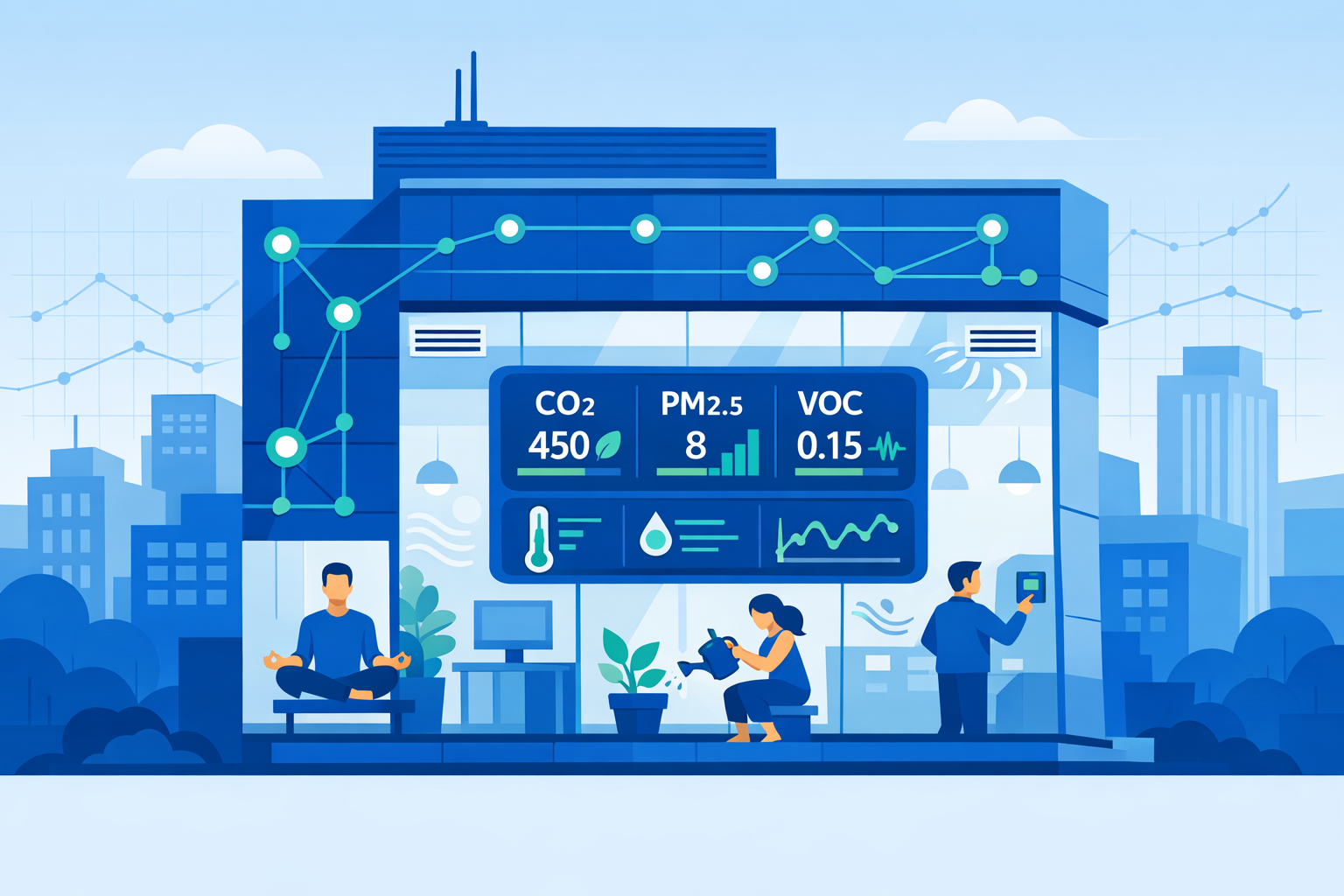
The formal release of LEED v5 in 2025 introduced a shift toward outcome-based metrics. Facilities are now required to demonstrate healthy indoor conditions via real-time IAQ monitoring, pollutant thresholds, and performance-based ventilation, making indoor air quality a measurable operational standard LEED v5 introduces continuous monitoring of CO₂, PM₂.₅, VOCs, ozone, NO₂ and other parameters, aligning with WELL and RESET standards[1]. The DGNB system updated its indoor air quality requirements, expanding VOC categories, aligning with EU Level(s), and offering incentives for reducing pollutants in incoming air DGNB added new VOC tracking, aligned ventilation criteria to ISO/EN standards, and introduced an Agenda 2030 bonus for pollutant reduction[2].
Legislation is also advancing IAQ. The European Union's recast Energy Performance of Buildings Directive now integrates indoor environmental quality-covering ventilation and monitoring-into energy and climate policy. While new binding IAQ limits are pending, member states are required to implement these directives into national law by 2026 The revised EPBD embeds indoor environmental quality alongside energy and climate goals, with transposition required in 2026[3].
Shifting demand across sectors is influencing procurement approaches and retrofit planning. JLL reports that electricity costs comprise 4%-26% of rental value. Incorporating energy-efficient, low-carbon solutions, such as onsite generation and storage, can deliver an additional 25%-50% in revenue. The firm notes that 70% of potentially obsolete building stock-approximately 140 million square meters-exists in markets with significant sustainability value-add potential Electricity costs are 4 %-26 % of rental value; energy-smart strategies can yield 25 %-50 % revenue uplift, and 70 % of obsolete stock (≈140 M m²) sits in high opportunity markets[4].
The deployment of artificial intelligence (AI), sensor networks, and interoperable platforms enables real-time adaptation to conditions ranging from occupancy shifts to weather events, supporting operational goals for energy efficiency and occupant comfort. By 2026, the convergence of AI-driven operations, sustainability, and security is becoming standard in smart buildings, fostering more resilient, efficient, and occupant-centric environments Agentic AI is being used to dynamically adapt temperature, lighting, room allocation and other systems based on sensor data and changing conditions in real time[5].
Outlook
As performance-based certifications evolve and EU directives become national law, owners and operators will benchmark assets against criteria for health, resilience, and flexibility. Technology platforms and AI are expected to accelerate the adoption of predictive, integrated management strategies, influencing investment, leasing, and retrofit decisions throughout 2026 and beyond.