Operators of high-consumption data centers are turning to AI-driven cooling and predictive analytics to manage energy use as AI workloads increase energy demand. Emerging regulations, lower power usage effectiveness (PUE) targets, and grid connection constraints are making optimized cooling an operational priority.
This analysis details the deployment of AI-powered cooling in hyperscale and colocation facilities, observed efficiency gains, and how predictive maintenance, standards, and regulations are influencing data center design strategies for the next 12-24 months.
Why Cooling and PUE Are Under Pressure in 2026
Cooling has become the main focus for improving data center energy performance as AI drives higher rack densities and total electrical load.
The International Energy Agency (IEA) estimates that global data centers consumed 240-340 TWh of electricity in 2022, representing about 1-1.3% of worldwide electricity demand.
In the IEA's base-case scenario, global data center electricity use could rise to roughly 945 TWh by 2030-nearly 3% of worldwide electricity consumption, with AI workloads as a leading growth factor.
In conventional air-cooled data centers, cooling represents 30-40% of total facility energy use, making it the largest non-IT load. At the same time, efficiency improvements have stalled:
- The Uptime Institute's 2025 Global Data Center Survey reports a weighted average annual PUE of 1.54 for operators' largest sites, unchanged for six years.
- A 2023 executive report on the German data center market notes global average PUE has remained in the 1.55-1.59 range since 2018, despite ongoing IT efficiency gains.
Regulatory actions are accelerating pressure for more advanced cooling optimization:
- Germany's Energy Efficiency Act (EnEfG) requires data centers operating before July 1, 2026, to achieve a PUE ≤ 1.5 from July 1, 2027 and ≤ 1.3 from July 1, 2030; new sites coming online after July 1, 2026, must reach PUE ≤ 1.2 within two years.
- The EU's recast Energy Efficiency Directive and Delegated Regulation (EU/2024/1364) establish an EU-wide rating system for data center sustainability, with mandated reporting of PUE, water usage effectiveness (WUE), and other KPIs in a central database.
- Industry groups, such as the Climate Neutral Data Centre Pact, set voluntary PUE targets (e.g., 1.3 in cool climates for new facilities), raising expectations for large operators.
These trends demand future-ready designs that treat cooling as a dynamic, data-driven process aligned directly with energy KPIs and regulatory thresholds.
How AI-Powered Cooling Works in Modern Data Centers
AI-based cooling systems move beyond static setpoints and rule-based logic, employing real-time data, forecasts, and learned system behavior for continuous optimization.
From Fixed Setpoints to Autonomous Optimization
A widely cited deployment is Google's use of DeepMind in its hyperscale facilities.
DeepMind's machine learning models cut cooling energy in Google data centers by up to 40%, reducing overall PUE overhead by roughly 15%.
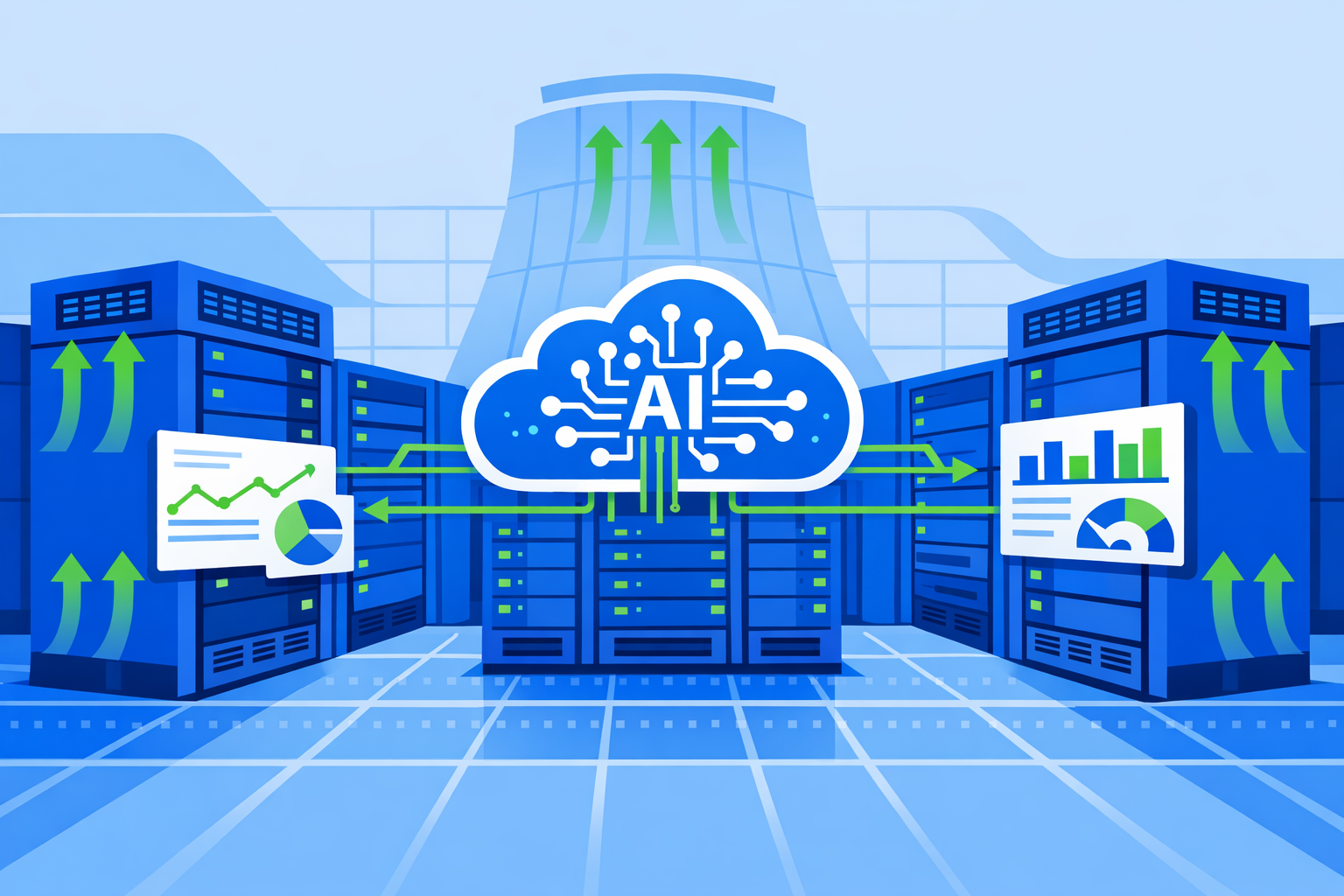
In this system, thousands of sensors feed operational data into cloud-based neural networks at regular intervals. The AI predicts the impact of control actions-such as modifying chilled-water setpoints or adjusting pump speeds-on energy use and thermal risk, then issues optimal commands within set safety margins.
Recent research and commercial solutions build on this approach:
- A 2025 study on offline reinforcement learning for data center cooling showed 14-21% reductions in cooling energy versus traditional control, with no thermal safety violations.
- Siemens reports its Exergenics AI chiller optimization platform typically achieves 5-35% energy savings and 10-15% peak-demand reduction in large plants.
While algorithmic methods vary (model predictive control, reinforcement learning, Bayesian optimization), the architectural components are consistent:
Dense sensing and telemetry
- Monitoring of rack inlet temperatures, chilled- and condenser-water systems, and equipment status.
- Real-time data from pumps, fans, compressors, power meters, and external weather sources.
Digital twin and forecasting models
- Models, either physics-informed or data-driven, predict response to load and outdoor conditions.
- Short-term forecasts of IT load and weather inform proactive adjustments.
Optimization and control
- Objectives minimize cooling energy use (kW/kWh) while enforcing temperature and redundancy constraints.
- AI outputs update plant setpoints, equipment staging, and server airflow as integrated.
Human-in-the-loop safeguards
- Role-based overrides, alarm thresholds, and explainable recommendations build operator trust.
- Autonomy is phased in, from advisory mode to supervised, then autonomous operation.
Key Enablers in the Smart-Building Stack
Critical enabling layers for building and electrical professionals include:
Instrumentation and networking: High-resolution sensors and networked equipment deliver the granularity needed for AI-driven optimization.
Integration among BMS, DCIM, and IT telemetry: Correlating IT workload with facility data enables anticipation of load shifts, especially among heterogeneous compute clusters.
Standards-based data models: Adopting harmonized naming and semantic models (e.g., EN 50600, ISO/IEC 30134 KPIs) streamlines model portability and site integration.
Hyperscale vs Colocation: How AI Cooling Is Being Deployed
Deployment strategies vary between hyperscale, colocation, and enterprise data centers.
High-Density Hyperscale Facilities
Hyperscalers typically lead in both PUE and AI application:
- Google reported a fleet-wide median PUE of 1.09 for its 2024 data centers.
- Other providers disclose top sites in the 1.05-1.15 range, combining free cooling, containment, and liquid approaches.
AI cooling here coordinates:
- Liquid and air cooling for racks over 50-100 kW.
- Economizer and chilled-water temperature optimization by region and schedule.
- Workload placement aligned with cooling and energy cost availability.
Multi-Tenant Colocation Data Centers
Colocation operators face heterogeneous loads and varying SLAs, with limited visibility into tenant IT utilization. However, regulatory and customer demands are prompting adoption.
A 2023-2024 European colocation pilot using AI-driven cooling and predictive analytics achieved a 3.5% improvement in PUE within three months at the test facility, with similar potential across its portfolio.
Strategies typically advance from analytic recommendations to semi-autonomous plant controls, integrating capacity planning with modeled cooling headroom to support higher densities without major upgrades.
Enterprise and Edge Sites
Enterprise data centers and edge sites often lack the scale for bespoke AI solutions, but benefit from:
- Cloud-hosted optimization for chiller plants.
- Supervisory controllers with embedded machine learning.
- Predictive maintenance for HVAC and power systems.
Vendors are targeting this segment with pre-configured AI optimization modules for BMS platforms, streamlining integration processes.
Comparative View: AI Cooling Impact by Facility Type
| Facility type | Baseline PUE (2024-2025) | Cooling energy reduction from AI* | Site-wide PUE reduction* |
|---|---|---|---|
| Hyperscale cloud | 1.10-1.30 | 15-30% | ~0.03-0.08 PUE points |
| Large colocation campus | 1.30-1.60 | 10-25% | ~0.05-0.12 PUE points |
| Enterprise / edge site | 1.50-1.80+ | 5-20% | ~0.03-0.10 PUE points |
*Ranges synthesized from public case studies, assuming cooling represents about 30-40% of total energy use; outcomes vary by site.
Predictive Analytics and Maintenance: Protecting Uptime While Saving Energy
AI-driven cooling increasingly aligns with predictive maintenance for HVAC, electrical, and supporting systems.
Why Predictive Maintenance Matters for Cooling and Power
Cooling and power failures are leading causes of costly data center outages. Studies consistently cite outage costs at hundreds of thousands of dollars per hour for mission-critical operations.
Predictive maintenance uses condition monitoring, anomaly detection, and remaining-useful-life (RUL) estimation to anticipate and avert failures. Recent findings include:
- A 2026 study applying digital-twin-based predictive maintenance for HVAC achieved 32.7% maintenance cost reduction and improved mean time between failures (MTBF) by 45.3%.
- A 2024 data center case study integrating predictive maintenance with DCIM reported a 30% reduction in unplanned downtime (from 27 to 19 hours annually).
Such improvements enable fewer unplanned outages, longer equipment lifespans, and reduced need for energy-increasing emergency interventions.
A Typical Predictive-Maintenance Stack for Cooling Systems
A robust predictive maintenance implementation generally covers:
- Data acquisition: Gathering vibration, temperature, flow, current, and pressure data, augmented by BMS and DCIM context.
- Feature engineering and anomaly detection: Machine learning models detect performance shifts in pumps, chillers, or heat exchangers.
- RUL estimation: Algorithms predict time-to-failure to inform and prioritize maintenance planning.
- Workflow integration: Automated work order creation in CMMS, including suggested spares and procedures.
Integrating predictive maintenance with AI cooling enables greater energy savings and asset management coordination.
Standards, Metrics, and Interoperability Challenges
Scaling AI-based cooling and analytics requires standardized metrics and interoperable infrastructure.
From PUE to CER and WUE
- PUE (Power Usage Effectiveness): Defined by The Green Grid and ISO/IEC 30134-2 as the ratio of total facility power to IT power.
- CER (Cooling Efficiency Ratio): EN 50600-4-7 defines CER to quantify cooling efficiency, measuring the ratio of total heat removed to the electrical energy consumed by cooling systems.
- WUE (Water Usage Effectiveness): The Green Grid's WUE metric-established in 2011 and adopted in several standards-measures liters of water used per kWh of IT energy.
AI optimization now must balance PUE with water use, especially where water restrictions or environmental requirements apply. Some operators are targeting water-free cooling, emphasizing WUE as a key design factor.
Thermal Guidelines and Control Limits
Cooling optimization must respect hardware thermal tolerances. ASHRAE TC 9.9 provides key reference ranges:
- Recommended server inlet temperatures: 18-27°C for most air-cooled IT.
- Broader allowable ranges (A1-A4 classes) for specific operational circumstances.
AI controllers encode safety constraints-including maximum temperature, rate-of-change, humidity, and redundancy-aligned with ASHRAE and OEM specifications.
Interoperability and Data Governance
Integrator challenges include:
- Multivendor protocols and data structures across BMS, DCIM, chillers, and electrical systems.
- Deciding between cloud and on-premises AI deployment based on latency, cyber, and data residency requirements.
- Risk of vendor lock-in when relying on proprietary connectivity or data formats.
Adopting standards (e.g., EN 50600, ISO/IEC 30134) and harmonized telemetry naming can streamline AI application across diverse portfolios.
ROI Models for AI Cooling and Predictive Analytics
Cooling and analytics projects must compete with IT and capacity upgrades for capital, requiring clear ROI cases.
Energy Savings and PUE/Opex Impact
With cooling making up 30-40% of total facility energy, fractional reductions have a significant effect on PUE.
- At a site with PUE 1.60 and a 10 MW IT load, a 20% reduction in 3 MW cooling load lowers total consumption by 0.6 MW and improves PUE to approximately 1.54.
In high energy-cost environments, such savings can postpone the need for substation upgrades or additional grid connections.
Benchmarks from Case Studies and Market Analyses
Example benchmarks for planners include:
- DeepMind/Google: 40% reduction in cooling energy and 15% reduction in total overhead.
- RL prototype studies: 14-21% cooling savings without SLA violations.
- Commercial solutions: 5-35% cooling energy reductions and 10-15% peak-demand reductions at large-scale facilities.
A 2025 industry white paper found that chiller and air-side upgrades, guided by AI, offered payback under two years for a mid-sized data center at typical European electricity prices.
Layering in predictive maintenance amplifies ROI via reduced outages and extended equipment service life.
Demand Response and Grid Services
AI-enabled cooling and IT load management can yield grid-services revenue:
A 2024 market study reports North America captured about 38% of global data center demand response market value (USD 798 million).
Facilities increasingly seek flexible grid contracts that permit controlled load reductions during peak events, often managed by predictive AI systems.
Implications for Grid Interaction and Facility Design (2026-2028)
Over the coming 12-24 months, AI-driven cooling and analytics are expected to shape grid strategies and facility design.
Cooling as a Dispatchable Flexibility Resource
Digital twins and predictive controls allow cooling plants to serve as partially dispatchable loads:
- Pre-cooling spaces prior to demand response events.
- Temporarily expanding deadbands within ASHRAE allowable limits.
- Adjusting pump and fan operations in response to grid signals, while meeting IT thermal SLAs.
This requires coordination among facility management, energy teams, and grid operators, influencing backup power strategies and on-site storage planning.
Liquid Cooling and High-Density AI Racks
High-density racks (50-80 kW+) drive adoption of direct-to-chip and immersion cooling. AI optimization enables:
- Balancing air and liquid strategies to reduce pumping power while ensuring adequate temperature differentials.
- Coordinating heat reuse (e.g., district heating) with IT load cycling.
- Optimizing water usage to meet tighter WUE requirements.
Design-for-AI in New Builds
New data centers, especially under regimes like German EnEfG or the EU rating schema, require "AI-ready" cooling design:
- Configurable zones for air and liquid cooling.
- Extensive metering and telemetries to future-proof AI deployment.
- KPIs aligned with PUE, CER, WUE, and EN 50600/EU legal standards.
Actionable Steps for Design, Operations, and Energy Teams in 2026
Key steps for electrical and smart-building professionals pursuing AI-based cooling:
1. Establish a Robust Data Foundation
- Standardize metering and sensing for all cooling and power systems.
- Ensure major assets are network-manageable via BMS/DCIM.
- Adopt standardized tagging and naming across sites.
2. Start with Targeted Pilots
- Choose sites with demanding regulatory or operational targets.
- Define baselines (PUE, CER, WUE, failure rates) before enabling AI.
- Deploy AI systems in advisory mode initially; automate only after validation.
3. Integrate Predictive Maintenance Early
- Focus on chillers, pumps, and cooling towers for predictive analytics.
- Connect predictive outputs to maintenance planning and inventory.
- Integrate downtime reduction and asset life into financial evaluations.
4. Align with Regulatory and Standards Roadmaps
- Benchmark site performance against jurisdictional efficiency targets.
- Use EN 50600 and ISO/IEC 30134 KPIs for internal and regulatory reporting.
- Ensure compliance for EU sites reporting into the sustainability database per Regulation (EU/2024/1364).
5. Address Governance, Cybersecurity, and Skills
- Define clear approval and override procedures for AI systems.
- Evaluate cybersecurity for cloud-connected platforms.
- Provide training for facility teams on AI system management and data quality standards.
Frequently Asked Questions
How is AI-based cooling different from traditional BMS control?
Traditional building management systems (BMS) use fixed setpoints and simple feedback loops. AI-based cooling continuously analyzes thousands of data points, forecasts future conditions, and optimizes controls to minimize energy while maintaining thermal safety and redundancy.
What PUE targets are realistic for facilities investing in AI cooling in 2026?
New builds in temperate climates deploying advanced AI cooling can achieve PUE values between 1.1 and 1.3, meeting both hyperscaler benchmarks and regulatory guidance. Existing sites starting with PUE between 1.5 and 1.8 typically realize improvements of 0.05 to 0.15 PUE points, subject to legacy limitations and cooling share.
Does AI cooling compromise reliability or thermal safety?
Properly deployed AI cooling operates within established ASHRAE and OEM safety margins. Modern configurations feature explicit thermal constraints, failback controls, and full audit trails to ensure reliability.
How should operators approach data privacy and cybersecurity for AI cooling platforms?
AI cooling requires access to operational telemetry-not customer application data. Best practices include network segmentation, zero-trust authentication, and ensuring analytics platforms comply with relevant data residency and critical infrastructure guidelines.
Can smaller or edge data centers adopt AI-based cooling and predictive maintenance?
Smaller sites can benefit from cloud-hosted analytics integrated with standardized BMS platforms. Value typically comes from reducing unscheduled service calls, unlocking more IT capacity, and achieving sustainability goals without major capital expenditure. Portfolio-wide analytics followed by selective automation at energy-intensive sites offers a scalable approach.