Telefónica Germany is deploying an AI-driven energy management platform across its German data center portfolio, integrating IoT sensing, advanced analytics, and real-time 3D digital twins of critical infrastructure. This initiative aims to reduce cooling energy consumption, improve Power Usage Effectiveness (PUE), and decrease data center emissions, while strengthening resilience and regulatory compliance.
For telecom operators and critical infrastructure providers, the project exemplifies how interoperable energy management platforms extend beyond traditional Data Center Infrastructure Management (DCIM) to deliver real-time optimization at scale.
Telecom Data Centers Under Pressure to Improve PUE and Emissions
Telecom data centers operate at the intersection of rapid traffic growth, expanding AI adoption, and increasingly stringent climate policy. Their energy and emissions profiles are under growing scrutiny from regulators, investors, and customers.
Recent international assessments estimate that data centers and communication networks together account for roughly 2-3% of global electricity consumption. This proportion is expected to rise as AI and high-density workloads increase.
In Germany, data center energy use is significant and closely monitored:
- In 2015, data center electricity demand in Germany was about 14.1 TWh, representing roughly 30% of ICT-related electricity consumption.
- German data centres report a PUE range from 1.05 to 2.20, with an average of 1.38.
- Cooling systems are a major factor: typically accounting for around 30-40% of a data center's total electricity use.
Given these pressures, telecom sustainability strategies are shifting from isolated efficiency projects to portfolio-wide energy management programs addressing cooling, capacity, and emissions comprehensively.
Regulatory and Market Drivers in Germany and the EU
Germany and the EU are increasing requirements for data center efficiency and transparency, especially for large facilities and critical infrastructure operators.
German Energy Efficiency Act (EnEfG)
Germany's Energy Efficiency Act sets binding performance thresholds and reporting duties for data centers above specified power thresholds. Key provisions include:
- New data centres starting operation on or after 1 July 2026 must achieve a PUE of no more than 1.2 within two years of commissioning.
- Existing data centres face stepwise PUE targets, typically ≤1.5 from mid-2027 and tightening to around 1.3 by 2030, depending on commissioning date.
- Operators must demonstrate progress on waste-heat utilization and renewable energy use.
These requirements are below the current German average PUE of 1.38, raising the standard for both new and existing telecom sites.
EU-Level Frameworks
EU policy reinforces this direction:
- The Energy Efficiency Directive (EED) mandates large data centers to report energy performance and encourages energy management aligned with ISO 50001 and EN 50600.
- The Climate Neutral Data Centre Pact (CNDCP), a voluntary industry initiative, commits signatories to defined targets: new data centres in cool climates must reach annual PUE of 1.3 by 2025, and 1.4 in warm climates.
Telecom operators managing both networks and data centers must align network-level energy strategies with facility-level measures such as advanced cooling optimization and waste-heat reuse.
Telefónica Germany's Energy Management Platform: Architecture and Scope
As part of its automation strategy, the Autonomous Network Journey (ANJ), Telefónica Germany has implemented an AI-based energy management solution in partnership with EkkoSense.
The system utilizes IoT sensors, advanced analytics, and a real-time 3D digital twin to optimize thermal management across data centers and technical sites.
The rollout is progressing across high-consumption sites in Germany, with planned extension to other markets within the group.
Real-Time Thermal Visibility and Digital Twin Control Loop
Telefónica Germany's platform marks a transition from static monitoring to ongoing, closed-loop optimization:
- High-granularity sensing: Thousands of IoT sensors provide real-time temperature and humidity data at rack and room levels.
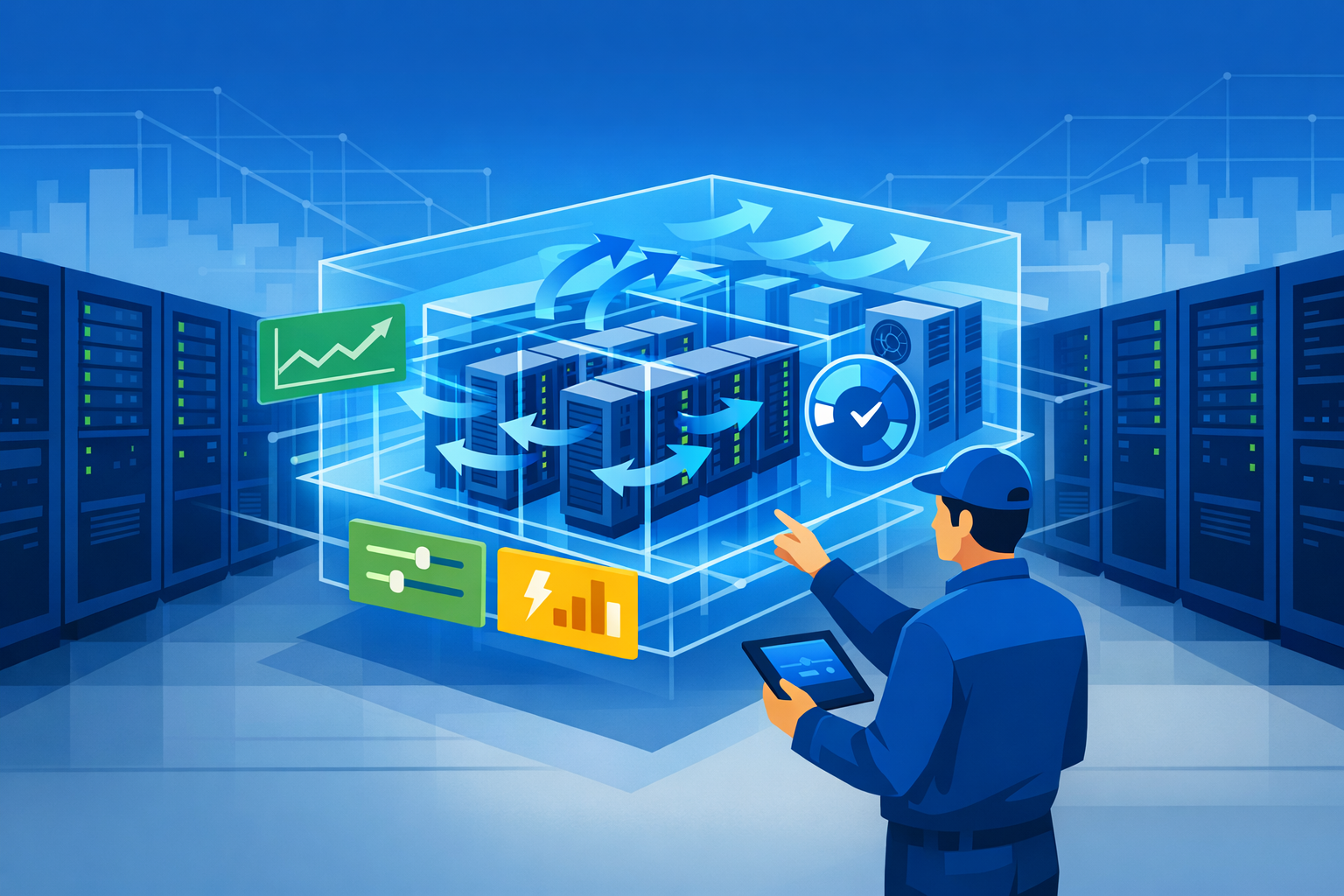
- 3D digital twin: Real-time three-dimensional models represent each room's physical, electrical, and thermal capacity, enabling operators to visualize airflow, hotspots, and load distribution.
- Dynamic risk maps: The system maintains live risk maps to highlight cooling shortfalls, over-cooling, and capacity challenges.
- Automated recommendations: AI analytics recommend actions-such as setpoint adjustments and fan speed changes-prioritized by energy savings and risk impact.
- What-if simulations: Operators can simulate failure scenarios or planned changes, such as the integration of AI racks, within the digital twin before implementing them on site.
This approach tightly couples cooling performance with IT load and infrastructure constraints, surpassing conventional Building Management System (BMS) views.
Scaling from Core to Edge
Rapid deployment is a key design feature. The solution supports a diverse range of facilities, from core data centers to smaller technical rooms:
- New sites can typically be onboarded within days, without service interruption or construction work.
- EkkoSoft Critical, the underlying software, is being deployed across Telefónica Germany's national data center network.
For operators managing extensive edge sites as well as centralized facilities, the ability to implement such platforms quickly across varied locations is critical for delivering portfolio-wide efficiency gains.
Quantified Benefits: Cooling Savings, PUE, and Data Center Emissions
Early results from Telefónica Germany focus on cooling energy performance, a primary lever for improving data center efficiency and emissions.
Initial evaluations indicate an estimated 15-20% reduction in cooling energy consumption at participating sites.
Given that cooling often accounts for 30-40% of facility electricity use, these reductions can yield:
- Improved PUE, depending on baseline conditions
- Lower emissions where grid electricity has carbon intensity
- Deferred capital expenditure via more efficient use of existing cooling and space
Illustrative Impact on PUE (Example Scenario)
The following table presents a generic example for a mid-size telecom data center, showing how a 15% reduction in cooling energy can affect PUE:
| Parameter | Baseline | After Optimization (Illustrative) |
|---|---|---|
| IT load | 5.0 MW | 5.0 MW |
| Non-IT load (cooling + other overhead) | 3.0 MW | 2.55 MW (15% less cooling share) |
| Total facility load | 8.0 MW | 7.55 MW |
| PUE (Total / IT) | 1.60 | 1.51 |
| Cooling share of total energy | 35% | 30% |
A 15% reduction in cooling energy can lower PUE by several points, a notable improvement when scaled across a portfolio and combined with other initiatives.
Link to Network-Level Sustainability Targets
Telefónica Germany's data highlights the interplay between facility and network efficiency measures:
- By 2023, O₂ Telefónica reduced energy consumption per data volume in its mobile network to 0.07 GWh per petabyte, an 83% decrease compared to 2015.
- Over the same period, Scope 1 and 2 CO₂ emissions were reduced by 97% versus 2015.
These results reflect broader actions, but transparency and efficiency in data center energy management remain vital as traffic continues rising.
From DCIM to Digital Twins: Interoperability and Data Transparency
Traditional DCIM platforms have promised integrated monitoring and control but are often limited by data quality, complexity, and prolonged deployment cycles.
EkkoSense and other vendors note common DCIM challenges:
- Snapshot rather than real-time data
- Limited coverage of mechanical and electrical assets
- Complex interfaces and reporting
- Lengthy deployment and integration
Next-generation platforms address these issues by:
- Integrating telemetry from BMS, DCIM, power meters, and IoT sensors into a unified, high-resolution data set
- Maintaining a live 3D digital twin of both M&E assets and IT load
- Providing prioritized operational recommendations, rather than just alerts
Telefónica Germany's deployment exemplifies how a digital-twin energy management layer can complement existing DCIM systems:
- DCIM and BMS remain primary systems of record for alarms and compliance
- The digital twin serves as a real-time optimization layer, focusing on energy, thermal risk, and capacity
- Transparency improves by correlating alerts (e.g., CRAC failures) with thermal and workload impacts
Extending smart-building management concepts to telecom data centers enhances data-driven control in high-density, critical environments.
Security, Resilience, and Operational Risk
Implementing an AI-driven energy management platform for power and cooling control raises targeted security and operational concerns for critical infrastructure.
Key factors include:
- Network segmentation and zero trust: Keep the optimization platform separate from production IT and core network systems, controlling interfaces to BMS, DCIM, and SCADA
- Role-based access control (RBAC): Use granular permissions to prevent unauthorized changes
- Change governance: Run automated recommendations in support mode until operational confidence is established, with human approval for major actions
- Fail-safe operations: Ensure platform failures do not compromise core cooling or power systems
Existing telecom frameworks (e.g., NIS2, national CI standards) must be extended to cover digital-twin and AI optimization technologies.
ROI and Procurement Implications for Telecom Operators
Telefónica Germany's program highlights key investment considerations for telecom and large-campus operators.
Sources of Savings
Savings typically come from:
- Lower cooling power through higher supply temperatures and optimized airflow
- Reclaimed capacity (power, cooling, space), delaying new construction
- Reduced downtime risk through early detection
- Improved ESG and regulatory reporting via granular data
Vendor case studies show cooling energy reductions up to ~30% are possible in well-managed environments, depending on starting conditions.
Payback Horizons
With rising electricity costs and regulatory pressures, many operators achieve paybacks of 1-3 years on advanced energy management deployments when:
- Sites have inefficient airflow or oversized cooling
- IT loads are rising quickly (e.g., due to AI clusters)
- EnEfG compliance would otherwise require substantial capital spending
Evaluating benefits in both emissions reduction and risk mitigation strengthens the investment case for all stakeholders.
Implementation Guidance for Building and Facility Teams
For electrical engineers, facility managers, and system integrators, the following practices emerge from Telefónica Germany's approach:
1. Prioritize High-Consumption and High-Risk Sites
- Begin with sites exhibiting high PUE, thermal challenges, or rapid growth
- Conduct brief diagnostics to benchmark cooling and airflow
2. Design for Interoperability, Not Replacement
- Integrate the energy management layer with existing BMS, DCIM, and power monitors
- Ensure open APIs and data models to avoid hardware lock-in
3. Establish Clear KPIs and Governance
- Define KPIs such as PUE, cooling kWh per IT kW, ASHRAE compliance, and thermal risk scores
- Schedule reviews so operations teams can validate AI recommendations and track results
4. Align with Regulatory and ESG Reporting
- Map outputs to EnEfG, EED, and CNDCP requirements, including PUE, Energy Reuse Factor (ERF), and emissions metrics
- Use high-resolution data to support audits and demonstrate improvement
5. Build Skills Across Teams
- Cross-train facilities engineers, network planners, and energy managers on digital twins
- Develop response protocols for major events or deployments
Actionable Conclusions and Next Steps
Telefónica Germany's rollout shows:
- AI-based, portfolio-wide data center energy management is viable for major telecom operators
- Focusing on data center cooling and thermal optimization can yield double-digit reductions in cooling energy, improving PUE and emissions
- Digital-twin platforms can complement existing DCIM and BMS systems, provided interoperability and security are prioritized
Recommended actions for telecom and critical-infrastructure leaders are:
- Audit current PUE, cooling performance, and regulatory alignment across all data centers
- Pilot digital-twin-based optimization at selected sites, set clear baselines and KPIs
- Develop roadmaps linking energy optimization with EnEfG compliance, CNDCP goals, and broader sustainability objectives
As regulatory requirements tighten and AI-related workloads expand, operators able to scale secure, interoperable energy management across their estates will be better positioned to meet performance and climate goals.
Frequently Asked Questions
How is a digital-twin energy management platform different from traditional DCIM?
Traditional DCIM platforms focus on asset inventories, monitoring, and capacity planning, often providing snapshot views. A digital-twin-driven energy management platform continuously ingests real-time sensor data into a 3D facility model, applies analytics to detect inefficiencies or risks, and generates prioritized optimization recommendations.
DCIM answers what is where and how is it connected, while the digital twin adds how is it behaving now, and how could it behave better under different operating conditions?
What level of PUE improvement is realistic from this type of solution?
Outcomes vary by baseline performance. Where airflow management is suboptimal, supply temperatures conservative, or cooling oversized, 15-30% cooling energy reductions are common in case studies, with corresponding PUE improvements. Telefónica Germany's 15-20% reduction in cooling energy consumption aligns with this range, pending sustained implementation.
How does this help with compliance with Germany's Energy Efficiency Act (EnEfG)?
EnEfG compliance requires:
- Accurate measurement of total and IT energy use
- Evidence of continuous improvement
- Progress on waste-heat utilization and renewable sourcing
A digital-twin platform delivers granular energy and thermal data, automated reporting, and documented actions, supporting both PUE targets (e.g., ≤1.2 for new data centres from 1 July 2026) and audit readiness.
What are the main integration points with existing building and network systems?
Key interfaces include:
- BMS and HVAC controls
- Power monitoring (UPS, PDUs, meters)
- DCIM for asset/topology data
- Network management/orchestration, where load placement is adjustable
Careful interface design and security segmentation are essential to avoid new single points of failure or vulnerability.
Where should facility and energy teams start if they want to replicate Telefónica Germany's approach?
A staged approach includes:
- Baseline: Measure PUE, temperatures, and cooling energy by site
- Pilot: Deploy digital twins and sensors on a representative site
- Prove value: Run in advisory mode, implement recommendations, measure impact
- Industrialize: Standardize deployment, integrations, and governance, then scale
- Integrate with ESG: Feed resulting data into sustainability dashboards and reporting
Telefónica Germany's experience emphasizes the importance of rapid, low-disruption deployment and quantifiable outcomes for stakeholder alignment and sustained progress.