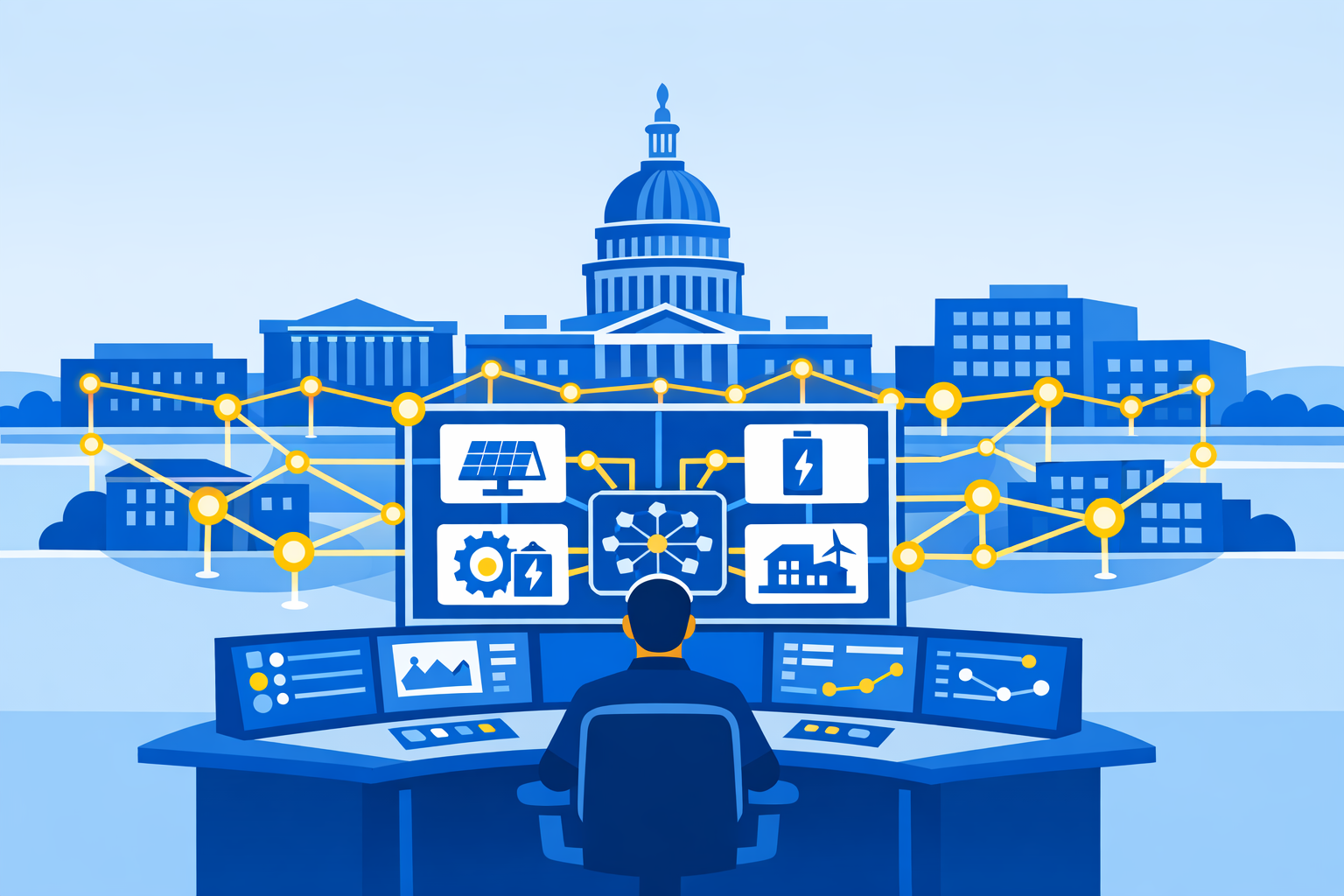
The U.S. Department of Energy's Federal Energy Management Program (FEMP) is advancing a new phase of energy management system (EMS) deployment at federal facilities, extending real-time coordination of distributed energy resources (DERs)-including rooftop solar, battery storage, demand response, and microgrid capabilities-across a broader portfolio of large office campuses and research centers. The initiative, developed with the General Services Administration (GSA) and utility partners, marks a structural shift from isolated energy conservation measures toward integrated, platform-level DER orchestration at scale.
Background
FEMP's Distributed Energy and Energy Procurement initiative helps federal agencies implement lasting and reliable energy-generation projects, including on-site renewables, storage, and combined heat and power, according to DOE documentation. The program operates under overlapping federal energy mandates-including the Energy Policy Act of 2005, the Energy Independence and Security Act of 2007, and the Energy Act of 2020-that require agencies to track, reduce, and report energy use across their building portfolios. FEMP also supports the identification and implementation of distributed energy projects, including on-site sources, storage, and combined heat and power, with an emphasis on enhancing energy resilience and integrating cybersecurity, the agency has stated.
Since 1975, FEMP has helped federal agencies reduce the energy intensity of their facilities by 50%, according to DOE, with energy consumption across the federal estate declining steadily over four decades. With FEMP's help, the federal government is on track to realize $60 billion in taxpayer savings by 2030, the agency projects. The latest EMS expansion builds on prior grid-interactive building pilots that demonstrated measurable improvements in peak-shaving, demand charge reduction, and outage resilience. For background on the earlier grid-interactive buildings pilot and EMIS adoption trends, see coverage of the Federal GEB Pilot Expansion and Federal EMIS Adoption Acceleration.
Details
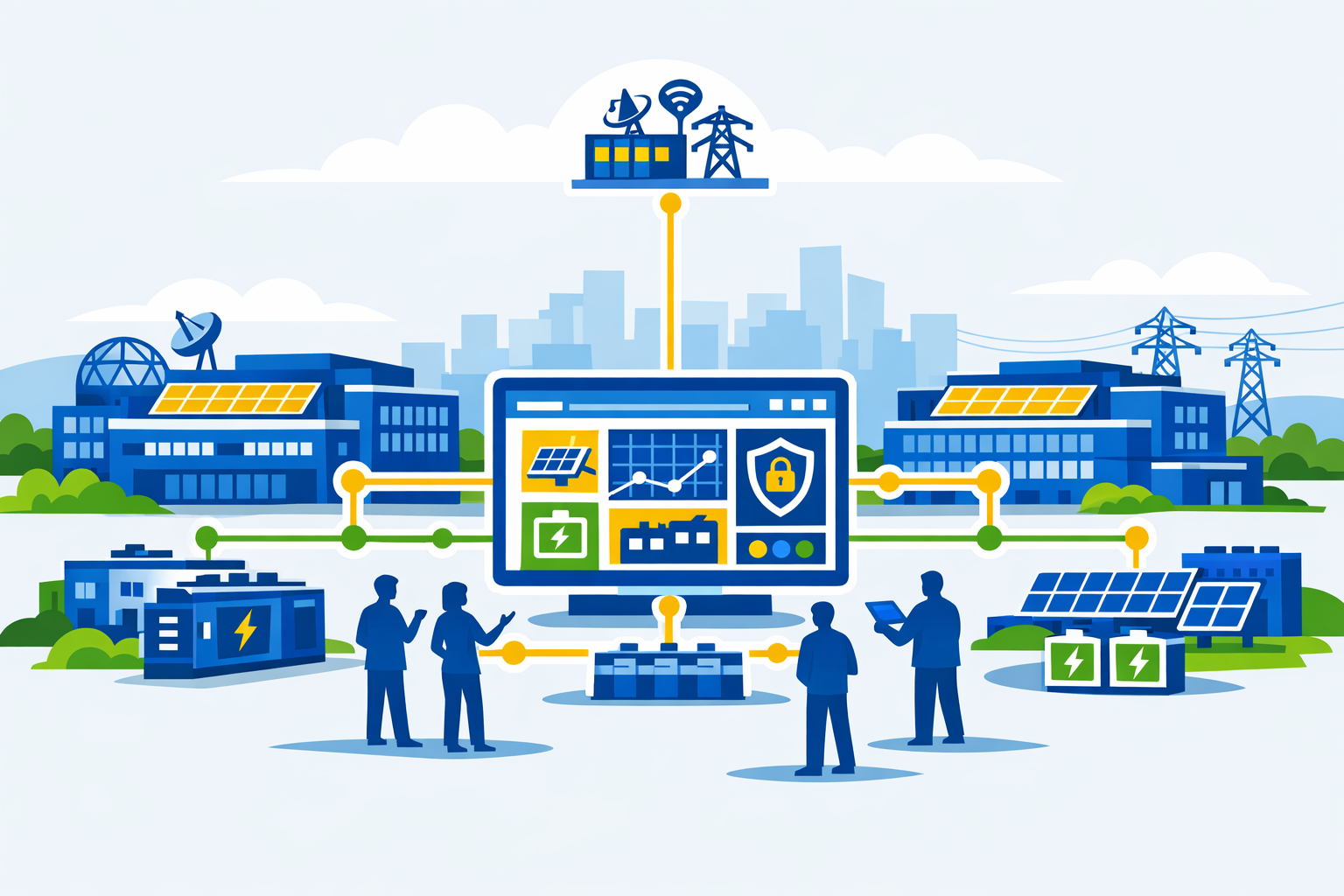
The expanded program centers on a shared EMS platform designed to harmonize DER outputs across diverse building systems. An Energy Management Information System (EMIS) is comprised of devices, data services, and software applications that monitor, analyze, and control metered building energy use and system performance, per FEMP's technical guidance. Elements of an EMIS work together to aggregate facility data and help federal energy managers optimize energy use at the building, campus, or agency level.
A central challenge is achieving interoperability between the EMS layer and legacy building automation systems (BAS) already installed across federal complexes. FEMP's guidance calls for systems with standards-based interfaces and open application programming interfaces (APIs) to improve connectivity with existing metering infrastructure and demand-response platforms. Procurement pathways under consideration include Energy Savings Performance Contracts (ESPCs) and Utility Energy Service Contracts (UESCs), which allow agencies to finance advanced system upgrades through guaranteed energy savings without upfront appropriated capital.
FEMP empowers, educates, and trains federal agencies on how to actively identify, prioritize, and mitigate the risks of cyber or physical attacks on facility-related control systems while maintaining the required level of service for efficient operations, according to DOE. Cybersecurity integration is a core requirement for the expanded EMS rollout. Agencies are expected to reference established frameworks, including the Federal Information Security Modernization Act (FISMA) Risk Management Framework (RMF) and NIST SP 800-53 controls, to safeguard connected DER and BAS infrastructure. National labs such as NLR help agencies enhance the cybersecurity posture of federal facilities, identify cybersecurity vulnerabilities in distributed energy systems, and develop customized action plans, per published DOE partnership documentation.
FEMP's REopt® optimization tool is being used to evaluate DER configurations at candidate sites. REopt® helps federal agencies accomplish their missions by evaluating energy generation, storage, and electrification solutions and identifying the optimal combination of energy technologies, system sizing, and operations for a site, according to DOE. FEMP's Technical Resilience Navigator (TRN) helps organizations manage the risk to critical missions from disruptions in energy and water services through a comprehensive, risk-informed resilience planning process.
On the funding side, analysts have flagged a structural risk to the initiative's continuity. DOE's fiscal year 2026 budget proposal requests $8 million to wind down activities at FEMP - potentially shutting its doors for good, according to the Federation of American Scientists. FEMP has funded 160 AFFECT projects, distributed nearly $300 million, and leveraged $4 billion in private-sector investment, yielding $137 million in cost savings to date, per the same analysis.
Outlook
Industry observers are watching whether the federal EMS expansion will catalyze broader private-sector adoption of interoperable DER orchestration platforms, particularly as standardized procurement templates and cybersecurity specifications developed for federal use become reference models for commercial building owners. FEMP plans to collect lessons learned from early deployments to guide governmentwide rollout, with participating agencies required to develop site-level implementation plans covering schedules, budgets, and workforce training. The program's long-term trajectory hinges partly on congressional appropriations decisions expected later in 2026.