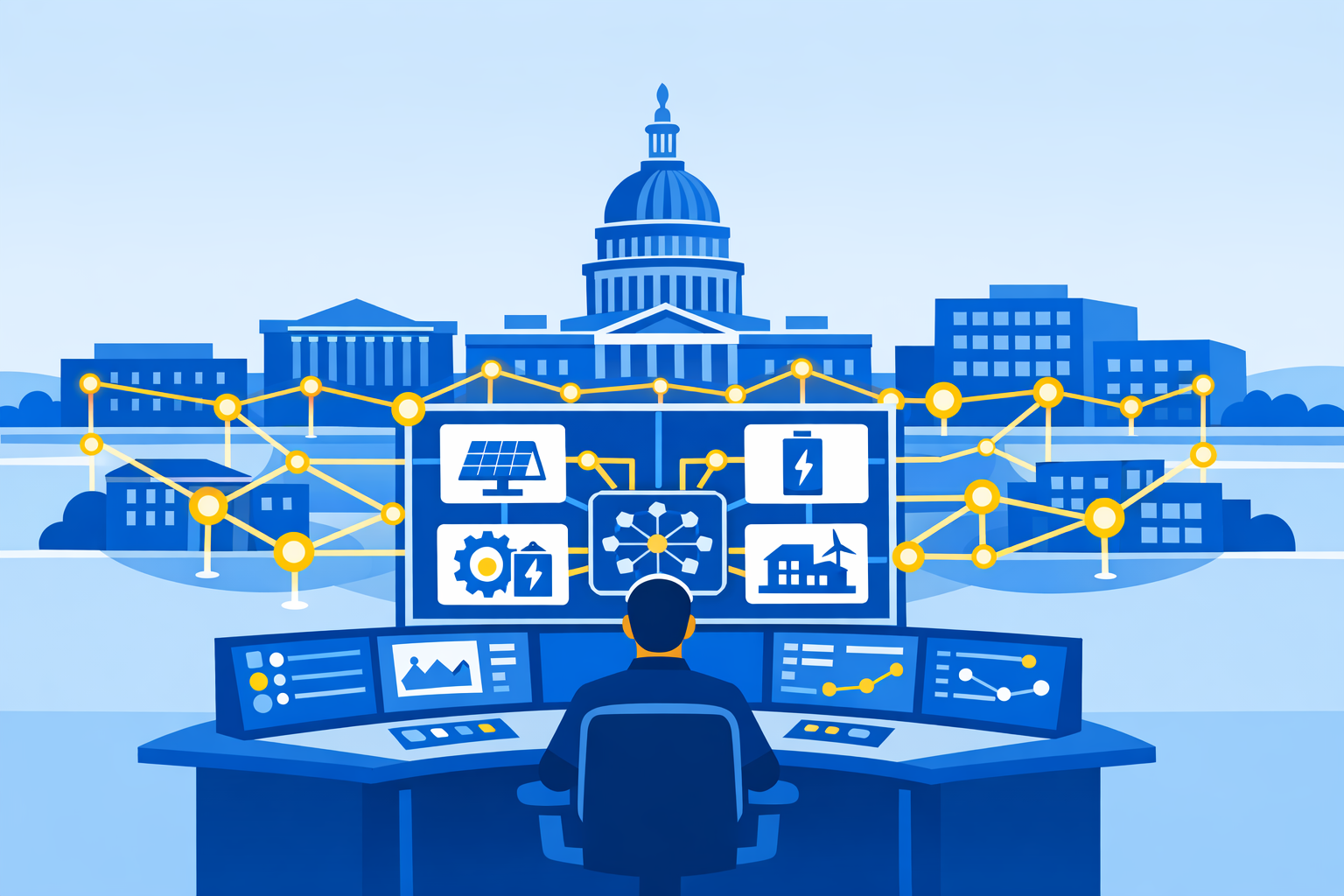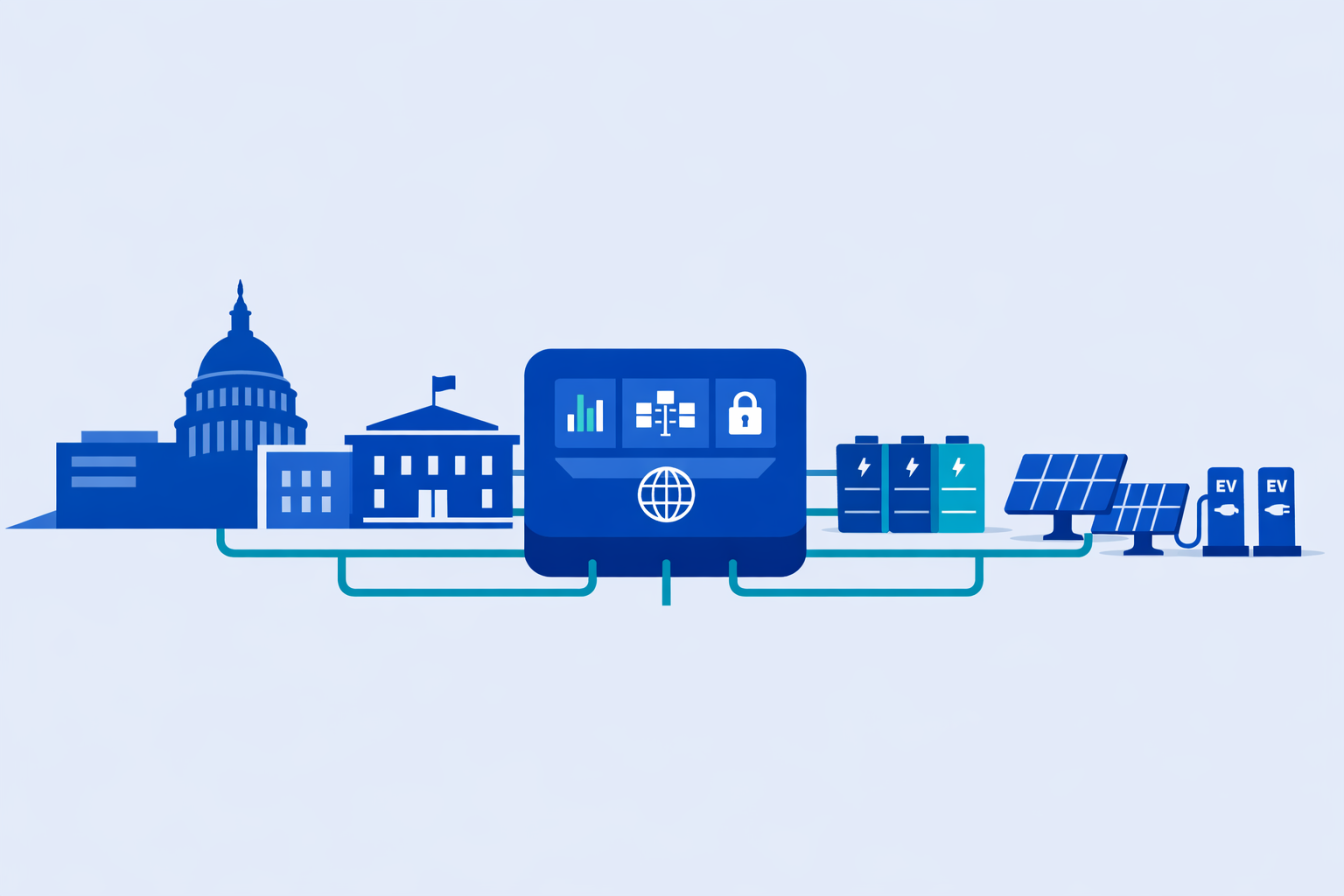
Federal agencies are deploying next-generation energy management systems (EMS) designed to coordinate distributed energy resources (DERs) in real time across multi-building complexes, marking a significant expansion beyond earlier monitoring-focused deployments. The U.S. Department of Energy's Federal Energy Management Program (FEMP) is leading the effort, providing technical assistance and tooling to federal sites integrating solar photovoltaics, battery energy storage systems (BESS), EV charging infrastructure, and smart HVAC into unified, controllable platforms. The 2026 pilot programs build on prior grid-interactive efficient buildings (GEB) work but target active DER dispatch rather than passive load monitoring - a distinction that reshapes both procurement requirements and cybersecurity obligations.
Background
The federal government manages one of the largest building portfolios in the world, and FEMP-supported initiatives have helped agencies achieve a 50% reduction in energy intensity since 1975, according to DOE. However, the proliferation of behind-the-meter assets - rooftop solar, stationary storage, and networked EV chargers - has outpaced the coordination capabilities of conventional building automation systems (BAS). FEMP's Energy Management Information Systems (EMIS) initiative helps federal agencies implement systems that monitor, analyze, and control metered building energy use, and has demonstrated median annual fault-detection savings of $0.27 per square foot against combined deployment and recurring costs of roughly $0.12 per square foot.
The current pilot cycle goes further. Next-generation EMS platforms are evolving into central coordination layers that integrate data from Asset Performance Management systems, advanced forecasting tools, Wide Area Monitoring Systems, and intelligent field devices, according to Hitachi Energy. Transmission system operators using these platforms require real-time visibility into downstream activity, including rooftop solar, batteries, EV charging, and flexible demand, the company noted in a May 2026 analysis. At the federal building level, the same principle applies: operators need closed-loop data exchange to actively dispatch DER assets in response to grid signals rather than relying on scheduled control actions.
Details
Interoperability is central to the pilots' technical requirements. IEEE 2030.5, the standard for interconnection and interoperability of DERs with electric power system interfaces, governs utility interaction with consumer devices and covers function sets for DERs, EV support, billing, and demand response. OpenADR is widely used in the U.S. to automate demand response and load shifting, and in some architectures OpenADR is used to trigger a grid event while IEEE 2030.5 handles actual coordination of DER assets behind the meter, according to industry analysis. Federal procurement documents for the 2026 cohort are expected to require support for both protocols alongside legacy interfaces such as DNP3 and IEC 61850.
Cybersecurity is treated as a co-equal design requirement. FEMP's Distributed Energy Resource Cybersecurity Framework (DER-CF), developed in collaboration with the National Laboratory of the Rockies (NLR), provides federal agency sites with a tool to assess the cybersecurity posture of distributed energy resource systems. As facilities move from analog systems to connected operational technology (OT), the risk of a disruptive cyberattack grows, requiring facilities to continuously assess and enhance their cybersecurity posture, according to FEMP guidance. Federal agencies are legally required to reference and follow NIST's Risk Management Framework (RMF), which includes OT devices in comprehensive cybersecurity assessments.
In parallel, the National Laboratory of the Rockies is leading a DOE-funded effort to harmonize DER cybersecurity requirements across multiple standards development organizations, with NLR co-leading an update to the cybersecurity section of the IEEE 1547-2025 standard revision. The UL 2941 cybersecurity certification standard, co-developed by NLR and UL Solutions, establishes security-by-design requirements for DERs before and after deployment. Agencies procuring EMS platforms for the 2026 pilots are directed to reference this standard during vendor evaluation.
DOE's Office of Cybersecurity, Energy Security, and Emergency Response (CESER) published a 2026-2030 strategy in early 2026 calling for the development of at least two private-sector-ready security innovations annually and deployment of resilient systems across critical energy infrastructure, according to reporting on the plan. The strategy explicitly addresses real-time response coordination across federal agencies during energy disruptions.
Outlook
FEMP projects that EMIS and EMS deployments will progress from monitoring toward real-time analytics, predictive maintenance, and automated demand response, with agencies establishing portfolio-level governance over data access, cost allocation, and performance reporting. If the 2026 pilots validate the technical architecture, agencies are expected to expand DER-integrated EMS to additional campuses under Energy Savings Performance Contracts (ESPCs), which allow cost savings to finance system upgrades without upfront capital. Industry analysts note that federal performance benchmarks from these deployments will likely influence private-sector EMS procurement specifications and utility interconnection requirements for commercial buildings.
Related coverage: Federal Expands Grid-Interactive Buildings Pilot to More Agencies | Federal Agencies Accelerate Adoption of EMIS Across Portfolios