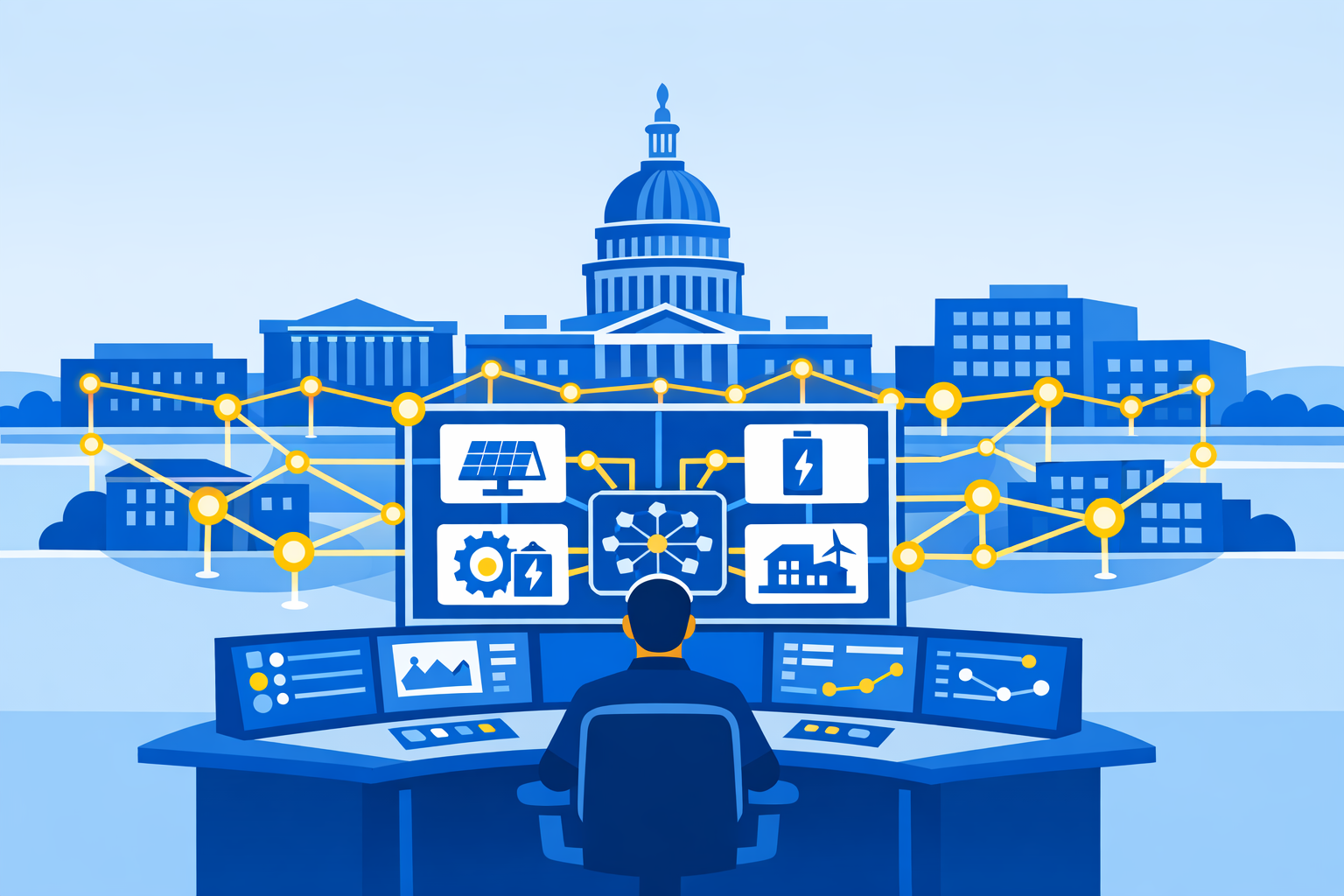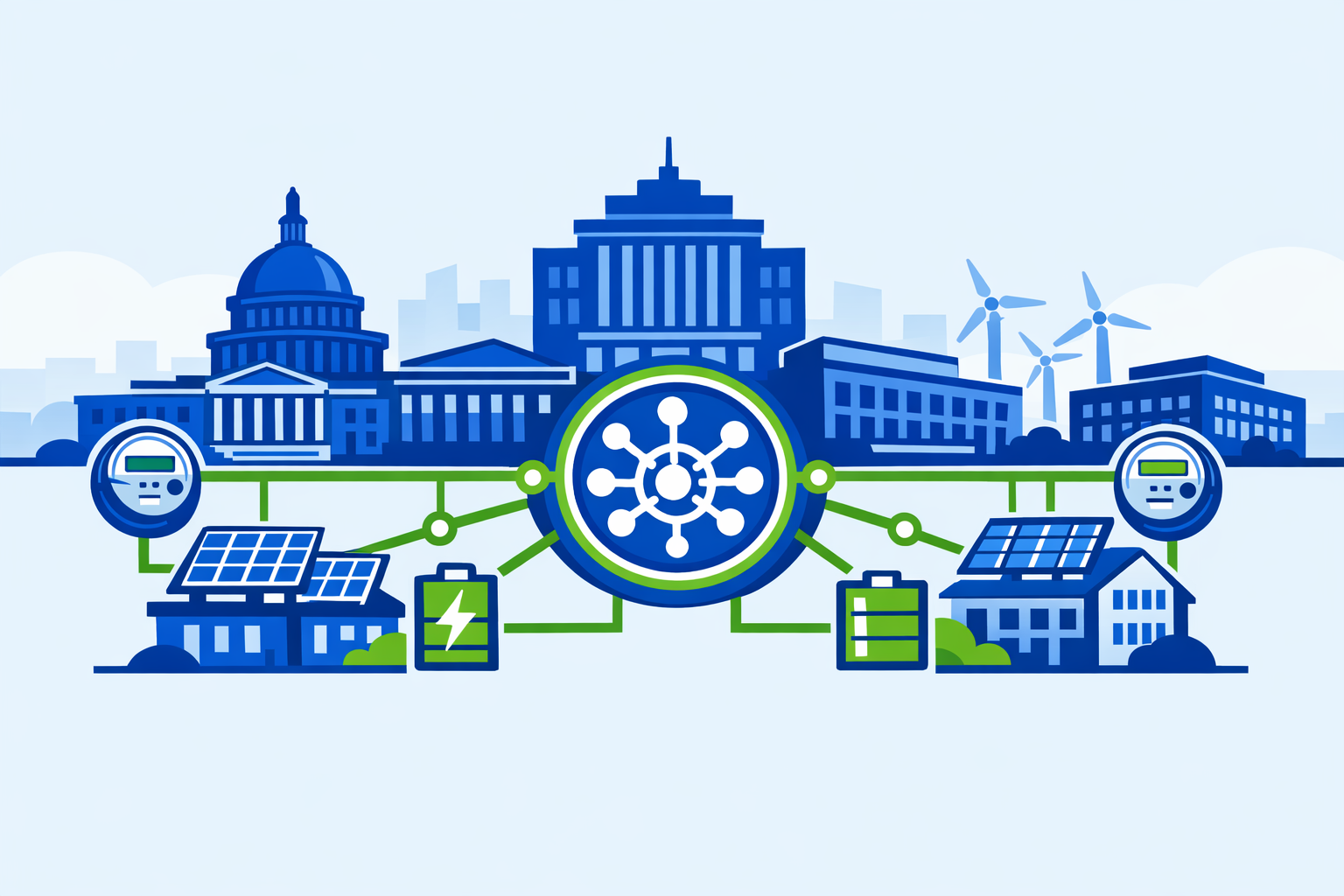
U.S. federal agencies are scaling open-data energy management system (EMS) protocols to enable real-time coordination of distributed energy resources (DERs) across a projected 1,200 facilities, marking a significant step in the government's push toward interoperable, data-driven building infrastructure. The initiative, anchored by mandates from the Department of Energy's Federal Energy Management Program (FEMP) and the General Services Administration (GSA), reflects growing urgency to integrate on-site generation, storage, and demand-flexible assets into a unified, agency-wide operational framework.
Background
Federal building energy management has been shaped by successive legislative requirements - including the Energy Policy Act of 2005, the Energy Independence and Security Act (EISA) of 2007, and the Energy Act of 2020 - which direct agencies to track, report, and reduce energy consumption across their building portfolios. FEMP's Energy Management Information Systems (EMIS) initiative has for several years helped agencies identify and implement platforms that aggregate facility data using advanced metering infrastructure (AMI), building automation systems (BAS), and interval data analytics, according to DOE. Fault detection and diagnostics deployed through EMIS have achieved median annual savings of $0.27 per square foot, compared to combined deployment and recurring costs of $0.12 per square foot, per FEMP data.
GSA has moved in parallel on open protocol mandates for its own portfolio. According to the agency's Smart Buildings directive, GSA policy now requires facilities to "promote interoperability between devices through open protocol systems with the objective of converging normalized data on, at least, a facility-wide tool". This positions open APIs and standards-based interfaces as a procurement baseline - not an optional upgrade - for new and modernized federal buildings.
Details
The scale of recent federal investment underscores the seriousness of the push. GSA unveiled plans to invest $80 million in smart building technologies, funded by the Inflation Reduction Act, targeting approximately 560 federal buildings across 49 states, Washington D.C., Puerto Rico, and the U.S. Virgin Islands, according to Facilities Dive. The initiative includes the installation of roughly 1,000 new meters for measuring electricity, water, and gas performance - the metering backbone required to support real-time DER coordination at scale. GSA's Federal Sustainability Plan goals include reaching net-zero emissions across the federal building portfolio by 2045, reducing operational emissions 65% by 2030, and using 100% carbon-free electricity by 2030.
In parallel, FEMP's Federal Smart Buildings Accelerator (FSBA), which was introduced at Energy Exchange 2022 and concluded in September 2024, provided technical assistance and EMIS education at federal campuses spanning NIST laboratories in Colorado and Maryland, Navy facilities in Virginia, Department of the Interior sites, Veterans Administration medical centers, and multiple GSA courthouses and offices, according to DOE. The accelerator identified a key barrier: while interest in grid-interactive efficient building (GEB) technologies is high among federal operators, knowledge gaps around implementation remain a persistent obstacle.
On the technology standards front, the broader demand response ecosystem is consolidating around open protocols that federal EMS vendors must support to qualify for program participation. OpenADR 3.1.0, released in September 2025, added a "program" construct that simplifies multi-market enrollment, according to Codibly. IEEE 2030.5, through its Common Smart Inverter Profile (CSIP), governs inverter-to-utility communication and is mandated for grid-connected inverters, batteries, and DERs in California. CTA-2045 addresses device-level control for grid-interactive assets - including HVAC systems, water heaters, and EV chargers - and can be embedded as a payload within OpenADR to create a unified approach to managing grid-connected devices, enabling cross-vendor coordination across heterogeneous building portfolios.
Data governance remains a central challenge. GSA's open data plan references OMB M-25-05, the OPEN Government Data Act, and Executive Orders 14240 and 14243 - signed March 20, 2025 - as drivers of interoperability and the elimination of information silos across federal systems. Cybersecurity obligations add further complexity: FEMP procurement guidance now routinely references the Federal Information Security Modernization Act (FISMA) Risk Management Framework, NIST SP 800-53 controls, and zero-trust architectures as required safeguards for connected EMS and AMI systems.
Outlook
GSA expects evaluation results from its current Green Proving Ground technology assessments - a $9.6 million effort evaluating 17 emerging and sustainable technologies across federal facilities, conducted in partnership with DOE - to be available in 2026, which should inform large-scale procurement decisions on EMS and DER integration. For private-sector vendors, the federal shift toward mandatory open protocols and cross-agency data sharing is reshaping qualification baselines for participation in federal energy programs, with interoperability certification increasingly functioning as a prerequisite rather than a differentiator. FEMP's trajectory - from monitoring toward automated demand response, predictive maintenance, and portfolio-level governance - suggests agencies are positioning for a substantive operational transition over the next procurement cycle.
For related coverage, see our earlier reporting on Federal Agencies Accelerate Adoption of EMIS Across Portfolios and Federal Expands Grid-Interactive Buildings Pilot to More Agencies.