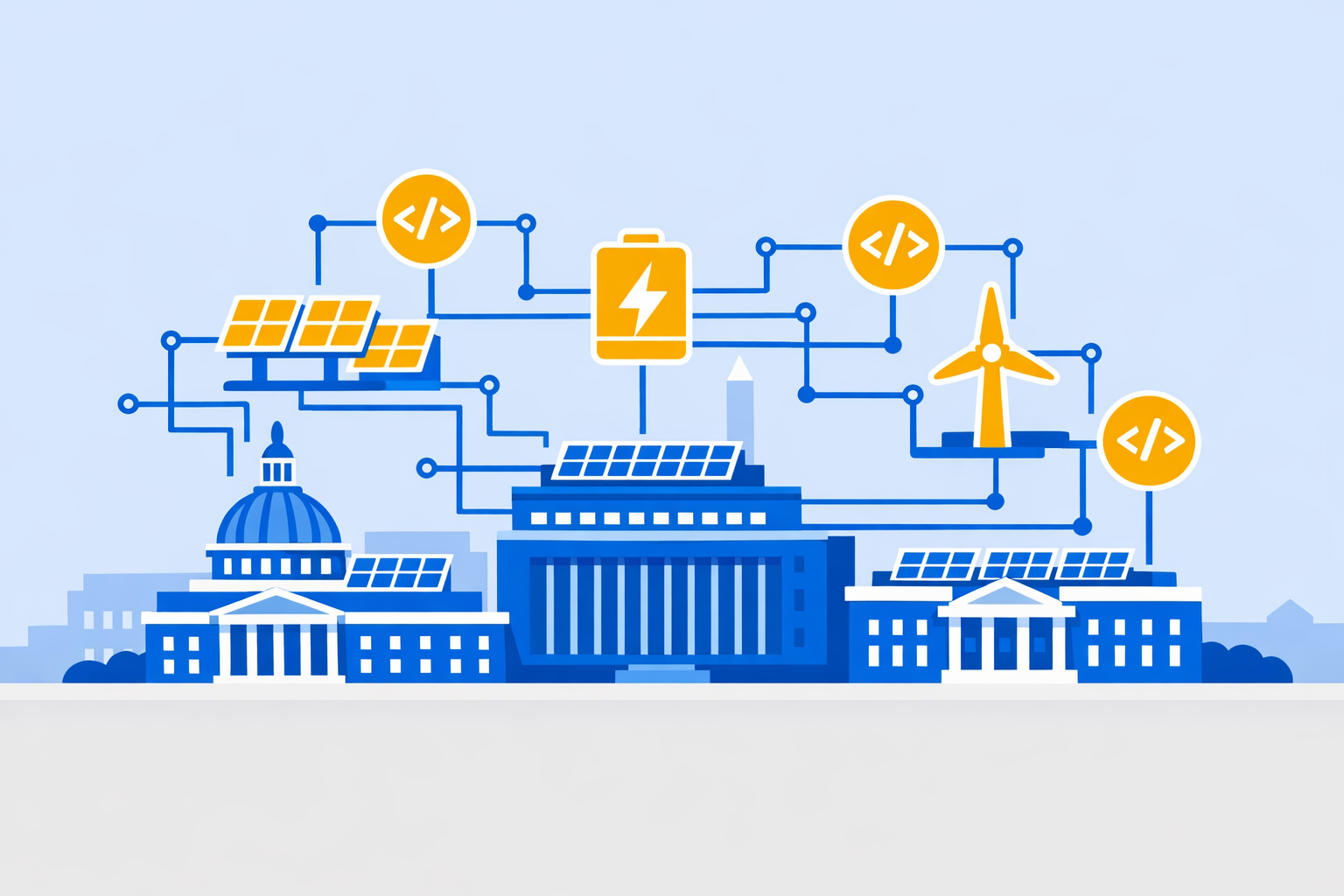
U.S. federal agencies are mandating supplier-neutral, open-data interfaces for energy management systems (EMS) spanning multi-building campuses, accelerating real-time coordination of distributed energy resources (DERs) across the government's vast property portfolio.
The Department of Energy's Federal Energy Management Program (FEMP) is driving the transition through its Energy Management Information Systems (EMIS) initiative, which helps federal agencies identify and implement an EMIS to help meet their building energy cost reduction goals and comply with federal facility energy efficiency laws and requirements, including the Energy Policy Act of 2005, the Energy Independence and Security Act of 2007, and the Federal Information Security Modernization Act (FISMA) of 2014. The mandate is intensifying as agencies move beyond metering and reporting toward active DER dispatch and real-time load coordination.
Background
Federal energy management policy has long required agencies to track and reduce consumption across their building portfolios, but the emphasis has historically centered on compliance reporting rather than grid responsiveness. That framing is changing. FEMP now identifies grid-interactive efficient buildings (GEBs) as a core objective, providing technical guidance on demand flexibility, DER integration, and building-to-grid communication.
The Federal Smart Buildings Accelerator (FSBA), referenced in the Energy Act of 2020 and concluded in September 2024, demonstrated GEB technologies across multiple agencies. FEMP noted the program "laid the groundwork for future advancements in energy efficiency" while exposing persistent gaps in education, funding, and technical support. Its conclusion has created momentum for successor procurement and technical frameworks that embed open interoperability requirements from the outset.
Separately, the GSA announced an $80 million investment in smart building technologies and DOE allocated $104 million for clean energy and net-zero projects at 31 federal facilities, signaling sustained capital commitment to connected building infrastructure.
Details
Agencies are now specifying open application programming interfaces (APIs) and standards-based protocols-including BACnet (ANSI/ASHRAE 135) and ASHRAE Standard 201, the Facility Smart Grid Information Model-in EMIS procurement documents, with the explicit goal of eliminating vendor lock-in across multi-building campuses. BACnet provides a vendor-independent networking solution to enable interoperability among equipment and control devices for a wide range of building automation applications, while ASHRAE 201 "defines an abstract, object-oriented information model to enable appliances and control systems in homes, buildings, and industrial facilities to manage electrical loads and generation sources in response to communication with a 'smart' electrical grid".
Early deployments illustrate the operational potential. At the Carl T. Hayden Veterans Affairs Medical Center in Phoenix, a 4.4-MW solar array capable of supplying 28% of its power needs, a 1.5-million gallon chilled water tank for peak load management, and direct digital air handler controls cut air conditioning electricity use by 45%. An upgraded building automation system and advanced data management enabled load shifting, reducing the center's energy consumption by more than 25%, according to a FEMP case study.
Real-time DER coordination introduces corresponding cybersecurity exposure. FEMP guidance states that FISMA requires agencies to reference and follow the Risk Management Framework (RMF), a NIST document that includes operational technology (OT) devices and components in comprehensive cybersecurity assessments. Procurement language now routinely references NIST SP 800-53 controls and zero-trust architectures for connected energy systems. FEMP advises agencies to address cybersecurity lifecycle requirements in supplier contracts, particularly given reliance on third-party vendors for hardware and software for energy delivery systems.
The DOE's Open Energy Data Initiative (OEDI), which houses data generated across 17 national laboratories and all their partner organizations, with over 200 providers from government labs, private industries, and universities contributing, provides the federal data infrastructure underpinning broader interoperability ambitions. OEDI data standards adhere to FAIR (findable, accessible, interoperable, and reusable) data principles and align with OMB Circular A-119, which directs agencies to use standards that promote data interoperability and openness.
Outlook
FEMP plans to expand its Demand Flexibility Challenge program to "bring GEB to a broader group of federal facilities [with] focus on recognition for planning and execution of demand flexibility projects at specific sites and at an agency or regional level", according to agency officials. As open-standard procurement templates mature, system integrators and building automation suppliers in the federal market will face rising pressure to certify interoperability with competing platforms. Cybersecurity assessments of OT-connected EMS are expected to become a standard contract deliverable rather than an afterthought in agency specifications.