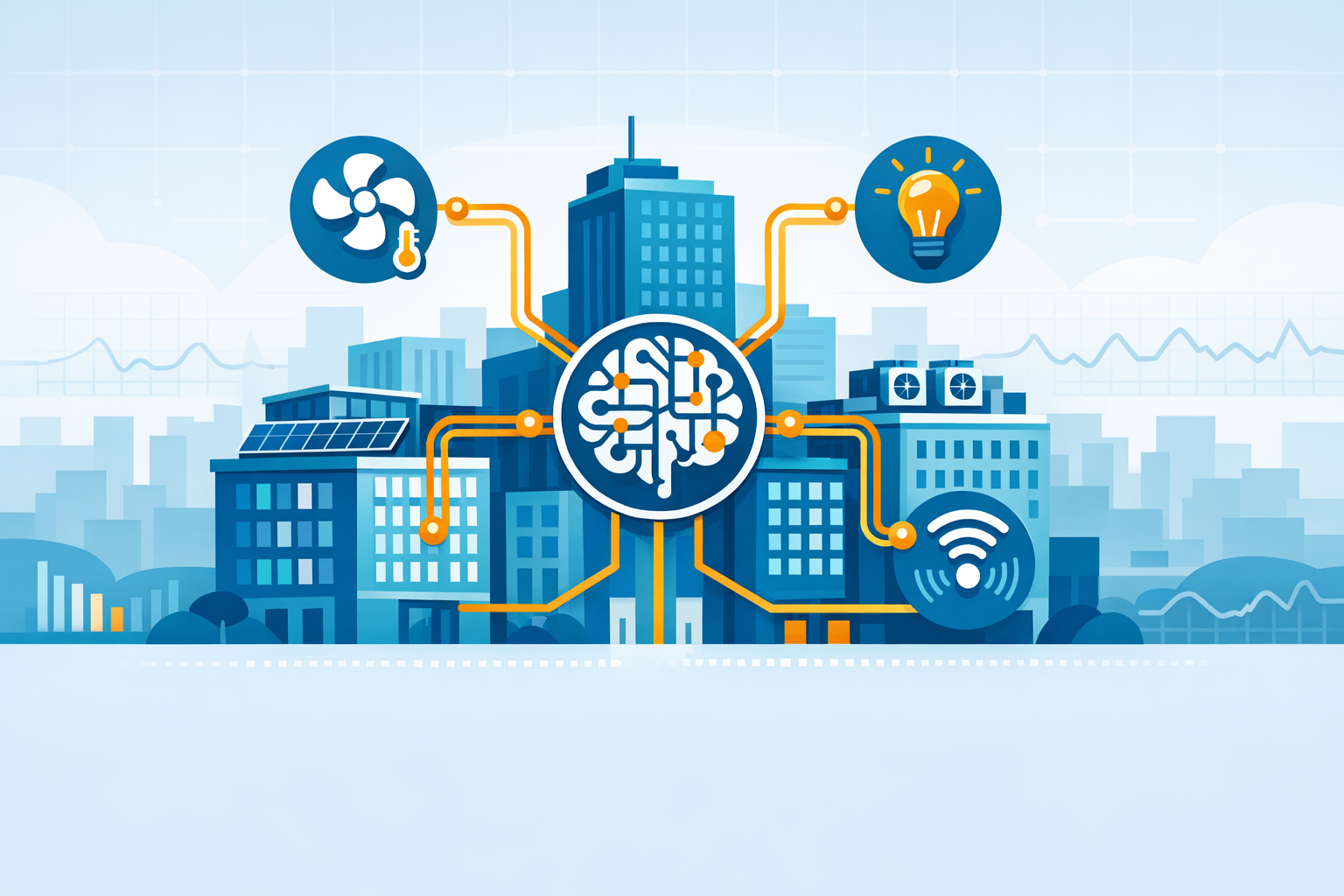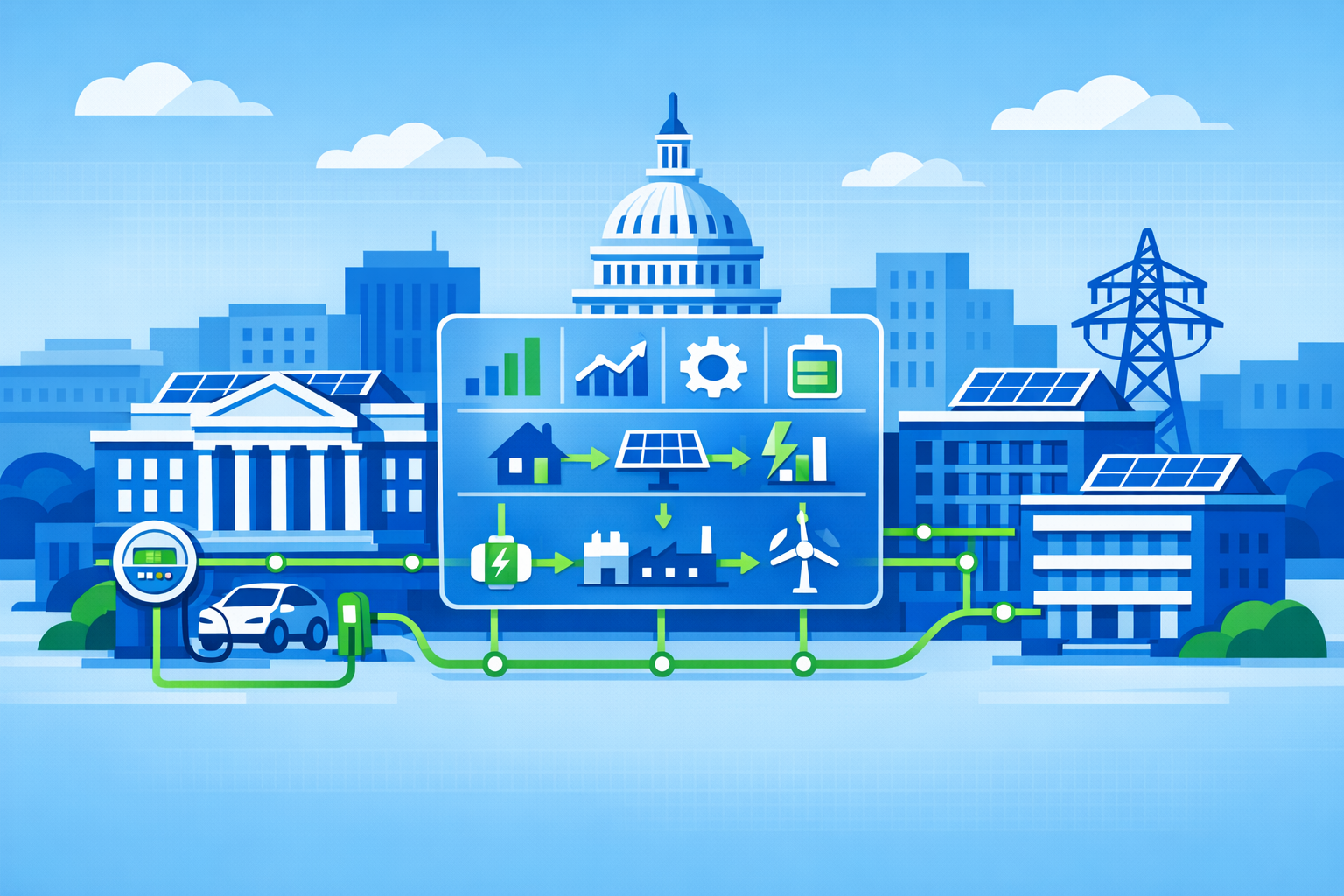
The U.S. General Services Administration (GSA) is scaling an interoperable energy management and distributed energy resource (DER) coordination program across a significant portion of its federally owned building stock, deploying real-time Energy Management Information Systems (EMIS) and grid-interactive controls as part of a multi-billion-dollar federal modernization effort. The expansion, backed by Inflation Reduction Act (IRA) appropriations, targets buildings identified by the U.S. Government Accountability Office (GAO) as a major source of federal greenhouse gas emissions and energy consumption.
Background
GSA maintains more than 1,500 federally owned buildings, which the Council on Environmental Quality has identified as a major source of the federal government's greenhouse gas emissions and energy and water use, according to a GAO report published in April 2025. Federal mandates including the Energy Independence and Security Act of 2007 and Executive Order 14057 require agencies to progressively reduce energy use intensity and transition to carbon-free power. Against this backdrop, GSA has deployed grid-interactive efficient building (GEB) strategies - a concept developed by the U.S. Department of Energy's (DOE) Building Technologies Office that combines energy efficiency with active demand management and grid integration. GEBs add strategies and technologies to manage peak demand and coordinate buildings' electrical loads, taking into account peak usage hours, generation mix, storage options, and resiliency needs, according to GSA's technical guidance.
The agency's Green Proving Ground (GPG) program has served as the evaluation backbone for these technologies. Since 2011, the GPG program has evaluated 107 technologies, 23 of which have been deployed across more than a third of GSA's federally owned portfolio, according to a July 2024 GSA announcement. Each year, already-deployed GPG technologies avoid 116,000 metric tons of CO₂ and save $28 million, GSA stated.
Details
The current expansion is anchored by an $80 million IRA investment in smart building technologies targeting an estimated 560 federal buildings across 49 states, the Commonwealth of Puerto Rico, U.S. Virgin Islands, and Washington, D.C., as GSA announced in June 2024. That initiative is part of a broader $975 million IRA allocation specifically for emerging and sustainable technologies within a total $3.4 billion IRA package designated for GSA facilities modernization.
A central component of the program is EMIS deployment with automated system optimization. According to GSA's Green Proving Ground findings, an EMIS can provide real-time situational awareness by combining siloed building systems data with external information sources such as weather data into a single integrated platform. The technology has demonstrated measurable results: using machine learning to optimize air handling units informed by weather and occupancy saved between 5% and 11% of whole-building energy, per GSA research findings.
Interoperability for DER coordination relies on advanced controls that enable buildings to function as dispatchable grid assets. Advanced controls and communications enable buildings to adjust power consumption to meet grid needs through control strategies applied to existing equipment - such as lighting and HVAC - along with onsite assets including solar photovoltaics and bi-directional electric vehicle (EV) charging equipment, according to GSA's building energy security guidance. The DOE's Federal Smart Buildings Accelerator (FSBA), which concluded in September 2024 after supporting federal agencies across multiple sites, identified a persistent gap: while interest in GEB technology is high, there is a lack of knowledge about getting started, indicating a need for more education around the implementation of GEB technology, DOE's Federal Energy Management Program (FEMP) reported.
Progress on IRA-backed projects is under scrutiny. As of January 31, 2025, GSA had selected 362 projects across the U.S. to receive IRA funding, obligating 49 percent of available funds but expending only 5 percent, according to a GAO report published in April 2025. The GAO also noted that as of February 2025, GSA officials stated that the IRA program is under review and priorities and goals could change. Approved project categories include low-emissions concrete, electric heat pumps, and building-level energy meters.
On the energy savings performance contracting side, GSA has validated the financial case for deep retrofits. A contract with Constellation NewEnergy covering five Washington-area federal buildings is expected to save $2.2 million in annual utility costs and cut carbon emissions by 5,734 metric tons per year, according to GSA's November 2024 announcement.
Outlook
GSA expects results from its FY2024 technology evaluations - including assessments of advanced energy management and grid-interactive systems - to be available in 2026, the agency stated, with findings intended to inform investment decisions in next-generation building technologies. The GPG's Applied Innovation Learning Labs are testing replicable technology combinations aimed at delivering net-zero operational emissions at the campus scale. For system integrators and MEP consultants, the federal program is establishing real-world benchmarks - including EMIS interoperability requirements, open API standards, and grid-signal responsiveness - that increasingly inform commercial procurement specifications and energy savings performance contract (ESPC) structures across the wider market.