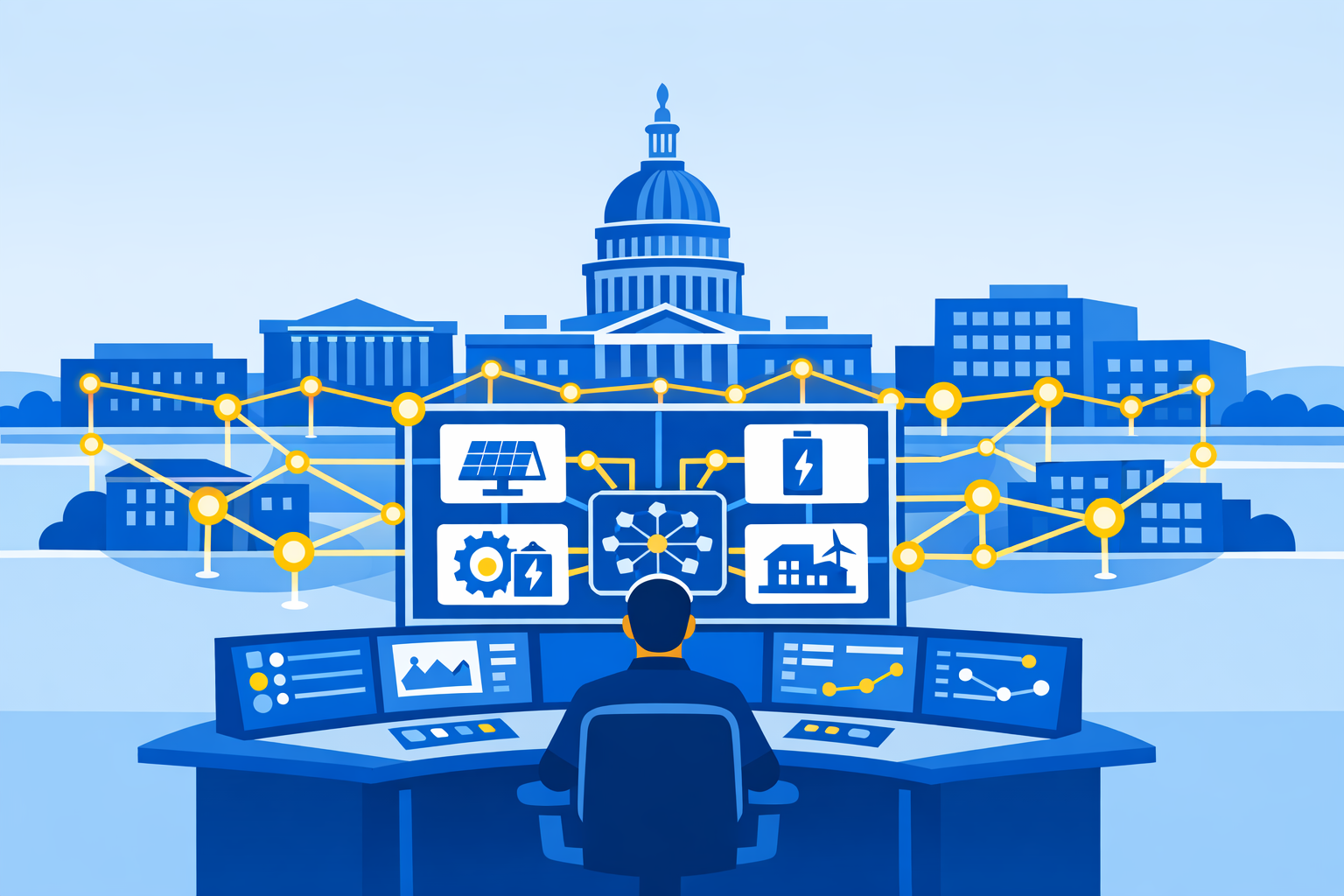
A case study from the U.S. General Services Administration's (GSA) grid-interactive efficient building (GEB) retrofit at the Oklahoma City Federal Building is now informing agency-wide procurement guidance, open-protocol building automation requirements, and operational technology (OT) cybersecurity frameworks - signaling a shift in how the federal government specifies and secures smart building infrastructure at scale.
Background
The case study documents a GEB renovation project at the GSA's Oklahoma City (OKC) Federal Building, demonstrating that GEB-ready strategies and technologies can be deployed across buildings with minimal investment. The deep energy retrofit was executed through a Utility Energy Service Contract (UESC) with Oklahoma Gas & Electric (OG&E) and its selected energy service company, Ameresco, covering the Oklahoma City Federal Building and four other Oklahoma federal facilities. The project received support through a Department of Energy grant and GSA appropriations totaling approximately $11 million.
The pilot fits within a broader federal push for smarter, more resilient infrastructure. The P100 Facilities Standards for the Public Buildings Service - which establish mandatory design, construction, and performance criteria for 300,000 federal buildings nationwide - were updated in 2024 to embed GEB and electrification requirements across the entire portfolio. The Federal Smart Buildings Accelerator (FSBA), introduced at Energy Exchange 2022 and concluded in September 2024, promoted smart buildings and GEB technologies across federal agencies, laying groundwork for future energy efficiency advances.
Details
The Oklahoma City project delivered measurable performance outcomes. It is projected to reduce energy use by 41%, cut 3,100 metric tons of carbon emissions, and save approximately $400,000 annually in energy and water costs. Energy savings stem from GEB technologies, a solar photovoltaic (PV) system, lighting controls, battery energy storage, and new HVAC controls. GSA is projected to save $13.5 million over the course of the contract through utility savings across five Oklahoma buildings.
On the automation and interoperability front, GSA's technical guidance mandates open-protocol architectures. The agency requires building automation controls to be native BACnet, enabling remote monitoring and control across integrated sites. The OKC project revealed that existing and new equipment use a variety of control systems, creating coordination and integration challenges - a lesson now reflected in federal specifications requiring convergence onto standardized protocols from the outset.
OT cybersecurity has emerged as a parallel priority. As IT and OT systems increasingly converge, addressing OT cybersecurity and assessing how the intersection of these systems affects a facility's overall security posture has become critical. The DOE's Federal Energy Management Program (FEMP) funded the Pacific Northwest National Laboratory (PNNL) to develop cybersecurity tools and training aligned with the NIST Cybersecurity Framework and Risk Management Framework for federal facility managers. NIST CSF 2.0, released in 2024, broadens its scope from IT systems to cyber-physical and operational technology, explicitly naming building and industrial systems. GSA's Zero Trust Strategy aligns with Executive Order 14028, OMB M-22-09, the NIST SP 800-207 Zero Trust Architecture principles, and CISA's Zero Trust Maturity Model, Version 2.0.
Lifecycle cost analysis is now embedded in procurement decisions. The 2024 P100 update requires lifecycle cost analyses and assessments of operational greenhouse gas emissions when evaluating alternatives for electrifying HVAC and domestic water heating systems, with each alternative's scope 1 and scope 2 emissions assessed. According to GSA, performing cost-benefit analysis alongside technology review helped screen out uneconomic options, including analysis of equipment lifecycle performance over time.
Outlook
The OKC GEB project findings are intended to pave the way for additional GEB-ready retrofits. Through education, technical assistance, and facility assessments, the FSBA helped agencies identify both opportunities and challenges in adopting GEB technologies - highlighting the ongoing need for continued funding, training, and technical support to ensure federal buildings can fully transition to energy-efficient, grid-interactive operations. For vendors supplying building automation, energy management systems, and physical security infrastructure to federal clients, the OKC pilot's documentation of integration challenges - combined with updated P100 mandates and NIST OT security guidance - is shaping both specification requirements and procurement-stage due diligence.