A Northeastern University engineering professor will bring a federally funded building operations training curriculum to Buenos Aires this September, expanding a U.S. workforce development model to an international audience for the first time.
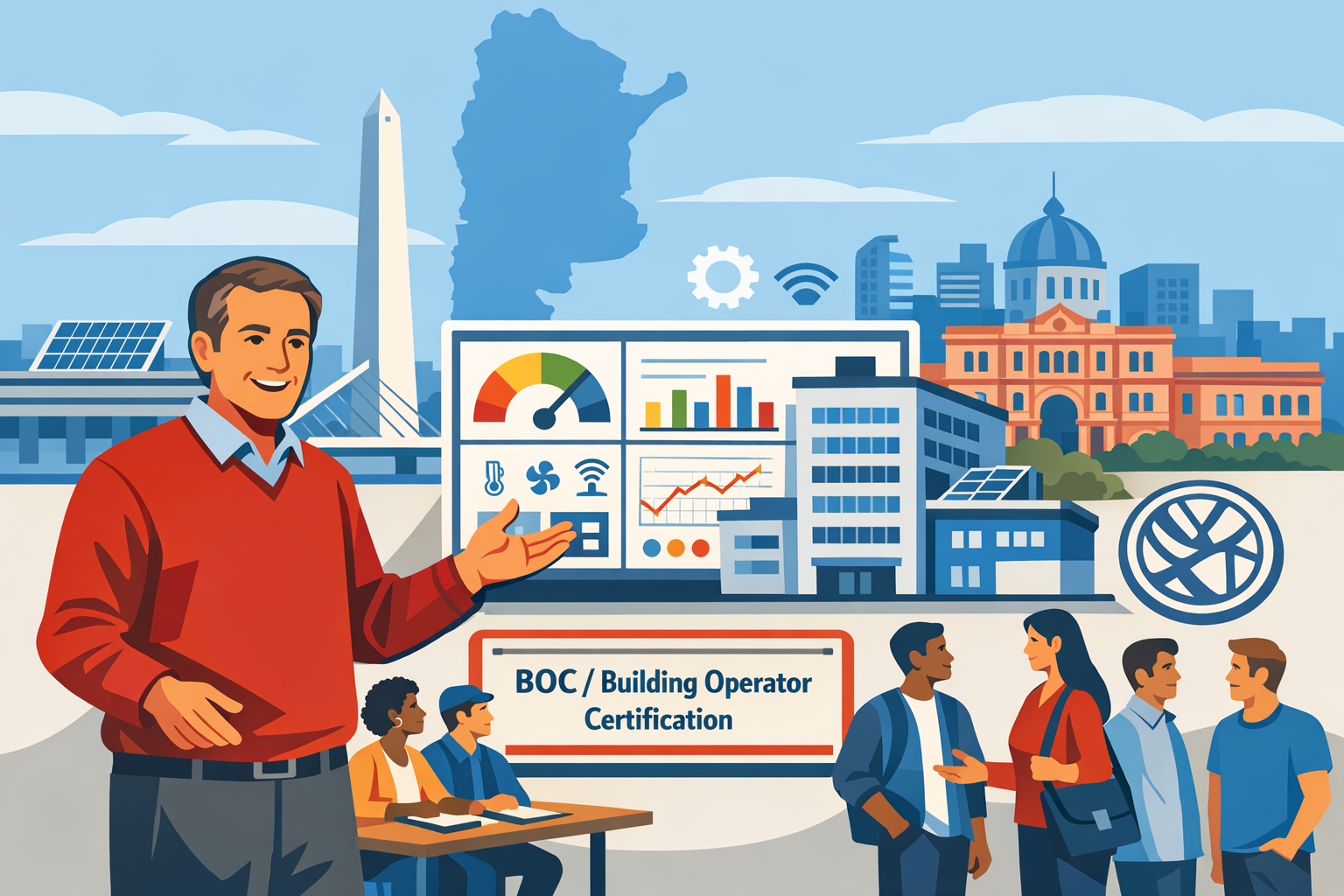
Fulbright Scholar and Northeastern professor Michael Kane will travel to Buenos Aires to translate his building operations program into Spanish at the Instituto Tecnológico de Buenos Aires (ITBA). The program is a 14-hour building operators training certification pilot that Kane, a professor of civil and environmental engineering, developed with collaborators using funding from the U.S. Department of Energy. During his residency, Kane will also work with the institute to host a major International Energy Agency (IEA) conference focused on human-centric building management and energy consumption.
Background
The training initiative addresses a persistent skills gap in building operations. The HVAC industry alone faces over 42,500 average annual job openings, according to industry data, with the shortage driven primarily by an aging workforce and fewer young entrants into the field. Employers increasingly seek technicians with specializations in energy auditing, building automation, and indoor air quality - competencies that existing vocational pipelines have struggled to supply at scale.
The project is led by Northeastern University in Boston, with partners including the Northwest Energy Efficiency Council in Seattle and Washington State University. It received $750,000 in DOE total funding under the Buildings Energy Efficiency Frontiers and Innovation Technologies (BENEFIT) funding opportunity. The Northwest Energy Efficiency Council administers the Building Operator Certification (BOC) program, a national training and credential program that educates building operators and maintenance staff on energy-efficient and smart building practices. The BOGO curriculum supplements the BOC Fundamentals program.
Details
For the past few years, Kane and his team have taken students at Madison Park Technical Vocational High School in Boston on virtual reality building walkthroughs designed to foster the mindset of a building operations manager - prompting them to consider what in a building affects power and energy use. A core component of the training is a "gamified" whole-building control simulator that models building physics, grid interactions, and occupants, allowing trainees to test how their decisions affect building energy dynamics.
The training was slated for continuous improvement through a three-year, 100-student trial before rolling out nationwide as a professional credential. The Fulbright award now extends its reach internationally. Kane also intends to bring a translated version of the program back to Boston for underserved English language learners in the United States. He noted that 28% of Madison Park students are English language learners and 53% identify as Hispanic/Latino.
At ITBA, Kane will work alongside Romina Rissetto, an engineering professor and researcher, who said what sets Kane's curriculum apart is its focus on teaching students the deep intersections between modern building design and occupant behavior. "We don't have many operational systems developed for our educational systems in our buildings," Rissetto said, adding that the institute expects to learn how to implement the protocol on its own campus. ITBA is currently constructing a new academic building, and Kane's protocol is expected to be applied once it is operational. The institute also hopes to integrate the program into its broader engineering curriculum - a civil engineering program only three years old.
Kane's research emphasizes that the next generation of building operators must understand not only complex systems but also how to communicate with occupants - a behavioral dimension frequently absent from traditional technician training.
Outlook
The program equips entry-level building operators with the skills to implement sustainable energy technologies and is intended to accelerate the rollout of grid-interactive efficient building measures, reducing stress on the electric grid and lowering building carbon emissions. With DOE's stated goal of tripling energy efficiency and demand flexibility in the buildings sector by 2030 relative to 2020 levels, programs that train operators on grid-interactive systems align directly with federal strategic priorities. The Argentina deployment may provide a replicable model for expanding standardized building operations curricula across regions where energy infrastructure is growing and qualified operators remain scarce.