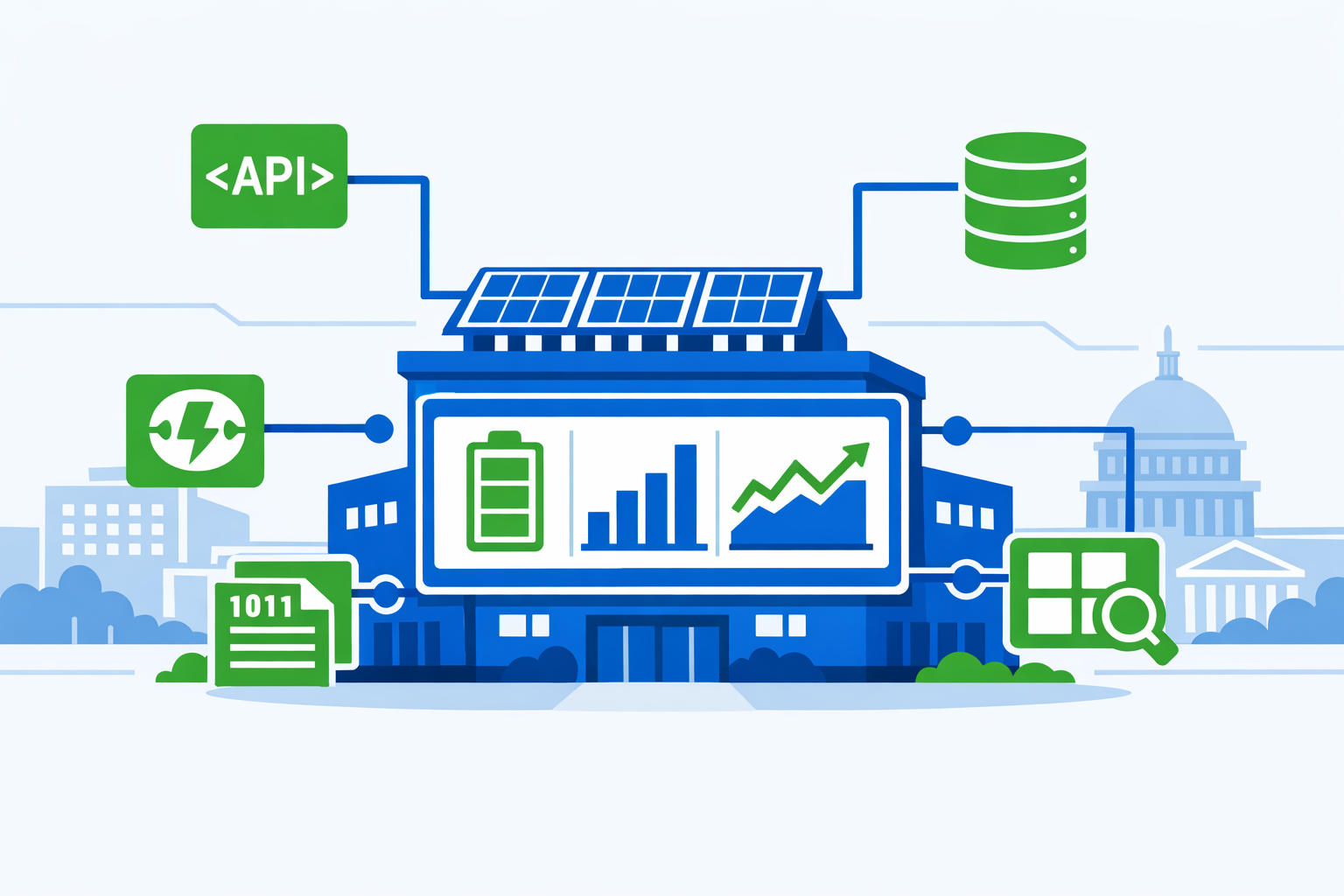
Federal agencies face mounting pressure to unify distributed energy resource (DER) management across multi-building campuses as government-wide open data requirements and interoperable energy system interfaces converge, reshaping how energy procurement, fault isolation, and demand response operate at the portfolio scale.
Background
The policy foundation driving this shift is OMB Memorandum M-25-05, issued on January 15, 2025, which provides Phase 2 implementation guidance for the OPEN Government Data Act. The memorandum requires agencies to inventory, format, and publish data assets in open, machine-readable formats by default, with annual open data plan updates and designated agency points of contact. For energy systems, this means metering outputs, DER performance records, and building automation data increasingly fall within structured data governance requirements.
The Federal Energy Regulatory Commission (FERC) has aligned its own data strategy with M-25-05, committing to at least annual updates to its Open Data Plan and incorporating open data standards directly into its information collections process. FERC utilizes Data Catalog Vocabulary (DCAT) 3.0 standards for metadata identification to facilitate interoperability across published data catalogs. The Department of Energy's (DOE) 2025 Open Data Plan similarly confirms compliance with M-25-05 requirements, reflecting a coordinated government-wide posture.
The DOE Federal Energy Management Program (FEMP) operates at the intersection of these mandates and facility operations. Its Energy Management Information Systems (EMIS) initiative helps federal agencies comply with the Energy Policy Act of 2005, the Energy Independence and Security Act of 2007, and the Federal Information Security Modernization Act (FISMA) of 2014. According to FEMP, an EMIS is comprised of devices, data services, and software applications that monitor, analyze, and control metered building energy use and system performance, and its elements work together to aggregate facility data and help federal energy managers optimize energy use at the building, campus, or agency level.
Details
At the platform level, the DOE Standard Energy Efficiency Data (SEED) Platform provides the interoperability layer for portfolio-scale building energy data. SEED is an open-source, secure enterprise data platform for managing portfolio-scale building performance data from a variety of sources, and can import information from ENERGY STAR Portfolio Manager accounts, datasets from other SEED instances, and private tools utilizing the Building Energy Data Exchange Specification (BEDES). This shared data model enables facility managers to correlate asset-level DER output-from rooftop photovoltaic (PV) systems and battery storage to flexible HVAC and electric vehicle (EV) charging-against procurement and grid-signal data.
Pilot evidence supports the value of tighter DER integration. A multi-site demonstration program reviewed by the DOE found that commercial and campus settings prioritize EMIS integration and load optimization when deploying packages of DER technologies, and that ten pilot projects demonstrated how groups of buildings combined with behind-the-meter DERs such as EV charging, battery storage, flexible HVAC and domestic hot water systems, and PV systems can reliably and cost-effectively provide grid services. On the demand response side, in fiscal year 2023, the Defense Logistics Agency facilitated the participation of 32 federal installations across seven states and the District of Columbia in demand response programs, representing approximately 139 MW of enrolled resources and resulting in approximately $4.6 million in savings.
Vendors supplying EMIS and DER coordination platforms to federal buyers face increasingly specific procurement requirements. Agencies are specifying open APIs, standards-based data interfaces, and pre-certified integration modules to ensure connectivity with existing building automation systems (BAS) and advanced metering infrastructure (AMI). Cybersecurity requirements are tightening in parallel. FEMP guidance directs facilities to maintain a regularly updated inventory of devices that includes operational technology (OT) systems such as meters, gateways, and remote terminal units, and to reference the NIST Risk Management Framework and zero-trust architecture controls throughout system procurement and operation.
Outlook
FEMP has projected that federal energy programs are on track to realize $60 billion in taxpayer savings by 2030, with EMIS deployments expected to advance from monitoring toward real-time analytics, predictive maintenance, and automated demand response. Agencies integrating open data pipelines with DER controls face a near-term compliance deadline: agencies must publish updated open data plans annually under M-25-05, creating a recurring procurement and governance review cycle that directly affects energy data system specifications. For vendors, API governance, data quality assurance, and alignment with FISMA and DCAT 3.0 metadata standards are emerging as baseline requirements in federal energy solicitations.