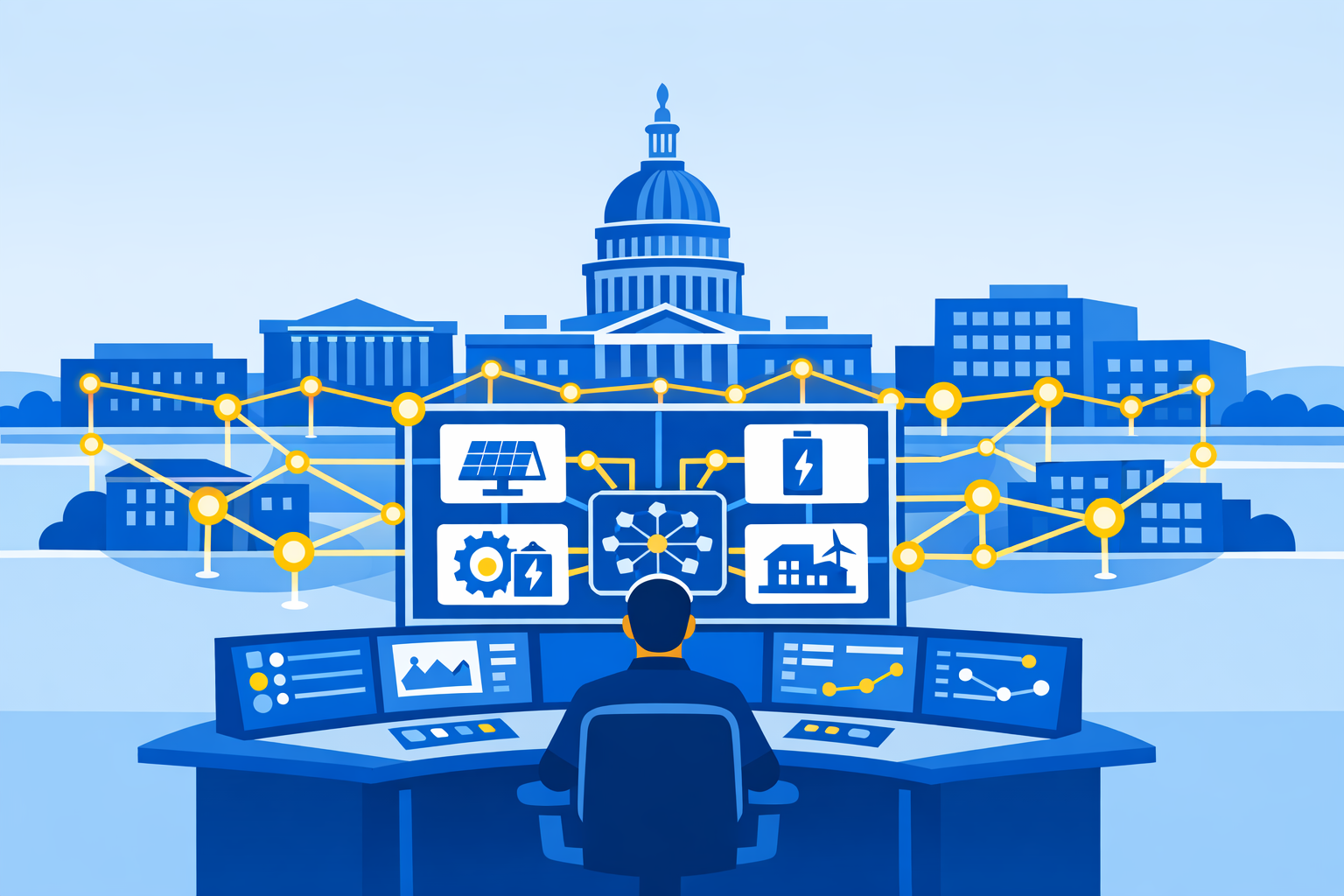
More than a third of Fortune 500 companies now manage their utility data through one of two platforms that, as of this week, are merging into a single entity. On 1 May 2026, Arcadia announced a definitive agreement to acquire ENGIE Impact - the utility expense management, energy procurement, and sustainability advisory arm of French energy giant ENGIE - in a deal that materially reshapes the enterprise energy management landscape.
For electrical engineers, facility managers, and building automation specialists overseeing complex commercial portfolios, the implications extend well beyond a change of vendor letterhead.
The Deal at a Glance
Arcadia, the energy intelligence platform for businesses, announced the acquisition of ENGIE Impact, describing the transaction as a combination of ENGIE Impact's global operational scale and 30-year track record with Arcadia's AI-powered utility data platform - creating a unified solution for managing the full lifecycle of utility data.
The combined platform will serve over 1,500 enterprise customers - including approximately 25% of the Fortune 500 - and manage more than 4.5 million meters globally, processing over $30 billion in annual utility payments.
Together, the platform covers nearly $100 billion in utility spend and 580 million MWh of annual electricity usage, equivalent to roughly 20% of total US commercial and industrial electricity spend.
Financial terms were not disclosed. J.P. Morgan Securities served as exclusive financial adviser to Arcadia.
The combined entity will operate under the Arcadia brand, with the ENGIE Impact name retired over time.
What the Integrated Platform Actually Does
The two companies have historically covered complementary but distinct layers of enterprise energy management.
Arcadia provides data and AI infrastructure for enterprise energy management, spanning 10,000+ utility providers globally. Its AI-powered tools transform fragmented utility data into a unified, actionable dataset - automating workflows, closing data gaps, and identifying savings across entire portfolios.
ENGIE Impact brings 30 years as a benchmark for enterprise utility bill management, energy procurement, and sustainability advising, with proven operational infrastructure that processes billions of dollars in energy payments annually.
The combined offering integrates utility data management, energy procurement, sustainability advisory, and bill payment workflows into a unified system designed to support enterprises managing complex, multi-site energy operations across global markets.
In practical terms for building portfolio operators, a single contractual and technical relationship could theoretically cover metered interval data, utility invoice reconciliation, energy procurement strategy, carbon accounting, and sustainability reporting - functions that most organisations currently manage across multiple vendors and platforms.
Interoperability: Opportunity and Pressure Points
The acquisition reflects a broader trend in the energy management and sustainability software sector, where platforms are increasingly consolidating data, procurement, and compliance functions into unified systems. As enterprises face mounting pressure to manage both energy costs and carbon reporting requirements, demand has grown for platforms capable of handling financial and environmental performance tracking simultaneously.
For building automation specialists, the consolidation introduces a familiar tension: a larger, more capable platform can simplify integration overhead on paper, but the real-world picture during a merger integration period is rarely so clean.
Integrating systems from different vendors is often costly and complex. Each system uses different formats, protocols, and standards, creating significant barriers to interoperability. Energy companies must invest in custom integration tools or third-party services, which can be expensive to maintain.
Operators with existing BACnet, Modbus, or MQTT-based building management system (BMS) integrations pointing to either Arcadia or ENGIE Impact services should audit their API dependency maps before contract renewal. The interim period - during which both platforms continue running independently - is the optimal window for this exercise.
Open APIs, semantic data models, and certified integrations with building, industrial, and grid protocols are increasingly the baseline expectation for interoperability in enterprise energy management. Procurement teams should verify explicitly that these commitments survive the integration roadmap.
Data Ownership: The Questions Building Operators Must Ask
The scale of the combined Arcadia platform creates an outsized concentration of utility and operational data. At nearly 580 million MWh of managed electricity usage, the platform oversees the equivalent of roughly 20% of total US commercial and industrial electricity spend. That concentration amplifies the importance of clear data ownership and sovereignty provisions in customer contracts.
Establishing data ownership, residency, and retention policies that enable AI use while meeting national requirements has become a core governance imperative - particularly as platforms increasingly train AI models on aggregated utility and building performance datasets.
Key questions building operators and procurement officers should raise with their account teams now:
- Who owns the metered and operational data? Ensure contract language explicitly assigns data ownership to the building operator, not the platform provider.
- What are the data portability terms? Can data be exported in standard formats if the contract is terminated or the platform is restructured further?
- Where is data stored and processed? Public-sector buyers in particular face statutory data residency obligations that a US-headquartered platform consolidation may complicate.
- How will AI training use your data? Clarify whether anonymised building performance data feeds platform-wide AI model training, and whether opt-out provisions exist.
Cybersecurity and data governance templates - including control baselines for OT/IT segmentation, patch cadences, and data residency guardrails for cross-border operations - are increasingly essential governance artifacts for organisations operating within regulated or multi-jurisdictional environments.
TCO and Vendor Ecosystem Recalibration
For operators running mixed-portfolio environments - combining legacy BMS infrastructure with newer cloud-connected energy platforms - the acquisition creates both cost and strategic planning implications.
The energy management software market was valued at USD 56.20 billion in 2025 and is projected to reach USD 60.94 billion in 2026, with a CAGR of 9.36%. Consolidation is compressing the field of credible independent platform providers, narrowing the negotiating leverage that comes with competitive alternatives.
On the cost side, a unified platform can reduce per-site licensing fees, eliminate redundant middleware, and simplify contract management overhead. Demonstrable 6-18 month paybacks through tariff optimisation, peak avoidance, and asset lifetime extension - validated at multi-site scale - are increasingly the benchmark operators should hold consolidated platforms to.
However, the integration period itself introduces near-term TCO risk. Data migration, staff retraining on merged interfaces, and potential API deprecations all represent real costs that belong in any 3-5 year financial model. Operators currently mid-implementation with either platform should request a formal integration timeline and feature-parity commitment in writing.
Flexible contractual arrangements, modular and interoperable architectures, and investment in cross-functional capabilities bridging IT, operations, and sustainability teams will define resilient procurement strategies in this environment.
Regulatory and Public-Sector Signals
The timing of this consolidation is notable. The publication of ISO 14001:2026 in April intensifies expectations on energy and resource efficiency embedded throughout environmental management systems. New rules require high-consumption organisations in parts of Europe to implement and certify ISO 50001 by late 2027, pushing enterprises to standardise metering, controls, and audit-ready data.
For public-sector buyers - local authorities, healthcare trusts, universities - pursuing centralised energy dashboards across large property portfolios, a platform combining utility bill management, procurement, and sustainability reporting under one roof has clear administrative appeal. The caveat: public procurement frameworks may require reassessment of supplier categorisation and data-handling obligations following a change of control at this scale.
Policy momentum behind the digitalisation of energy is accelerating interoperability and data-sharing frameworks, encouraging utilities and enterprises to connect assets into grid-responsive ecosystems. Platforms that demonstrate compliance with emerging open-data and interoperability standards will hold a distinct advantage in public-sector tender evaluations.
For context on how centralised EMS deployments have performed in practice across public building portfolios, see earlier coverage of the City EMS pilot that delivered up to 20% energy savings across 50 municipal buildings, and how smart building adoption is navigating integration and procurement headwinds.
Key Takeaways for Building and Facilities Professionals
- Audit API dependencies now. If your BMS or energy monitoring stack integrates with either Arcadia or ENGIE Impact services, map those dependencies and request integration roadmap documentation before your next renewal window.
- Review data ownership clauses. Platform consolidations frequently involve changes to sub-processors and data handling terms. Treat this as a trigger event for contract review.
- Model TCO over 3-5 years, not 12 months. Migration and retraining costs during the integration period are real; factor them against projected savings from platform unification.
- Engage early on public-sector compliance. If managing government-owned or publicly funded assets, raise data residency and sovereignty requirements directly with your account team and legal counsel.
- Use the competitive window. Until integration is complete, alternative platforms remain credible negotiating leverage. Use this period to benchmark pricing, portability terms, and interoperability commitments.
Frequently Asked Questions
Will ENGIE Impact customers see immediate service disruption? During the integration period, customers of both companies will continue to receive uninterrupted service. No immediate changes to products, pricing, or contracts are expected.
Does this deal signal further consolidation in the EMS sector? The market is expected to consolidate further, with larger players acquiring smaller companies to expand product offerings and geographical reach. The Arcadia-ENGIE Impact combination accelerates that trajectory.
What should operators do if they are mid-contract with either company? Request a formal written statement from your account manager confirming: (1) continuity of named contacts, (2) no changes to SLAs, and (3) a timeline for any planned platform migrations or API changes. Document this for procurement records.