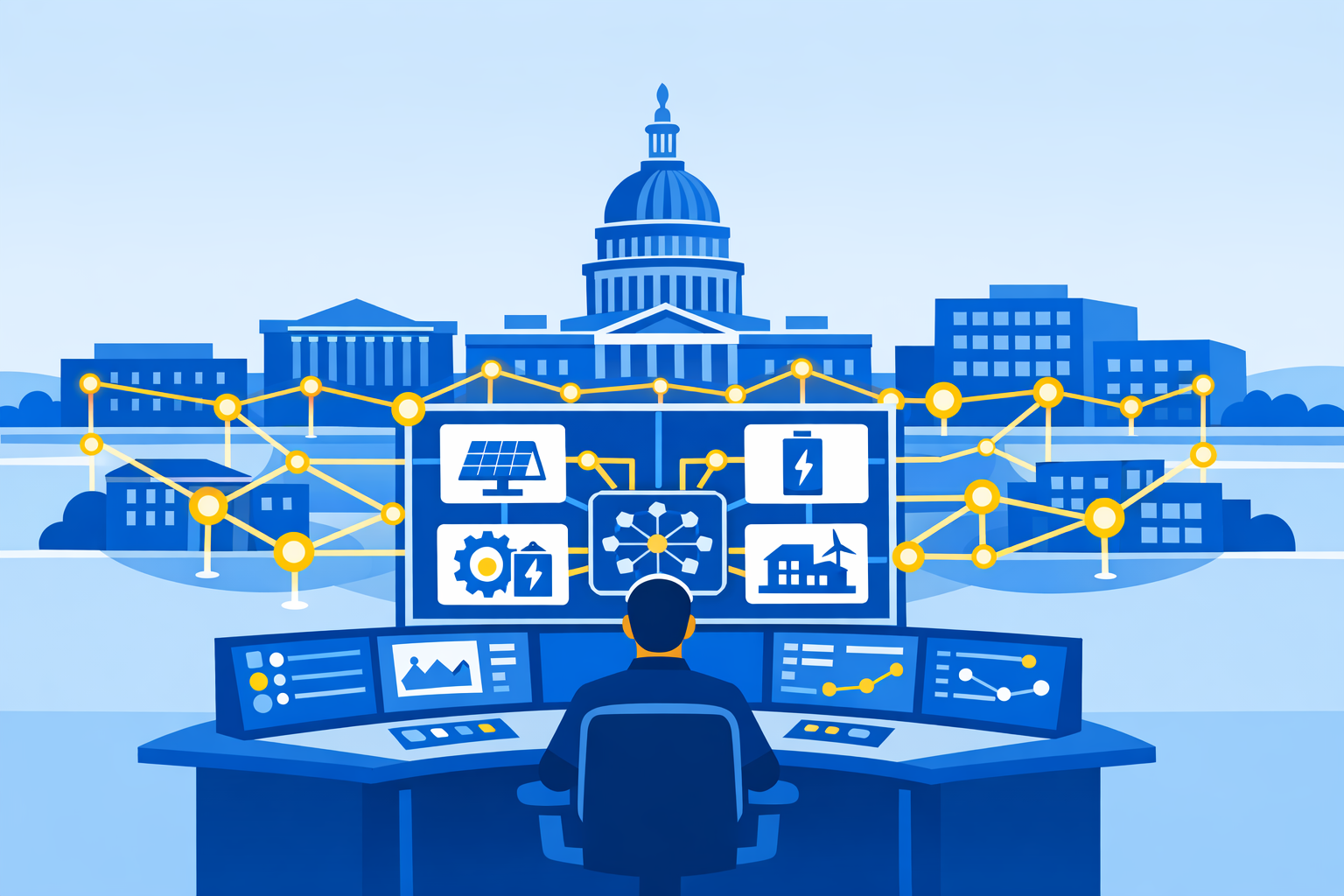
The global building automation and control systems (BACS) market is expanding rapidly as commercial real estate operators, healthcare facilities, and industrial campuses adopt digital twin technology, tighten cybersecurity frameworks, and demand open-standard interoperability. The global digital twin for smart building market was valued at $2.9 billion in 2025 and is projected to reach $65.2 billion by 2034, growing at a compound annual growth rate of 44.2%, according to Straits Research. Separately, smart building automation software and systems are expected to reach $19.3 billion in North America by 2026, according to Research and Markets.
Market Context and Drivers
Digital twins are moving from experimentation into everyday building operations, with 2026 shaping up as a pivotal year for the sector.[1] Industry observers expect the strongest operational adoption in sectors where buildings are mission-critical or operationally complex - including healthcare, higher education, social housing, and large commercial real estate portfolios - environments facing aging estates, constrained budgets, regulatory pressure, and high occupant expectations.[2]
Greg Turner, Chief Solutions Officer of Building Automation at Honeywell, has noted that many digital twins today remain detailed visual representations and that operators seeking performance insight need what he calls a "functional twin."[3] A functional twin replicates performance and dependencies within a building system, simulating the effects of heat waves, peak occupancy, or equipment malfunctions and projecting how changes would affect overall performance.
Honeywell, Schneider Electric, and Siemens collectively hold over 35% revenue share of the digital twin for smart building market, according to Intel Market Research. Specialized digital twin applications for building retrofits represent a $12 billion market opportunity, enabling older structures to achieve modern integrated building management system functionality without complete system replacements.
Open Standards and Cybersecurity Pressures
Open standards remain central to adoption momentum. BACnet, the global data communications standard for building automation and control networks, provides vendor-independent interoperability for networked equipment and control devices. The BACCARI Certificate Authority software tool beta 3 was released in 2025, with the operating code set for public release at no charge in Q1 2026 to promote interoperable certificate signing and exchange, according to BACnet International.
BACnet Secure Connect (BACnet/SC), a newer protocol addition, uses TLS 1.3 encryption, eliminates broadcasts, works across VLANs and WANs, and requires certificate-based authentication for every device - making BACnet ready for the modern IT landscape. Cimetrics is working with the U.S. Army Corps of Engineers to validate multi-vendor BACnet/SC interoperability for federal projects.
Cybersecurity is becoming an operational imperative. According to Claroty, 75% of organizations have building management system devices with known exploited vulnerabilities. A 2024 CISA report warned that building automation systems are now as targeted as traditional IT networks, according to Facility Executive.
Regulatory pressure is intensifying in Europe. The EU Cyber Resilience Act entered into force on December 10, 2024, with vulnerability and incident reporting obligations taking effect September 11, 2026, and full compliance required by December 11, 2027, according to the European Commission. The CRA sets mandatory cybersecurity requirements for all products with digital elements sold in Europe, covering hardware and software throughout their entire lifecycle. Manufacturers must build security in by default, maintain a software bill of materials, actively manage vulnerabilities, and report incidents within strict timelines.
Outlook
Building operators and procurement teams face a convergence of technology shifts and compliance deadlines. Cybersecurity is becoming a competitive differentiator in commercial real estate, as tenants and investors increasingly evaluate a building's digital resilience before signing leases or financing projects. With BACnet/SC adoption progressing, EU CRA reporting obligations approaching in September 2026, and digital twins maturing from visualization tools into operational platforms, vendor selection and system architecture decisions made in the near term will carry long-term implications for interoperability, security posture, and portfolio-level operating costs.