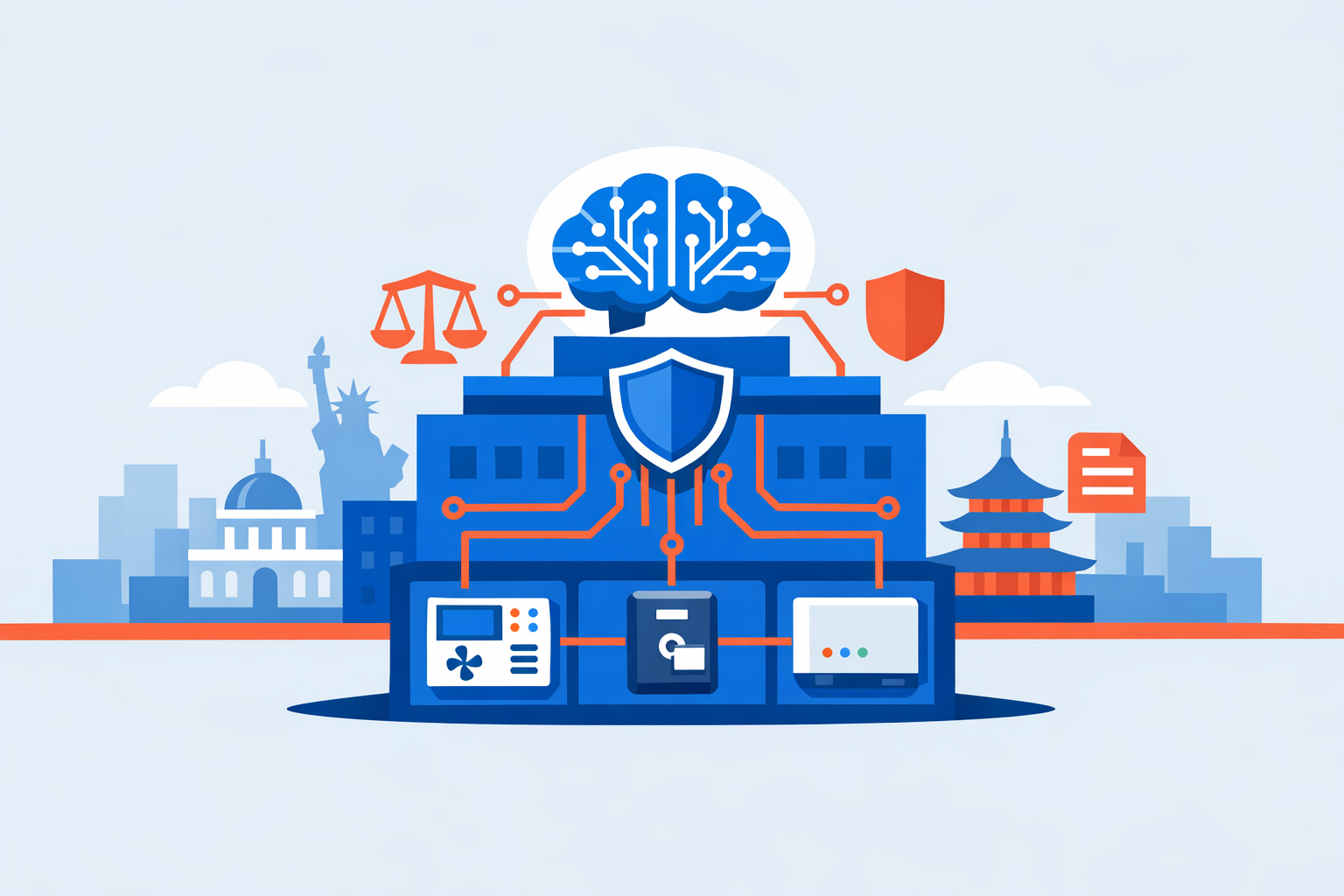
A convergence of new AI governance rules across North America, Europe, and Asia is forcing smart building operators to confront a compliance challenge they were not designed for: managing the cybersecurity of AI-embedded operational technology (OT) systems under multiple, diverging regulatory frameworks simultaneously.
The pressure is not speculative. On December 3, 2025, CISA, the NSA, the FBI, and several international cyber authorities released Principles for the Secure Integration of Artificial Intelligence in Operational Technology - a joint framework aimed at helping critical infrastructure operators deploy AI safely and responsibly. This joint effort includes the Canadian Centre for Cyber Security, the German Federal Office for Information Security (BSI), and the National Cyber Security Centres of the Netherlands, New Zealand, and the UK - making it one of the first major documents to treat AI-in-OT as a distinct risk domain. For building owners and facility managers, that designation carries direct operational implications.
A Fragmented but Convergent Regulatory Map
The EU is advancing detailed, lifecycle-based obligations under the AI Act, while countries in the Asia-Pacific are prioritizing governance frameworks, security guidance, and national capability-building. In the US, momentum is building through sectoral enforcement and state-level AI laws rather than a single comprehensive statute.
That divergence is the central challenge for operators managing cross-border building portfolios. The compliance map is not unified - but common themes are crystallizing across jurisdictions.
South Korea's National Assembly adopted the Act on Promotion of Industrial Digital Transformation and Utilization of Artificial Intelligence, establishing a framework for AI use in industry and broader digital transformation. The Act sets out governance for AI authorities, organizational requirements, data governance standards, cybersecurity regulations, and interoperability obligations to ensure secure, responsible, and coordinated deployment of AI technologies across industrial sectors.[1] South Korea's Enforcement Decree came into force in January 2026, with a one-year grace period before fines apply.
In Europe, the EU AI Act is progressing through phased implementation from 2025 to 2027, introducing structured obligations around documentation, monitoring, traceability, and human oversight for high-risk systems. The EU Cyber Resilience Act (CRA) will apply to smart building components from December 2027.
Japan's Parliament approved the AI Promotion Act on May 28, 2025, following an innovation-first approach that is lighter-touch than the EU, more principle-based, and designed to encourage adoption while still shaping behavior.
The table below summarizes key frameworks across major jurisdictions relevant to building portfolio operators:
| Jurisdiction | Regulatory Instrument | AI-OT Scope | Status |
|---|---|---|---|
| United States | CISA/NSA AI-OT Principles; NIST Cyber AI Profile | Critical infrastructure OT; AI/ML in ICS | Guidance Dec 2025; NIST draft late 2025 |
| European Union | EU AI Act; Cyber Resilience Act | High-risk AI; smart building components | AI Act phased to 2027; CRA from Dec 2027 |
| South Korea | AI Basic Act; Industrial AI Act | Industrial AI; cybersecurity & interoperability | Enforcement decree Jan 2026 |
| Australia / UK / Canada / Germany | CISA/NSA joint guidance co-signatories | OT/ICS; industrial AI integration | Joint guidance Dec 2025 |
| Japan | AI Promotion Act | Principle-based; non-punitive framework | Approved May 2025 |
| China | PIPL; algorithmic rules; content labeling | Data sovereignty; traceability | AI content labeling effective Sep 2025 |
What "AI in OT" Actually Means for Building Systems
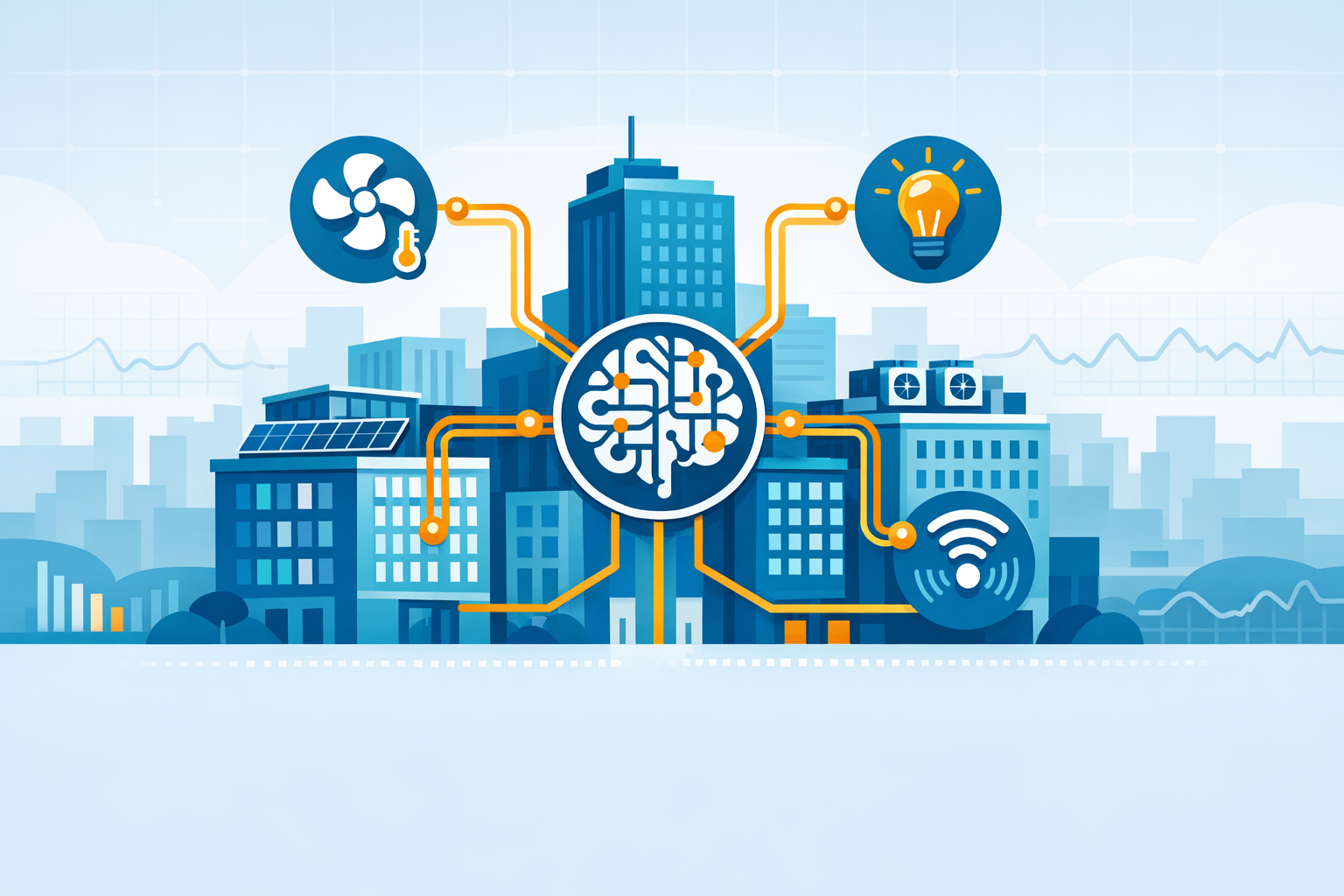
The regulatory movement addresses a specific and growing reality: AI features are no longer confined to analytics dashboards. They are embedded in building automation controllers, HVAC optimization engines, access control decision systems, and edge gateways that manage energy loads in real time. When those systems make autonomous decisions, they create a new category of cyber risk.
The new guidance signals a major shift: AI used in operational technology can no longer be treated as a generic IT deployment or governed solely through traditional enterprise AI risk frameworks.
The principles emphasize that AI in OT is fundamentally different from AI in business or IT environments and requires dedicated safeguards to prevent cascading failures, unsafe control logic, unmonitored autonomous decision-making, and the erosion of human operator awareness.
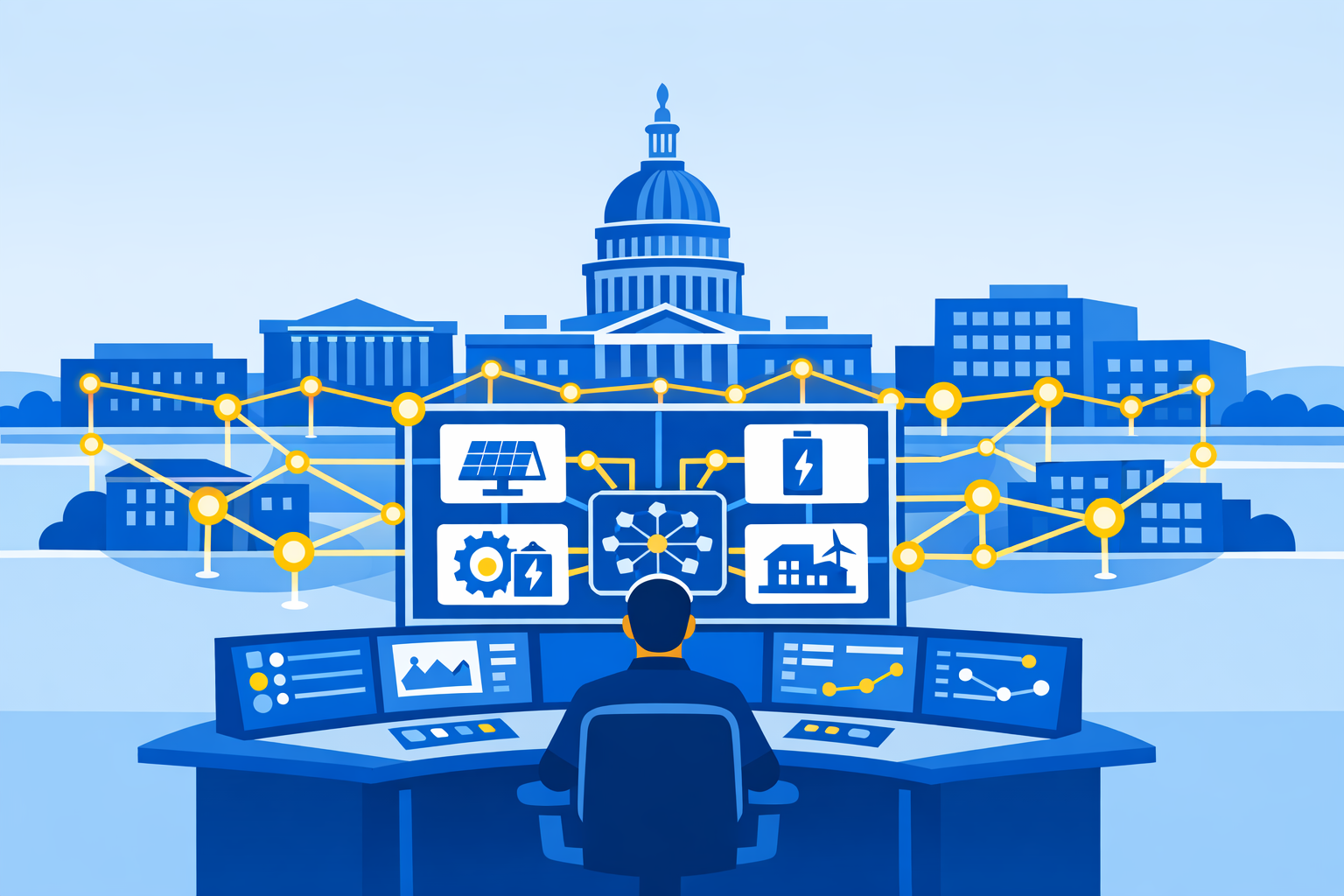
For a commercial high-rise or mixed-use campus, this translates into concrete exposure. An AI model managing demand-response across a multi-tenant building relies on external data streams, cloud-based inference, and periodic model updates - each of which introduces supply-chain risk and data provenance questions that regulators are now actively targeting.
The Four Pillars of Emerging Compliance
The CISA/NSA framework, reflecting input from nine national cybersecurity agencies, organizes operator obligations around four core principles already being mirrored in national legislation:
Understand AI: Educate personnel on AI risks, impacts, and secure development lifecycles. Assess AI Use in OT: Evaluate business cases, manage OT data security risks, and address immediate and long-term integration challenges. Establish AI Governance: Implement governance frameworks, test AI models continuously, and ensure regulatory compliance. The fourth principle - embed safety and security - requires maintaining oversight, ensuring transparency, and integrating AI into incident response plans.
What regulators are pressing for in practice:
- Mandatory risk classifications for AI features embedded in building automation systems (BAS)
- Software Bills of Materials (SBOMs) covering AI components and their data supply chains
- Expanded incident reporting that includes AI-driven decision-making events, not just traditional cybersecurity breaches
- Periodic re-certification tied to model updates and real-world performance metrics
- Open standards and interoperable interfaces to prevent vendor lock-in and facilitate cross-vendor security updates
Critical infrastructure owners and operators should demand clear transparency and strong security commitments from vendors regarding how AI is embedded in their products. This includes negotiating contracts that spell out AI features and functionality and requiring vendors to explain how AI is incorporated, supported by a software bill of materials and visibility into the supply chain for the models they use.
AI in OT Is a Distinct Risk Domain. The CISA/NSA joint guidance explicitly states that AI used in operational technology cannot be governed through traditional enterprise IT risk frameworks alone. Smart building operators should treat embedded AI - whether in HVAC controllers, access management systems, or energy optimization platforms - as a separate risk category requiring dedicated assurance, governance, and incident response processes.
This is directly relevant to building operators who procure AI-enabled subsystems from multiple vendors across jurisdictions. Operators may not want vendors training AI systems on operational data, since that data may involve intellectual property or other sensitive information. A data usage policy should govern residency, communication paths, encryption, and storage. Buyers should also ask whether the product can operate on-premises or without constant access to the vendor's cloud.
Supply Chain Transparency as a Regulatory Imperative
The security of AI-enabled building systems depends heavily on the integrity of external data and model pipelines - and regulators across jurisdictions are now targeting this explicitly.
Key supply chain risks include relying on untrusted third-party data or models that can compromise accuracy or introduce legal and regulatory exposure; maliciously modified ("poisoned") data, involving intentional manipulation of training data to cause unsafe AI behavior or help attackers bypass AI-driven safeguards; and data drift, the natural or sudden shift in input data properties over time, which silently degrades model accuracy and reliability.
The NIST Cybersecurity Framework Profile for Artificial Intelligence, released in preliminary draft form in late 2025, maps AI-specific risks to the core functions of NIST CSF 2.0, providing organizations a roadmap for managing AI risk across OT and IT environments. When finalized, the profile will help organizations incorporate AI into their cybersecurity planning by suggesting key actions to prioritize, highlighting special considerations from specific parts of the CSF, and providing mappings to other NIST resources, including the AI Risk Management Framework.
For building portfolios operating in multiple markets, data-focused regulations will become a foundational element of supply chain security, requiring organizations to rigorously manage and validate data inputs as they would any other critical software component.
Vendors, in turn, face pressure to disclose model training provenance, performance boundaries, and resilience against adversarial manipulation. The trend is unmistakable: regulators are treating AI less as a novelty and more as infrastructure demanding provenance, explainability, and human liability. This signals the start of "compliance-driven innovation," where responsible design, transparent datasets, and auditable systems become strategic assets.
Practical Actions for Operators and Facilities Teams
Building portfolios with international footprints face the most immediate compliance burden. Below is a structured approach for facilities managers, system integrators, MEP consultants, and technical directors working to mature their governance programs ahead of enforcement timelines.
1. Inventory and classify AI-enabled subsystems Document every AI feature embedded in the building automation platform - from predictive maintenance algorithms to autonomous HVAC controls. Assign a risk tier to each, aligned to the EU AI Act's risk classification model or NIST's AI RMF, whichever is most applicable to the jurisdiction.
2. Build AI-specific risk registers Organizations must create clear governance structures covering the entire AI lifecycle. This means establishing a dedicated risk register for AI components in industrial settings and instituting frameworks for rigorous testing, continuous monitoring, and assurance.
3. Renegotiate vendor contracts around AI transparency As more OT devices incorporate embedded AI, the guidance emphasizes increased transparency and contractual control. This includes software supply-chain disclosures, SBOMs for AI components, information on hosting locations and external connections, identification of unsafe model behaviors, and the ability to disable AI features and impose data-usage restrictions.
4. Extend incident response plans to cover AI events Traditional OT incident response plans were designed around known failure modes in deterministic systems. AI-enabled systems introduce new event categories - model drift, adversarial input, autonomous decision errors - that require dedicated playbooks and notification workflows, particularly in jurisdictions with mandatory reporting requirements.
5. Upskill facilities and operations teams AI governance compliance requires competencies most facilities teams do not yet hold: AI risk assessment, model lifecycle management, data provenance documentation, and a working understanding of regulatory obligations across operating jurisdictions. Key priorities include enhancing AI governance through ethics policies, internal guidelines, and operational implementation; establishing structured compliance programs for overseas regimes with extraterritorial reach, including the EU AI Act; and conducting ongoing risk assessments reflecting both hard law and soft law requirements.
6. Adopt an interoperability-first procurement stance Regulators across multiple jurisdictions are pressing for open standards to prevent vendor lock-in and facilitate cross-vendor security updates. For multi-jurisdictional enterprises, prioritizing cross-border compliance strategies is imperative - aligning AI systems with the most rigorous applicable standards and ensuring operational and legal consistency across regions.
Outlook: Toward Harmonization - or Further Fragmentation?
Developments across jurisdictions point to a clear shift from experimentation to enforceable governance. Regulators are no longer debating whether to regulate AI, but how fast organizations can operationalize risk controls, transparency, and accountability.
For building owners with global portfolios, the near-term uncertainty lies in whether enforcement timelines and audit requirements will converge or continue to diverge. Businesses operating in the Asia-Pacific will face challenges such as data sovereignty requirements and fragmented compliance demands. The EU AI Act's extraterritorial reach - which can capture building operators outside the EU if they deploy AI systems affecting European occupants or assets - adds a further layer of complexity.
The Stanford AI Index recorded 233 harmful AI-related incidents in 2024, a 56% increase year-on-year, demonstrating how quickly AI-enabled risks are expanding across sectors and geographies. For smart building operators, the trend underscores why waiting for regulatory clarity before acting on AI governance is itself a risk management failure.
The practical message for commercial building portfolio managers is direct: AI compliance is becoming operational, not theoretical. Inventorying AI systems, documenting risk decisions, preparing incident reporting workflows, and aligning security controls will be critical to staying ahead of 2026 enforcement timelines.
Those who treat AI governance as a compliance exercise will remain reactive. Those who embed it into procurement specifications, vendor contracts, and OT security programs will operate with greater resilience - and with the documentation required when auditors arrive.
For further background on secure-by-design principles in building automation, see Security-by-Design Surge in Building Automation Amid Rising Cyber-Physical Risks. For context on integrated standards development across building systems, see Integrated Building Security Standards Gain Momentum.
Frequently Asked Questions
Does the CISA AI-OT guidance apply to commercial buildings specifically? The guidance targets critical infrastructure broadly, including building systems that support essential services. While the primary framing covers utilities, water, and manufacturing, the principles - AI risk registers, vendor transparency, supply-chain SBOMs, and continuous monitoring - are directly applicable to commercial building automation systems, particularly those in large portfolios or government-linked facilities.
What is a Software Bill of Materials (SBOM) for AI, and why do building operators need one? An AI-specific SBOM documents the components, data sources, external model dependencies, and hosting locations embedded in an AI-enabled OT product. Regulators in multiple jurisdictions are moving toward requiring SBOMs as a condition of procurement and continued operation. Building operators should begin requesting them from vendors as part of standard contract negotiation.
How does the EU AI Act affect building operators outside the EU? The EU AI Act has broad extraterritorial reach. If AI systems deployed in buildings outside the EU affect EU residents or assets - or if building operators supply services into EU markets - the Act's obligations can apply. Operators with pan-European portfolios should treat EU AI Act compliance as a baseline, not a regional matter.
What is model drift, and why does it matter for building OT? Model drift occurs when an AI model's input data changes over time, degrading accuracy without visible error signals. In a building context, an HVAC optimization model trained on pre-pandemic occupancy patterns may perform poorly in today's hybrid-work environments. Regulators and the CISA guidance specifically call for continuous monitoring and periodic re-validation to detect and address drift before it produces unsafe or inefficient building operations.
When should building operators expect mandatory re-certification requirements? Timelines vary by jurisdiction. Some are actively exploring third-party cybersecurity assessments with periodic re-certifications tied to model updates and performance metrics. EU AI Act high-risk system obligations include ongoing conformity assessments. Operators should establish internal review cycles - at minimum aligned with major model updates - and monitor jurisdiction-specific timelines as enforcement matures through 2026 and 2027.