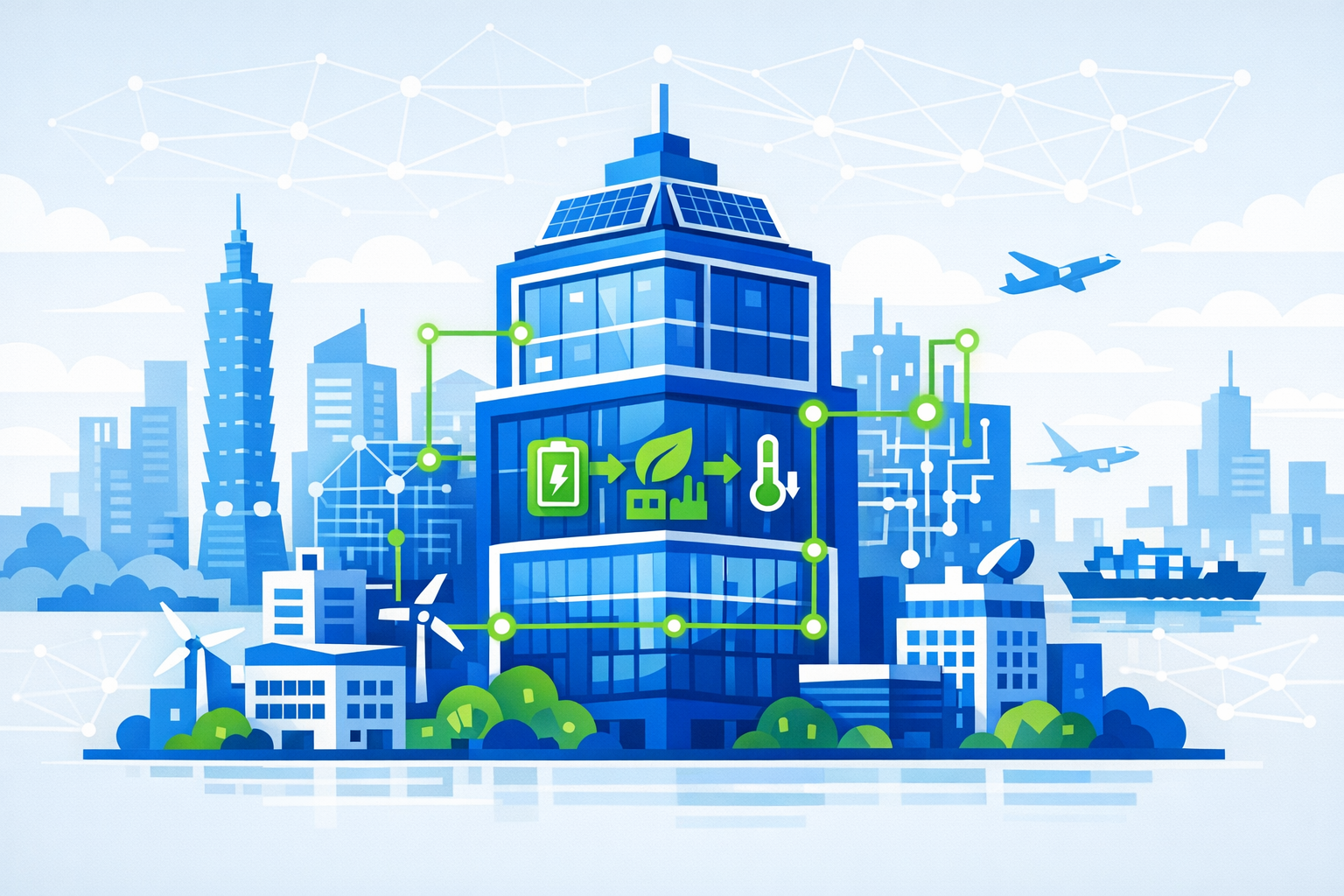
Taiwan's accelerated push into smart building and intelligent city infrastructure in 2026 is reshaping component supply chains, influencing energy management system (EMS) adoption worldwide, and intensifying pressure on interoperability standards - with implications that extend well beyond the island's borders.
The country's government, industry, and academic sectors are moving in coordinated fashion this year. The 13th Smart City Summit & Expo (SCSE) opened on March 17 at the Taipei Nangang Exhibition Center, drawing delegations from 53 countries and 174 cities alongside more than 3,000 international business leaders. The event - led by ASUSTeK Computer Inc. and Foxconn alongside more than 20 industry partners - introduced what organizers described as the world's first full-scale AI City Pavilion, signaling Taiwan's intent to position itself as an exporter of sovereign AI urban solutions rather than solely a component supplier.
Background
Taiwan's role in global building technology supply chains has traditionally centered on semiconductor and ICT hardware manufacturing. That position is now evolving. Taiwan's National Science and Technology Council supported 57 startups at CES 2026, participating alongside 83 local supply chain partners in fields spanning edge computing, smart manufacturing, and green energy. Shifting global regulations and supply chain demands are simultaneously changing buyer priorities, with international purchasers now favoring partners that offer traceable components and verified security credentials, according to reporting by IndexBox.
On the energy side, Taiwan's municipalities are deploying targeted financial incentives to accelerate EMS integration. New Taipei City's 2026 Green Energy Subsidy Program increased subsidy ceilings for enterprises implementing combined solar, storage, and EMS configurations, offering up to NT$1.5 million per qualifying project. Taiwan's construction market - valued at USD 37.4 billion in 2025 - is also expanding its digital toolkit, with adoption of building information modeling (BIM), automation, and prefabrication techniques gaining traction across commercial projects, according to market analysis.
Details
The convergence of policy and technology is producing tangible cross-border effects. At the 2026 SCSE, companies including Delta Electronics, Chunghwa Telecom, Taiwan Mobile, Far EasTone Telecommunications, and Acer presented solutions integrating energy management, communications infrastructure, and climate resilience for urban deployment. Demonstrations included AI-driven distributed energy systems, virtual power plants, and digital twin platforms - technologies directly relevant to building automation engineers and MEP consultants evaluating next-generation EMS architectures.
Taiwan's industrial activity is also attracting international partners seeking EMS co-development. In March 2026, Tokyo-based Osaki Electric signed an agreement with Kyocera Corp. and two Taiwan Plastics Group affiliates to jointly develop an AI-controlled EMS integrating solar generation and lithium iron phosphate battery storage, with a final contract targeted by the end of December 2026.
For system integrators, interoperability remains the critical unresolved challenge. Protocols including BACnet (Building Automation and Control Network), KNX, and Matter each address distinct layers of building automation - HVAC, lighting, energy management, and access control - but their convergence in multi-vendor environments requires gateways, middleware, and semantic mapping, adding integration cost and complexity. Cross-border disparities in certification standards, including varying interpretations of ISO 50001, continue to hinder interoperability and discourage multinational firms from uniform EMS deployment across Asia-Pacific markets, according to market data analysis by MarketDataForecast. Taiwan's scale of deployment in 2026 is creating a testbed for resolving precisely these gaps, applying the island's ICT manufacturing expertise to system integration across hardware, software, and operations layers.
At the policy level, Taiwan's Ministry of Economic Affairs adopted a dual-track "Economy Next" strategy at the 2026 Smart City Summit, simultaneously addressing AI adoption and net-zero requirements - including renewable energy systems, low-carbon supply chains, silicon photonics, and AI robotics. Seven government ministries and 13 county and city governments participated in coordinated demonstrations, reflecting a degree of policy-technology alignment that international policymakers and vendors are watching closely.
Outlook
The Net-Zero Taiwan and Energy Taiwan exhibitions are scheduled for October 14-16, 2026, at the Taipei Nangang Exhibition Center, with over 480 exhibitors expected - up from 450 across 18 countries in 2025. Those events will feature dedicated forums on smart energy and EMS solutions, providing a further platform for standard-setting dialogue between Taiwanese vendors and international buyers. For building professionals evaluating supply chain positioning and interoperability strategy, Taiwan's 2026 trajectory represents both a sourcing opportunity and a reference implementation for integrating AI, energy management, and open standards in large-scale smart building deployments. Readers seeking context on the broader interoperability headwinds facing smart building procurement can refer to our earlier analysis on integration and procurement challenges.