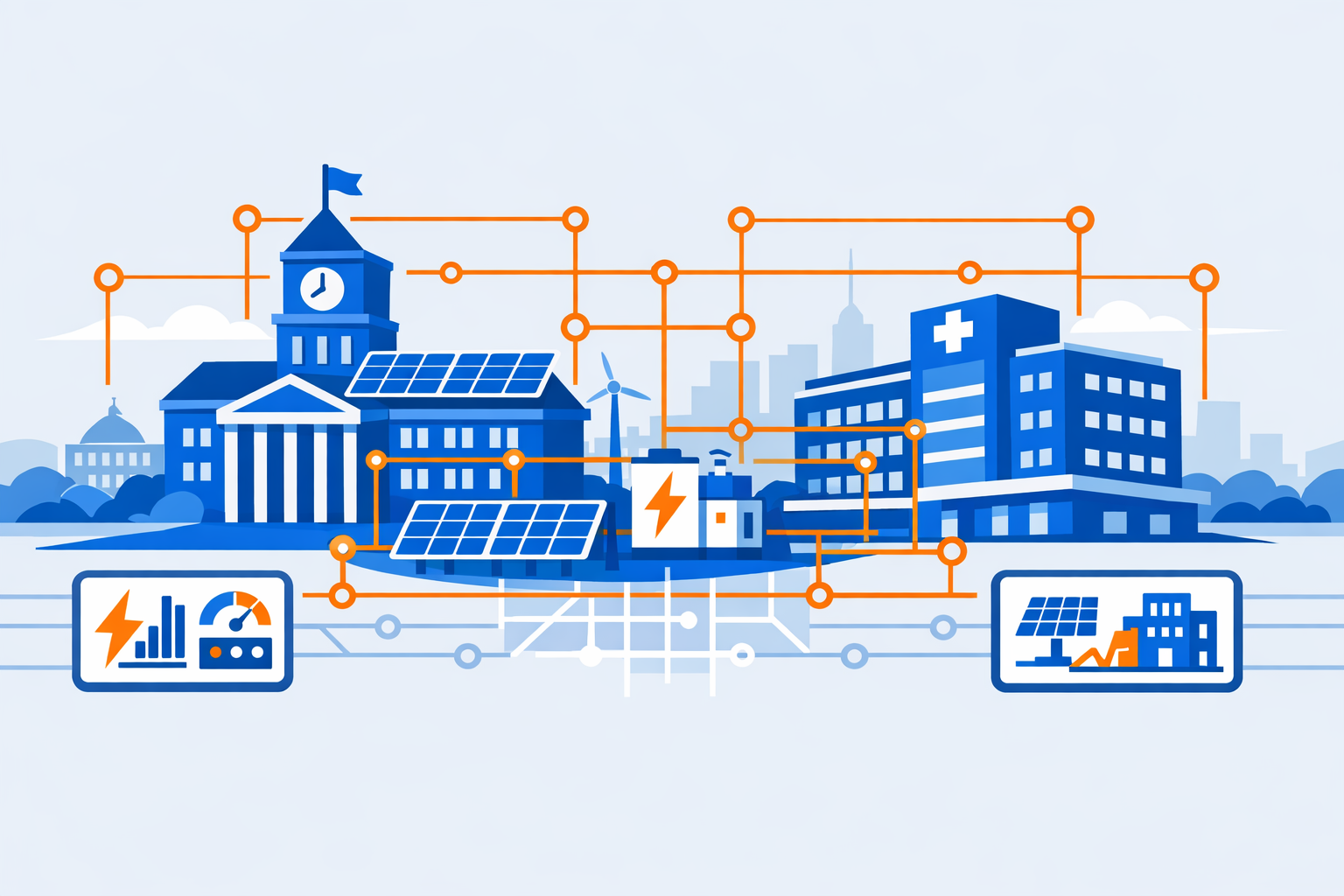
Federal agencies have broadened the Grid-Interactive Efficient Buildings (GEB) pilot program to include university campuses and hospital networks, extending participation beyond traditional federal facilities for the first time at this scale. The expansion, led by the U.S. Department of Energy's Building Technologies Office (BTO) and the Federal Energy Management Program (FEMP), targets high-occupancy institutional campuses where energy demand, grid stress, and operational complexity present significant test cases for demand flexibility and distributed energy resource (DER) integration. The move builds on DOE's Connected Communities initiative and its existing GEB research portfolio, as rising electricity costs and grid reliability concerns intensify pressure on facility operators to adopt intelligent building controls.
Background
DOE's GEB Initiative has convened a broad range of stakeholders-including federal agencies, state and local governments, utilities, and building component manufacturers-with technical support to advance grid-interactive capabilities in both residential and commercial buildings nationwide.[1] According to DOE's National GEB Roadmap, achievable national adoption of GEBs could save hundreds of billions of dollars in power system costs and reduce carbon emissions. DOE has established a goal of tripling energy efficiency and demand flexibility in residential and commercial buildings by 2030, relative to 2020 levels.
The pilot's expansion to institutional campuses follows a precedent set by Ohio State University, selected as one of 10 Connected Communities projects in 2021. Ohio State received a $4.2 million DOE grant to demonstrate cybersecure control of buildings and DERs across 20 diverse campus buildings, targeting a 35% energy reduction over a 2017 baseline. The project leverages the university's public-private partnership with Ohio State Energy Partners, which has installed nearly 1,000 smart meters and approved more than $190 million in energy efficiency measures across its 485-building Columbus campus.
Hospitals represent a particularly compelling use case. According to the U.S. Energy Information Administration (EIA), healthcare buildings account for 4% of total commercial floorspace but approximately 9% of energy consumption in commercial buildings. Inpatient hospitals use about 2.75 times the energy per square foot of the average commercial building, according to EIA data, with energy intensity of 193,300 BTUs per square foot per year.
Details
The expanded pilot is expected to test how building management systems (BMS), smart meters, and on-site generation assets-including solar photovoltaics, battery storage, and combined heat and power systems-can be coordinated in real time across multi-tenant campuses. DOE defines a GEB as an energy-efficient building that uses smart end-use equipment or other onsite DERs to provide demand flexibility while co-optimizing for energy cost, grid services, and occupant needs in a continuous, integrated way. The agency has noted that state-of-the-art sensors and controls can curtail or temporarily manage up to 30% of commercial building peak load.
Interoperability is a central focus. University and hospital campuses typically operate heterogeneous BMS environments, with legacy systems running protocols such as BACnet and Modbus alongside newer IP-based platforms. NIST is working to strengthen the cybersecurity of building systems-including HVAC, security, lighting, and elevators-with the goal of developing a suite of building services cybersecurity application profiles within a larger Digital Building Profile effort. The Cybersecurity Working Group will draw on the NIST Cybersecurity Framework, NIST Risk Management Framework, the DOE Cybersecurity Capability Maturity Model, the FEMP Facility Cybersecurity Framework, and ISA/IEC 62443.
For hospitals, the pilots must navigate strict ventilation standards under ASHRAE Standard 170 and continuous uptime requirements that constrain how aggressively loads can be curtailed during peak events. The GEB approach addresses this through predictive controls and thermal storage that shift loads rather than shed them, maintaining indoor environmental quality while delivering grid services.
Outlook
Participating campuses are expected to generate standardized performance data on demand flexibility, energy cost reductions, and interoperability between BMS platforms and utility DER management systems. DOE's Connected Communities program issued its first funding opportunity in 2021, and a second-Connected Communities 2.0-followed in 2024, signaling sustained federal investment in scaling grid-interactive building research beyond single-facility demonstrations. Industry observers expect the pilot's findings to influence both federal procurement specifications and state utility incentive program design for institutional campuses.