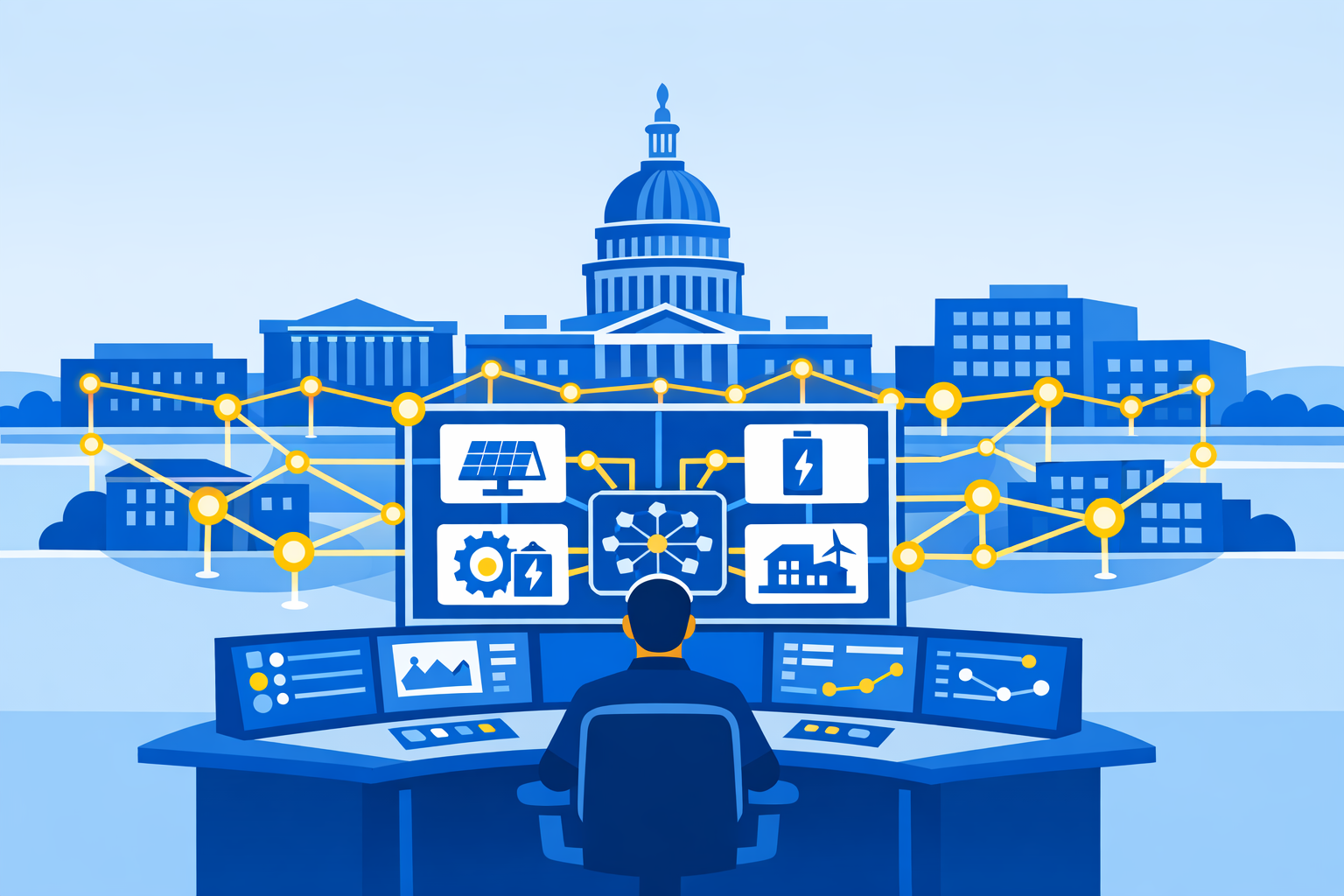
The building sector accounts for approximately 40% of global energy consumption - yet a substantial portion of that demand is still managed by static schedules, rules-based controls, and aging building automation infrastructure. A coordinated federal initiative is now accelerating a shift toward something far more capable: AI-driven energy optimization platforms that can perceive, learn, and act in real time.
The U.S. Department of Energy's Federal Energy Management Program (FEMP)[1], operating under authority of the Energy Act of 2020, launched the Federal Smart Buildings Accelerator (FSBA) to fast-track adoption of smart building and grid-interactive efficient building (GEB) technologies across federal agencies. Its implications extend well beyond government campuses.
What the FSBA Actually Does
The FSBA provided federal facilities with education, technical support, and assessments to promote smart building and grid-interactive efficient building technologies, according to the Department of Energy[2]. The program centers on the GEB concept - buildings that don't merely consume energy efficiently but actively participate in grid management.
Grid-Interactive Efficient Building (GEB) defined: A GEB is an energy-efficient building that uses smart technologies and on-site distributed energy resources to provide demand flexibility while co-optimizing for energy cost, grid services, and occupant needs in a continuous, integrated way.
The FSBA's technical assistance findings[1] revealed a consistent pattern: strong interest in GEB and energy management information system (EMIS) software, but persistent gaps in implementation knowledge, staffing, and capital funding. This gap between intent and execution is precisely what the private-sector AI energy market is being called upon to fill.
High interest was recorded in on-site generation, electric vehicles, and GEB and EMIS software. The accelerator also confirmed that all sizes and types of federal facilities, across all agencies, require technical assistance to move forward - pointing to a market opportunity spanning facility scales and organizational types.
AI's Expanding Role in Building Energy Management
The technology backdrop is compelling. According to a 2025 systematic review published in Energy Informatics[3], AI-driven building energy optimization has progressed beyond proof-of-concept to practical viability, with advanced approaches demonstrating energy savings of 22-28% and a median payback period of 3.4 years.
Research from the American Council for an Energy-Efficient Economy (ACEEE)[4] reinforces this trajectory. Building energy management and control systems (BEMCS) - encompassing what many in the industry call energy management systems or building management systems (BMS) - already deliver measurable outcomes. Organizations can reduce energy use by 10-25% by deploying BEMCS to control building systems, ACEEE research found.
AI extends that baseline substantially. AI-driven BEMCS apply advanced analytics, predictive modeling, and automation to optimize building operations. Specifically:
- Anomaly detection: AI identifies patterns in building data that traditional systems miss, enabling dynamic responses to environmental changes.
- Predictive maintenance: Machine learning models anticipate equipment degradation before failures occur, reducing downtime and unplanned energy waste.
- Demand response: BEMCS can coordinate demand response program participation, manage distributed generation, facilitate EV charging and storage, and interface with retail electricity markets.
- HVAC optimization: AI-driven control of heating, ventilation, and air conditioning maintains occupant comfort while minimizing energy intensity across varying occupancy profiles.
For electrical engineers and facility managers, this represents a meaningful shift from periodic manual adjustments to continuous, data-informed optimization running in the background.
Open Standards: The Architecture Underpinning the Market Shift
The FSBA's most consequential design decision for private-sector vendors is its insistence on open standards. The program pushes agencies to standardize data interfaces, adopt common data models, and deploy interoperable AI tools - an approach intended to prevent lock-in and enable multi-vendor integration across heterogeneous BMS and OT networks.
This aligns with broader industry consensus. As Memoori's 2025 smart buildings research[5] highlights, key frameworks including Brick Schema, Project Haystack, and RealEstateCore are collaborating via ASHRAE 223P to enhance interoperability across building IoT data representations. Common protocols - BACnet, MQTT, OPC-UA - remain essential transport layers, but shared semantic models are what make AI analytics genuinely portable across facilities.
For system integrators and MEP consultants, the practical implication is significant: AI modules that cannot consume and publish data in standardized formats will increasingly struggle in federal procurement. The expected knock-on effect is that this requirement migrates into private-sector RFPs as commercial clients observe federal benchmarks and adopt similar specifications.
What This Means for Procurement
Procurement cycles are already being reshaped. The FSBA's emphasis on demonstrating measurable energy savings within one to three years compresses the evaluation window vendors have historically relied upon. Agencies want performance evidence at the bid stage - not case studies from dissimilar deployments.
The table below summarizes FSBA-driven requirements most likely to define vendor qualification in both federal and private-sector markets:
| Requirement Area | Federal Mandate / Standard | Vendor Implication |
|---|---|---|
| Open Data Interfaces | Open APIs, Brick Schema, Haystack, ASHRAE 223P | AI modules must publish standardized data streams; proprietary lock-in disqualifies bids |
| OT Cybersecurity | NIST SP 800-82 Rev. 3, NIST RMF, ISA/IEC 62443 | Auditable AI logs, software bill of materials (SBOM), access control documentation required |
| Interoperability | BACnet/SC, MQTT, OPC-UA; multi-vendor BMS/OT integration | Plug-and-play deployment across heterogeneous facility types |
| Energy Performance | Measurable energy intensity reduction within 1-3 years | Verifiable savings metrics required at contract award |
| AI Governance | Explainable AI (XAI), auditable decision-making | Black-box AI models face procurement rejection |
| Demand Response | Dispatchable demand flexibility with utility coordination | Systems must respond to real-time grid signals without manual intervention |
OT Cybersecurity: The Non-Negotiable Baseline
Security is where many AI energy vendors currently fall short - and where the FSBA is raising the bar most visibly.
As buildings become increasingly connected, the IT/OT boundary blurs. Legacy protocols present well-documented vulnerabilities: BACnet was developed without any authentication mechanism, meaning internet-facing BACnet devices can be easily compromised, a pattern documented across the building automation sector. Newer versions address this - BACnet Secure Connect (BACnet/SC) uses transport layer security and WebSockets to implement encrypted communication and peer authentication between BACnet/SC devices - but retrofit adoption remains uneven.
The regulatory environment is hardening. Key standards now shaping OT security requirements include:
- NIST SP 800-82 Rev. 3: Updated to include Zero Trust for OT networks, risk assessment frameworks for industrial control systems, and guidelines for IT-OT security integration.
- ISA/IEC 62443: The primary security standard series for industrial automation and control systems, now increasingly applied to building automation environments.
- CISA Cyber Performance Goals (CPGs 2025): Focused on OT network segmentation, Zero Trust principles, and supply chain security.
The FSBA's cybersecurity framework directly mirrors these standards: vendors must provide auditable validation of AI decision-making, robust data handling practices, strong access controls, and clear incident response documentation. Critically, the accelerator designates cybersecurity responsibilities explicitly - a departure from the informal shared-responsibility models common in earlier BMS deployments.
For facility managers integrating AI-energy platforms into live OT environments, practical guidance from FEMP's Cybersecurity Considerations for Grid-Interactive Efficient Buildings[1] is clear: interconnected systems and smart devices must be designed with cybersecurity best practices embedded from the start, not added after deployment.
Private-Sector Market Outlook: What the Accelerator Signals
The FSBA is not merely a procurement exercise for federal estates. It is functioning as a de facto standards-setting mechanism for the broader AI energy optimization market - a dynamic Electronics Insider has tracked in related federal GEB programs such as the expanded GEB pilot and grid-interactive buildings adoption trends.
For private-sector providers, three strategic signals are worth tracking:
1. Federal contracting as a commercial proof point. Firms that demonstrate rapid, secure, and measurable AI energy deployment in federal facilities gain a powerful validation signal for commercial clients in healthcare, higher education, and commercial real estate - sectors increasingly seeking similar energy-performance guarantees.
2. The rise of the plug-and-play AI module. The FSBA's open-standards mandate is accelerating demand for modular AI components that can layer onto existing BMS and OT networks without full system replacement. System integrators that deliver this capability - combining AI analytics with standardized data connectors - are positioned at the intersection of the highest-growth procurement categories.
3. Governance as competitive advantage. Recent advances in explainable AI (XAI) have begun addressing the "black box" problem that has limited AI adoption in critical building systems, according to research in ScienceDirect. Vendors who invest in XAI capabilities - where AI systems can articulate why they made a given control decision - will hold stronger positions in both federal and regulated private-sector procurement.
Key Takeaways for Electrical and Smart Building Professionals
- The FSBA has reset procurement expectations for AI energy tools: open APIs, auditable AI, and proven OT cybersecurity are now prerequisites, not differentiators.
- Energy intensity reduction within 1-3 years is the performance window agencies are using. Private-sector procurement officers are watching and will likely adopt similar evaluation timelines.
- OT cybersecurity is the principal implementation risk for AI energy deployments. BACnet/SC adoption, NIST 800-82 alignment, and Zero Trust for OT should be specified in vendor contracts.
- Open data models (Brick Schema, Haystack, ASHRAE 223P) are becoming the connective tissue of interoperable AI energy platforms. Integrators should audit existing BMS data architectures against these standards before specifying AI modules.
- AI energy optimization's value case is now well-supported by field evidence - the remaining challenge is governance, security, and verifiability, not the underlying technology.
The federal government's accelerator is, in effect, compressing a multi-year technology adoption curve into a condensed proving ground. Vendors and integrators who master the technical, security, and governance requirements being road-tested in federal facilities today will be well positioned to serve the broader market that follows.