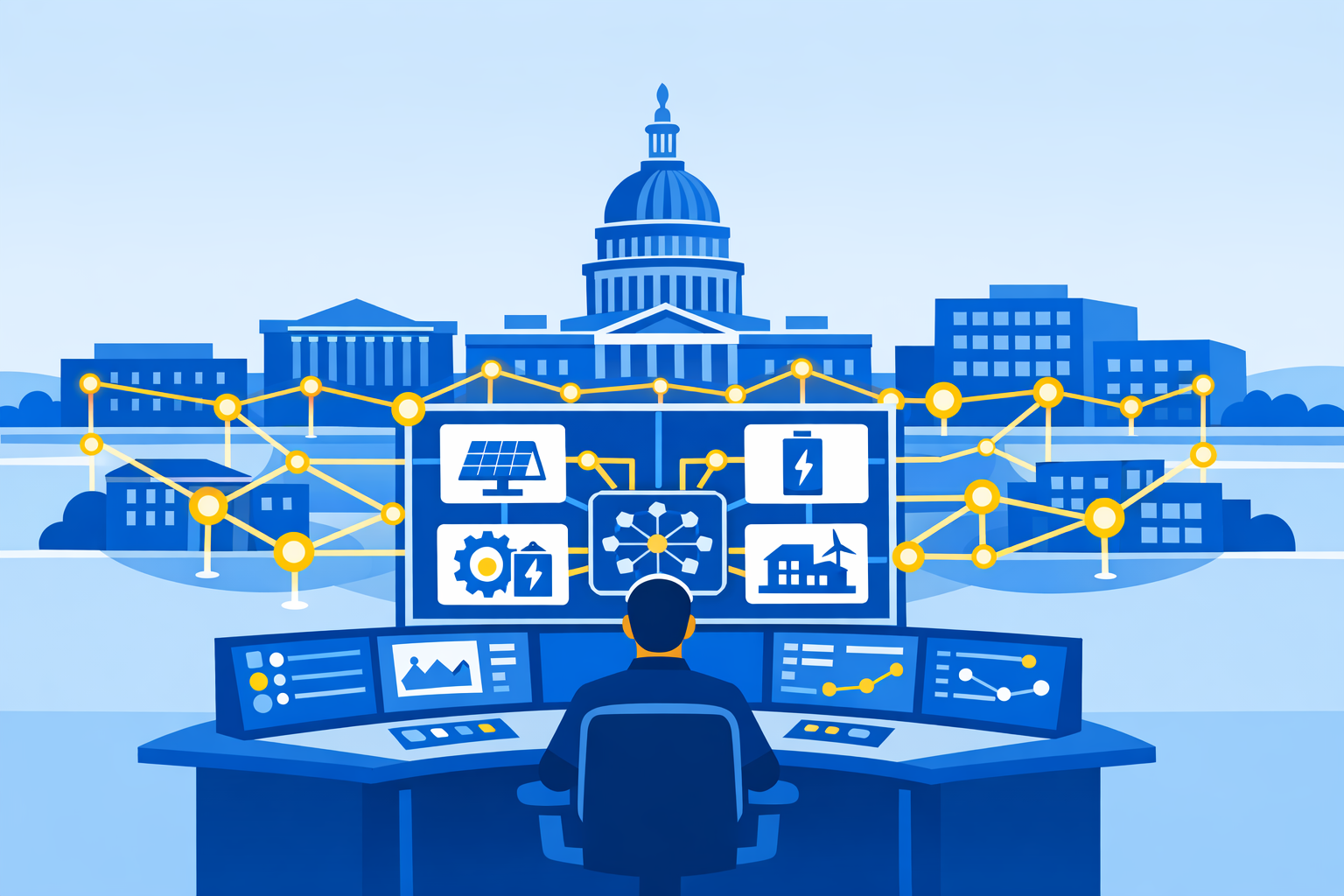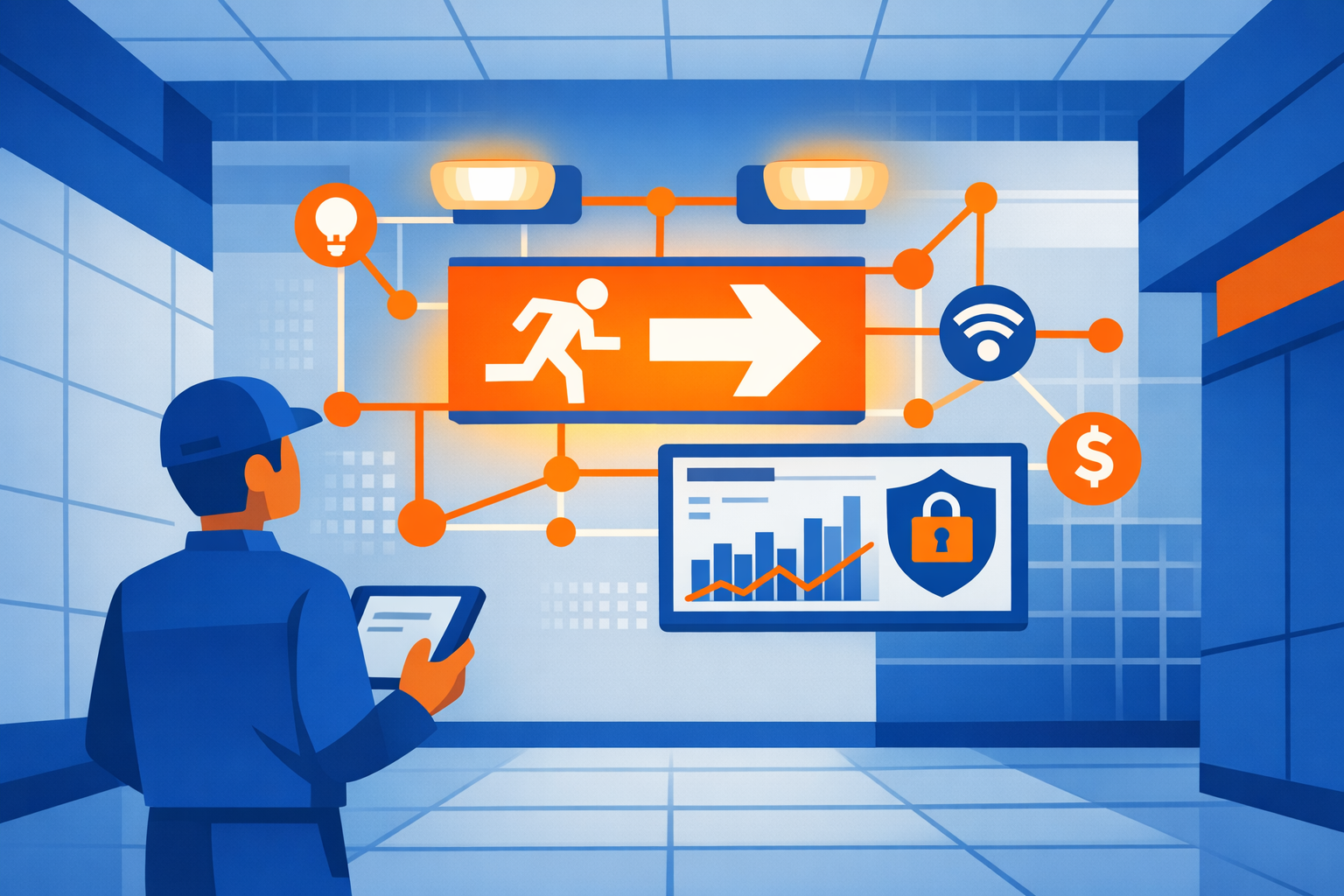
Emergency lighting is evolving from isolated fixtures and paper logs to networked, data-rich safety infrastructure. IoT-enabled emergency lighting delivers automated testing, real-time monitoring, and streamlined reporting, but also raises new questions regarding cybersecurity, integration, and budgeting for commercial buildings.
This analysis details retrofit pathways, summarizes the applicable regulatory baseline, outlines cybersecurity requirements asset owners must address, and examines how lifecycle costs and funding mechanisms are changing the overall business case.
From Standalone Luminaires to IoT Safety Assets
Historically, emergency lighting has been treated as a static, code-driven requirement: install compliant luminaires, perform scheduled testing, and maintain records. IoT connectivity shifts this paradigm.
Networked emergency luminaires now integrate sensors, addressable control gear, and wired or wireless communications, enabling:
- Automated function and duration testing
- Centralized fault detection and reporting
- Portfolio-wide status monitoring and benchmarking
- Integration with building management systems (BMS) and energy management systems (EMS)
Exit and emergency lighting typically operates 24 hours a day and can represent a significant share of a building's lighting energy use[1]. Replacing incandescent or fluorescent exit signs (often ~40 W) with LED-based systems (approximately 4-8 W) reduces electricity use by 70-90%.LED exit signs can consume about one-tenth the power of incandescent signs, while delivering higher brightness and contrast[2].
Emergency lighting is increasingly part of broader smart building strategies, with unified dashboards overseeing HVAC, security, general lighting, and life-safety systems.
Regulatory Baseline: Compliance and Reliability Still Come First
IoT connectivity does not change fundamental life-safety obligations. Emergency lighting retrofits must continue to meet illumination, duration, and testing requirements specified in relevant codes and standards.
Core Performance Requirements (Europe Focus)
In Europe, EN 1838 and EN 50172 (and national equivalents) define emergency lighting design and maintenance.
- EN 1838 mandates a minimum of 1 lux horizontal illuminance along escape route centerlines and stricter requirements for high-risk areas, with at least 0.5 lux in anti-panic open areas[3].
- EN 1838 requires emergency escape lighting to provide at least 1 hour duration, with 3-hour systems widely adopted for commercial buildings following risk assessments and national practice[3].
EN 50172 and national codes (e.g., BS 5266 in the UK, VDE 0108 in Germany) dictate testing and documentation:
- Monthly functional checks of all emergency luminaires and signs
- Annual full rated-duration tests (typically 1 or 3 hours)
- Logbook entries for all tests, failures, and corrective actionsBS EN 50172 requires documented monthly function tests and an annual full-duration discharge test for emergency lighting installations, with records in a system logbook[4]
In North America, NFPA 101 (Life Safety Code) establishes similar requirements: monthly 30-second functional tests and annual 90-minute battery tests for unit equipment, with written records retained for inspection.NFPA 101 Section 7.9.3 requires a functional emergency lighting test every 30 days for 30 seconds and a full 90-minute test annually, with written documentation of results[5]
IoT-Driven Changes
IoT systems primarily change how testing and documentation are handled:
- Automated test routines replace manual walk-throughs
- Electronic dashboards replace paper logbooks
- Granular fault diagnostics at the luminaire level (e.g., battery health, communications, hardware faults)
Authorities generally accept automated testing and electronic records if these satisfy the intent of the standard and remain accessible to inspectors. Asset owners must ensure automatic test systems fully comply with EN 50172 / BS 5266 or local equivalents.
Retrofit Pathways: Wiring, Wireless, and Hybrid Architectures
Upgrading emergency lighting to smart, networked systems in existing commercial buildings typically follows one of three architectural models.
1. Bus-Based Systems over Existing Wiring (e.g., DALI-2 Emergency)
Digital Addressable Lighting Interface (DALI) and DALI-2 are commonly used for addressable lighting. IEC 62386 Part 202 defines control gear for self-contained emergency lighting, enabling automated testing and detailed status feedback.[6]
Strengths:
- Utilizes existing power and control wiring where feasible
- Mature, multi-vendor ecosystem for interoperability
- Device-level control and monitoring
Constraints:
- Segment size limits (e.g., 64 devices per basic DALI loop)
- Requires gateways for BMS/EMS integration (BACnet, KNX, Modbus, IP)
2. Wireless Mesh and Cloud-Managed Retrofits
Wireless emergency lighting platforms (using Bluetooth mesh, sub-GHz radios, or other protocols) are viable for buildings where additional wiring is impractical.
Common features include:
- Radio-mesh emergency networks linked to cloud management platforms
- Automated periodic testing and remote access to device-level histories
- Shared infrastructure with general lighting control (one network, multiple roles)[7]
While commissioning is simplified and invasive cabling avoided, these systems require robust RF design, careful planning, and cybersecurity measures.
3. Hybrid and Gateway Integration with Existing BMS/EMS
Many sites already use BMS platforms with BACnet, KNX, or proprietary protocols.BACnet and KNX are standard building automation protocols supporting lighting, HVAC, access control, and more[8]
Common retrofits include:
- Retaining self-contained emergency luminaires with gateway-enabled test panels
- Using DALI/KNX or DALI/BACnet gateways for BMS-triggered testing and status collection
- Deploying dedicated lighting management platforms that exchange alarms and KPIs with central BMS
Interoperability challenges:
- Consistent mapping of alarm states and test results across protocols
- Reliable time synchronization for legal records
- Device identity management across overlapping networks
Cybersecurity: Integrating Safety Lighting with OT and IoT
Connecting emergency lighting to IP networks, cloud platforms, or wireless infrastructure expands the operational technology (OT) attack surface. Lighting controllers and gateways become potential targets, with implications for both cybersecurity and physical safety.
Actual Vulnerabilities in Smart Lighting
Studies of smart lighting and building IoT systems have identified frequent risks:
- Default or hard-coded credentials
- Lack of encryption or authentication on lighting control channels
- Unpatched firmware with known Common Vulnerabilities and Exposures (CVEs)
A 2022 analysis found more than 60% of smart lighting devices examined had at least one known CVE, highlighting widespread vulnerabilities[9]
For emergency lighting, these can lead to:
- Denial-of-service attacks on testing and reporting
- False alarms that reduce trust in dashboards
- Malicious control of emergency scenes or exit signage
- Use of gateways as entry points into wider building systems
Applicable Cybersecurity Standards and Frameworks
Relevant standards for IoT emergency lighting in critical building infrastructure include:
- IEC 62443 - A multi-part standard for cybersecurity in industrial automation and control systems (IACS), outlining security levels, system requirements, and asset owner responsibilities for OT networks.IEC 62443 offers a role-based framework for securing industrial automation and control systems, with sections for asset owners, integrators, and product suppliers[10]
- ISO/IEC 27001 - Information security management systems standard used for risk assessment and governance in organizations managing OT.
- ETSI EN 303 645 - European baseline for cybersecurity in consumer IoT, referenced for requirements like secure defaults, vulnerability disclosure, and update mechanisms.[11]
- EN 17927 (SESIP) - Security evaluation for IoT platforms, referenced by ENISA for supply chain security, relevant when lighting relies on shared IoT infrastructure.[12]
- NIS2 Directive (EU) - Expands cybersecurity obligations for operators in critical sectors, including digital infrastructure. Operators of large facilities may find emergency lighting systems in scope as part of essential services.[13]
Manufacturers and integrators increasingly provide secure deployment guides for KNX, BACnet, and building automation, focusing on network segmentation, hardened gateways, and secure remote connections.[14]
Practical Controls for Facility and Engineering Teams
Recommended measures for emergency lighting projects include:
- Segmenting emergency lighting networks within OT environments, with controlled and monitored interfaces to corporate IT
- Using secure commissioning steps (unique credentials, certificate onboarding if available)
- Applying strict firmware and software patch management
- Limiting remote access (VPN with multi-factor authentication; avoid open management ports)
- Integrating lighting alarms into central Security Operations Center (SOC)/monitoring
- Documenting cyber risks in assessments covering system duration, redundancy, and test frequency
Cost, Lifecycle, and Funding: Beyond Initial Budgets
IoT emergency lighting retrofits impact the compliance cost profile by automating testing, enabling more efficient LED use, and reducing ongoing manual effort.
Energy and Maintenance Savings
LED emergency luminaires provide significant lifetime and energy advantages:
- LED emergency lights generally deliver about 30% energy savings compared to traditional non-LED systems, while lasting longer and requiring fewer replacements[15]
- LED tubes outlast fluorescents by 3-5 times, cutting labor in high or hard-to-reach spaces[16]
Continuous-operation fittings, such as exit signs, benefit further from adaptive charging algorithms and IoT energy management.
Automated Testing vs. Manual Labor
Automatic test systems, both wired and wireless, reduce labor demands:
- Automated function and duration tests per EN 50172 / BS 5266 schedules
- Centralized result collection and exception-based maintenance
- Cloud dashboards accessible from any location[7]
For large campuses, this can eliminate hundreds of hours of manual testing, shifting staff time to targeted corrective action.
Funding and Grants for Digital, Energy-Efficient Retrofits
IoT emergency lighting projects often qualify under broader energy-efficiency and digitalization initiatives.
At the EU level:
- The European Commission expects more than €80 billion from the Recovery and Resilience Facility and €17 billion from Cohesion Policy Funds to be directed to building energy performance upgrades from 2021 to 2027[17].
- Funding instruments such as ELENA and local revolving funds commonly list lighting upgrades and building systems digitalization as eligible measures.
National schemes include:
- Germany's Federal Funding for Efficient Buildings (BEG) supports renovation measures, including lighting system replacement and advanced controls[18]
- Other EU member states feature grant schemes for public and commercial building retrofits, often bundling HVAC, envelope, and lighting upgrades[19]
Facility managers can often incorporate emergency lighting modernization into larger renovation packages, combining:
- LED energy savings
- Reduced labor through automated testing
- Improved compliance and documentation
Comparative View: Conventional vs. IoT Emergency Lighting
| Aspect | Conventional (Standalone) | IoT / Networked (Bus or Wireless) |
|---|---|---|
| Testing method | Manual push-button at each device | Automated tests via controller or scheduler |
| Records | Paper logbooks, spreadsheets | Centralized electronic logs and dashboards |
| Fault detection | During scheduled tests or user reports | Near-real-time alarms and trends |
| Energy efficiency | Fluorescent/incandescent; higher load | LED-based; optimized charge and control |
| Interoperability with BMS/EMS | Limited, often isolated | Gateways to BACnet/KNX/Modbus/IP; API integrations |
| Cybersecurity exposure | Low (isolated) | Higher; requires OT security controls and standards |
| Upfront CAPEX | Lower; basic devices, minimal networking | Higher; advanced devices and platform, integration needed |
| Ongoing OPEX (maintenance & testing) | Higher manual labor and access costs | Lower; targeted, exception-based maintenance |
Integration with BMS/EMS: Interoperability and Data Strategy
Data Prioritized by Facility and Energy Teams
When emergency lighting is integrated with BMS/EMS platforms, additional data streams become available:
- Asset inventories, locations, and commissioning dates
- Battery trend analysis and predicted end-of-life
- Test pass/fail rates by area
- Correlation of power events with emergency activations
Analytics can support maintenance planning, spares management, and broader resilience strategies.
Typical Integration Methods
Common integration models include:
- BMS as Visualization: Emergency lighting remains separate, exporting alarms and KPIs to the BMS for operator awareness.
- BMS as Orchestration: BMS schedules tests, aggregates logs, and coordinates emergency scenarios (e.g., fire alarm, access control, lighting).
- Enterprise Integration: Data forwarded to data lakes or computerized maintenance management systems (CMMS) for cost and lifecycle analytics.
Clear interface definitions are important to avoid ambiguity and maintain cybersecurity across systems.
Actionable Conclusions and Next Steps for Retrofit Projects
Electrical engineers, facility managers, and system integrators should follow a structured approach to manage compliance and cyber risk during IoT emergency lighting retrofits.
1. Risk and Compliance Review
- Map applicable standards (EN 1838, EN 50172 / BS 5266, NFPA 101, local codes)
- Confirm required system duration (1 h or 3 h) based on occupancy
- Identify NIS2 or critical infrastructure designations if present
2. Infrastructure Audit
- Document luminaire types, circuits, batteries, and wiring
- Note existing BMS/EMS technologies and protocols
- Evaluate cable routes and RF conditions for wireless suitability
3. Define Target Architecture
- Select bus-based, wireless, or hybrid IoT architecture
- Specify integration points with BMS/EMS and CMMS
- Develop cybersecurity architecture
4. Cybersecurity Alignment
- Apply IEC 62443 and ISO/IEC 27001 principles
- Require secure development practices from vendors (e.g., ETSI EN 303 645)
- Plan lighting network monitoring under SOC/OT oversight
5. Business Case Modeling
- Quantify labor savings through automation
- Calculate energy savings from LED conversion
- Investigate funding options for eligible retrofit measures
6. Pilot Implementation
- Pilot in a limited area to validate network, integration, and reporting
- Gather feedback from maintenance and safety teams
- Use findings to refine specifications and training
Frequently Asked Questions
Does IoT Emergency Lighting Change Legal Testing Obligations?
No. IoT solutions change how tests are conducted and recorded, not the underlying requirements. Standards such as EN 50172 / BS 5266 and NFPA 101 still mandate monthly functional and periodic full-duration tests with comprehensive records. Automated systems can meet these requirements if correctly configured and logs are appropriately retained.[4]
Is a Full BMS Necessary for Smart Emergency Lighting?
No. Many IoT emergency lighting platforms provide their own gateways, dashboards, and cloud services for test scheduling and compliance reporting. Integration with a BMS/EMS is advantageous for centralized alarms and building-wide oversight but is not required for test automation or fault reporting.
How Does IoT Emergency Lighting Affect Cybersecurity Audits and NIS2 Compliance?
Organizations subject to NIS2 or sectoral cybersecurity regulations must consider networked emergency lighting as part of the OT asset inventory. Audits will require inventories, network diagrams, risk assessments, access policies, patch management, and incident response plans aligned with IEC 62443 and ISO/IEC 27001.[13]
Can Partial IoT Emergency Lighting Retrofits Be Deployed?
Yes. Partial retrofits are common, especially for high-priority areas. Mixed estates with both legacy and IoT-managed devices are permissible if overall installations remain compliant and clear records are maintained for all assets.
What Data Should Be Retained from IoT Emergency Lighting Systems?
Recommended retention includes:
- Test logs (timestamp, type, pass/fail, devices)
- Alarm histories with resolution details
- Configuration change logs
Retention periods depend on regulations, insurance, and policy but commonly match fire-safety recordkeeping practices, with several years' retention to support audits and investigations.
Treating emergency lighting as an IoT-enabled safety asset-rather than a static compliance system-can improve reliability, reduce costs, and support evolving cybersecurity and regulatory demands. Success depends on rigorous standards, coordinated integration, and proactive risk management beginning at the design stage of each retrofit project.