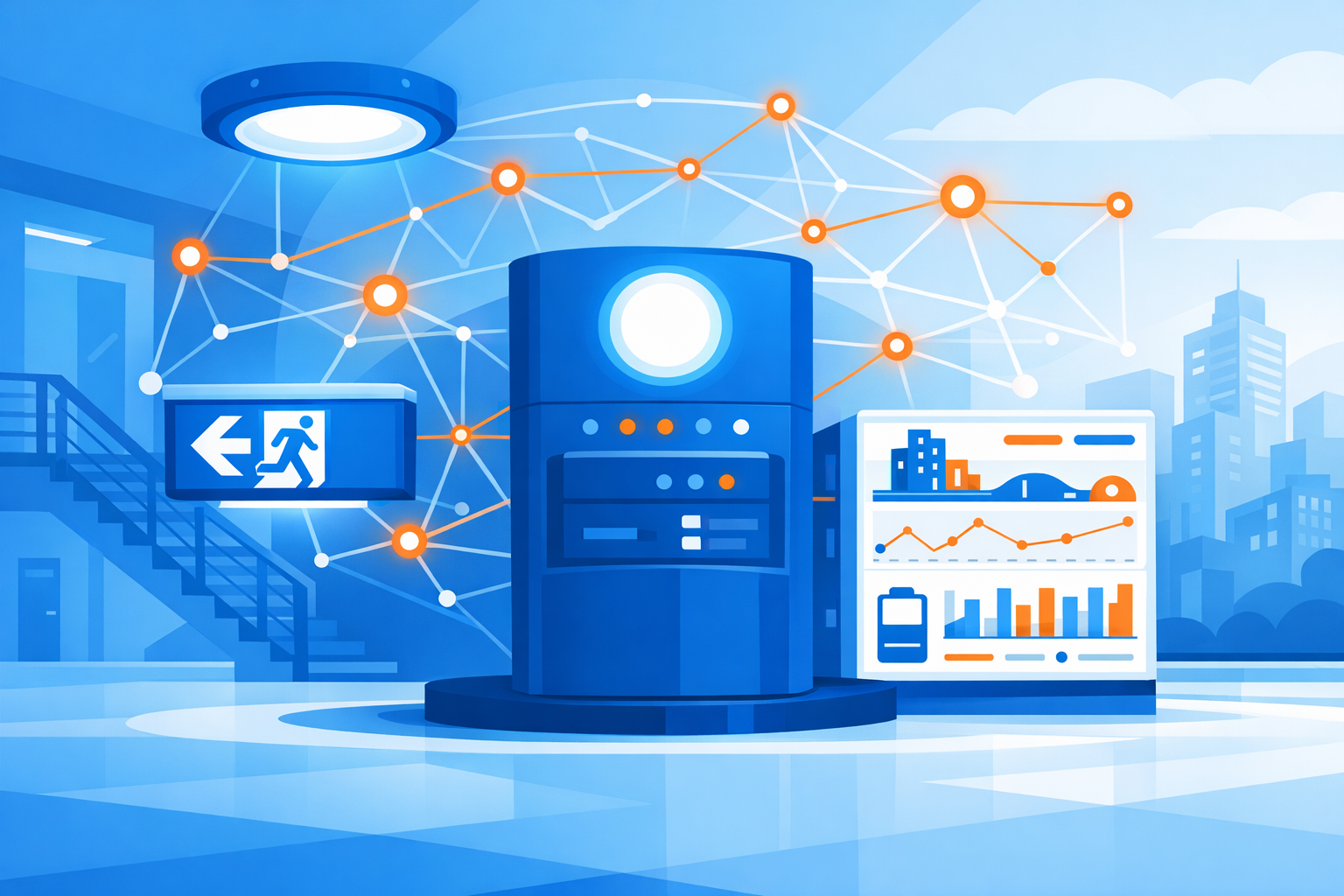
Smart emergency lighting systems are becoming integral to building management platforms, evolving from compliance-driven installations into active safety and operational assets. Operators now connect these systems to centralized building management systems (BMS) or energy management systems (EMS), often via Internet of Things (IoT) modules that enable real-time monitoring and automated fault reporting. This trend, emerging in early 2026 across retrofit and new-build projects globally, is driven by demands for greater resilience, occupant safety, and energy efficiency.
Background
Regulations have historically mandated emergency lighting to ensure safe evacuation during power outages. Traditional systems were passive, compliance-focused, and required manual testing and maintenance. As buildings incorporate digitalization, electrification, and IoT connectivity, emergency lighting is entering the integrated safety ecosystem managed by BMS. This aligns with industry trends in predictive maintenance and real-time infrastructure monitoring, highlighted at Light + Building 2026[1].
Details
At Light + Building 2026 in Frankfurt, leading manufacturers demonstrated advances in smart emergency lighting. Eaton introduced a wireless, cloud-connected monitoring system using a radio mesh network, controlled by its Building Safety Manager app, which enables remote fault detection and maintenance without complex wiring[2]. Inventronics presented systems that support comprehensive supervision of emergency luminaires, live diagnostics, energy consumption tracking, and automated fault reporting, all integrated with BMS platforms[3]. Additionally, ams OSRAM's Emergency Hub features sensors and ceiling-mounted warning lights that provide real-time escape route guidance by combining smoke detection with dynamic evacuation cues[4].
Energy efficiency gains have been reported in retrofit projects. The World's End Health Centre in London upgraded existing LED fixtures with IoT-enabled modules, achieving an 81.8% reduction in LED energy use over six months-approximately £3,600 saved annually and a 19,000 kWh decrease in consumption[5]. These upgrades also supported automated compliance testing, remote integration with HVAC and BMS workflows, and enhanced operational oversight while reducing administrative work[5].
Outlook
Broader adoption of smart emergency lighting is expected to accelerate the development of standard integration protocols and enhanced cybersecurity guidance as connectivity increases. As safety-critical systems converge with smart building platforms, emergency lighting is poised to shift from passive compliance infrastructure to a data-rich component within intelligent building ecosystems.