Across North America, the question is no longer whether distributed energy resources (DERs) can support grid operations - it is whether energy management system (EMS) infrastructure can coordinate them fast enough to matter. A series of utility-led pilot programs launched in 2024 and 2025 is now answering that question with data.
On July 8, 2025, more than 70,000 residential batteries in Puerto Rico discharged simultaneously, delivering 48 MW to the grid and averting a widespread blackout. The event, documented by the Pew Charitable Trusts[1], demonstrated under real operational conditions what grid planners have long modeled in theory: aggregated DERs can stabilize a stressed grid faster and more flexibly than centralized generation.
That incident is not an isolated data point. It reflects a broader wave of EMS-enabled DER coordination programs reshaping how utilities approach grid resilience, peak demand management, and the integration of rooftop solar, battery storage, and demand response assets.
The Pilot Landscape: Programs Taking Shape Across the US
Several utilities now operate or are structuring pilots that place real-time EMS coordination at the center of their DER strategies.
Virginia has set a legislative framework requiring Dominion Energy to develop a virtual power plant (VPP) tariff. Dominion submitted its pilot proposal in December 2025 and must develop a VPP tariff by November 15, 2026, setting out terms under which residential, commercial, and industrial customers will be compensated for grid services. The pilot will operate through summer 2028 to collect actionable data on DER integration at scale, after which the Virginia State Corporation Commission will assess performance and establish a permanent program. Virginia's approach stands out for its formal procurement targets and performance-based compensation metrics[1] - a model regulators in other states are watching closely.
In California, battery aggregation has reached operationally meaningful scale. During a July 2025 test event under the state's Distributed Solar and Storage Grid Services program, aggregated residential batteries delivered over 500 MW, reducing CAISO's net load by an average of 539 MW. This confirms that residential storage has crossed a threshold from retail product to dispatchable grid resource. US residential battery installations surged by more than 130% year-over-year in 2025, adding approximately 608 MW of new capacity in the second quarter alone.
Arizona Public Service has refined customer enrollment for its Residential Battery Pilot by aligning marketing and incentive structures with original equipment manufacturers (OEMs), yielding higher enrollment and more consistent dispatch performance. Vermont's Bring Your Own Device pilot enrolled over 3,000 customers, delivering more than 20 MW of flexible capacity[2]. Georgia Power, meanwhile, is piloting a Resiliency Asset Service (RAS) tariff model in which the utility provides resiliency as a service through customer-sited, behind-the-meter DERs - a structure that strategically pairs flexible customers with utility grid needs[3].
| Utility / Program | State / Region | DER Types | Notable Metric | Status |
|---|---|---|---|---|
| Dominion Energy VPP Pilot | Virginia | Storage, demand response | VPP tariff by Nov. 2026; runs through summer 2028 | Active |
| CA Distributed Solar & Storage Grid Services | California (CAISO) | Residential solar + storage | ~539 MW net load reduction (July 2025 test) | Active |
| Arizona Public Service Battery Pilot | Arizona | Residential battery storage | Improved enrollment via OEM co-branding | Active |
| Puerto Rico DER Aggregation | Puerto Rico | Residential solar + batteries | 48 MW delivered by 70,000+ batteries (July 2025) | Active |
| Vermont Bring Your Own Device | Vermont | Mixed customer-sited DERs | 3,000+ customers; 20+ MW flexible capacity | Active |
| Georgia Power RAS Tariff | Georgia | Behind-the-meter DER | Customer-sited resiliency-as-a-service model | Active |
EMS Architecture: Cloud, Edge, and Hybrid Approaches
The technology stacks underpinning these pilots vary considerably, and architecture choices carry direct consequences for performance, resilience, and security.
Cloud-centric EMS platforms offer high scalability and suit portfolio-level DER scheduling and day-ahead optimization. However, traditional cloud-dependent architectures can exhibit response latencies exceeding 500 milliseconds - a significant limitation for frequency regulation applications requiring sub-second response.
Edge-processing architectures address this constraint. Research on IoT-enhanced VPP frameworks[4] demonstrates that hybrid edge-fog computing can achieve sub-50-millisecond response times, critical for voltage and frequency stabilization events. Edge nodes also maintain autonomous operation during network outages - a key resilience advantage in rural deployments.
Hybrid architectures combining edge-level device control with cloud-level analytics and market participation are emerging as the preferred model for utility-scale DER programs. These platforms typically integrate Advanced Distribution Management Systems (ADMS), IEEE 2030.5 and OpenADR communication standards, and IoT-enabled smart inverters[5] for bidirectional metering and autonomous voltage regulation.
| Architecture Element | Cloud-Centric | Edge-Processing | Hybrid (Cloud + Edge) |
|---|---|---|---|
| Response Latency | >500 ms typical | <50 ms achievable | Low at edge, analytics in cloud |
| Cybersecurity Attack Surface | Centralized; larger target | Distributed; localized risk | Segmented; defense-in-depth |
| Scalability | High - cloud elasticity | Limited by local hardware | High scalability with local resilience |
| Offline / Outage Operation | Degraded or unavailable | Fully autonomous | Autonomous locally; syncs on reconnect |
| Key Standards | IEEE 2030.5, OpenADR | IEC 61850, IEEE 1547 | Full dual-stack compliance |
| Typical Use Case | Portfolio DER scheduling | Real-time voltage/frequency response | Utility-scale DER management programs |
Interoperability Standards: The Technical Foundation
Interoperability is a precondition for scalable DER coordination, and the standards landscape has matured significantly. NIST has developed an IEC 61850 interoperability profile[6] that maps IEEE 1547 functional requirements - defining interconnection behavior across varying power conditions - to IEC 61850-7-420 communication and data requirements. This gives implementers a clear compliance pathway bridging device-level interconnection standards and substation automation communications.
At the market participation layer, FERC Order 2222[7] requires regional transmission organizations (RTOs) and independent system operators (ISOs) to create rules enabling DER aggregations to participate in capacity, energy, and ancillary services markets. CAISO is actively implementing FERC Order 2222 compliance, requiring changes to market rules, interconnection processes, and operational protocols for DER aggregators. The order enables aggregators to bundle multiple small DERs - typically ranging from 1 kW to 10,000 kW - into wholesale market-eligible resources.
Implementation complexity remains significant, however. Communication pathways for distribution company-aggregator coordination are still being defined across many RTOs, and dual-participation structures - allowing DERs to participate in both retail utility programs and wholesale RTO products - require careful regulatory design to avoid double compensation.
Cybersecurity: A Non-Negotiable Design Requirement
The expansion of networked DERs enlarges the digital attack surface of the distribution grid. Effective DER integration requires secure authentication and encryption for all DER communications, role-based access controls, and compliance with NERC CIP and IEC 61850 security provisions[5]. Research indicates that 68% of grids report IoT-related cybersecurity risks as a significant concern in VPP and DERMS deployments.
Edge computing architectures offer a partial mitigation: by processing sensitive operational data locally rather than routing it through centralized cloud platforms, edge nodes limit the blast radius of a network intrusion. Utilities operating DER pilot programs increasingly specify cybersecurity compliance requirements - including IEEE P1547.3, which covers cybersecurity of DER interconnection - as procurement criteria rather than post-deployment considerations.
For commercial building operators and facility managers participating in utility DER programs, the implications are direct. The EMS or DERMS platform must meet utility-grade security specifications to qualify for program enrollment. Articles covering how EV charging networks are adopting smart EMS for grid coordination and the expanding role of city-scale EMS pilots provide useful context for building-side integration requirements.
Regulatory Outlook: What Pilots Must Prove
Regulators are not passive observers. The Virginia State Corporation Commission's structured review process - assessing pilot performance before establishing a permanent program - reflects a broader regulatory posture demanding measurable outcomes before full-scale procurement commitments.
Key performance indicators under regulatory scrutiny include peak demand reduction (MW), voltage and frequency deviation response times, customer enrollment and dispatch reliability, and per-unit cost of flexible capacity relative to traditional grid infrastructure investments.
Louisiana, North Carolina, and Oregon are developing community-based resilience programs that deploy DERs to support the grid and serve customers during system outages, adding to a growing pipeline of state-level pilots that will inform future regulatory frameworks.
The data emerging from current programs - particularly the documented dispatch events in Puerto Rico and California - strengthens the regulatory and business case for scaling DER coordination infrastructure. The central question for utilities, system integrators, and commercial building operators is no longer whether real-time EMS-enabled DER coordination works. It is how quickly the procurement, standards, and cybersecurity frameworks can be assembled to support deployment at grid-relevant scale.
FAQ
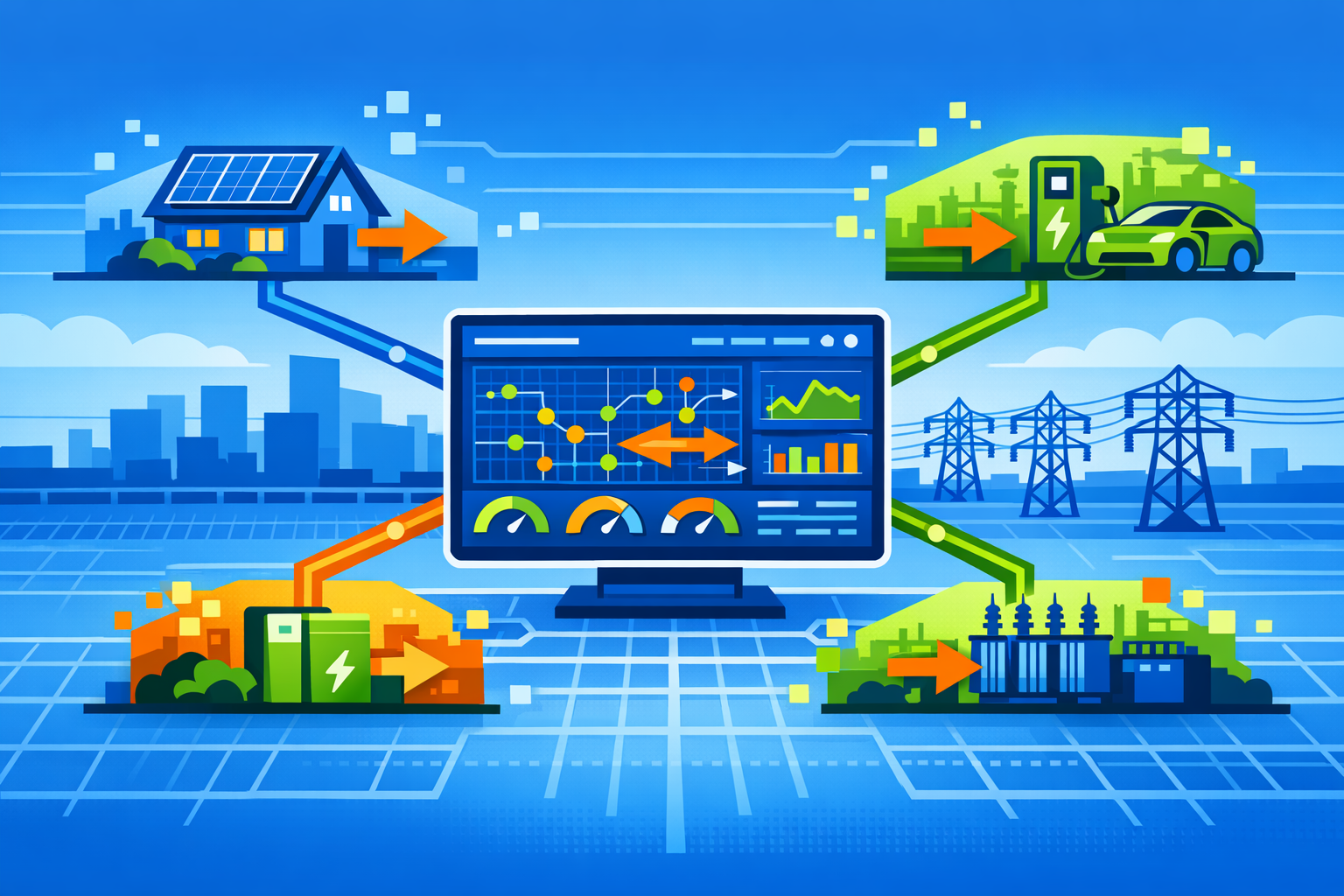
What is a Distributed Energy Resource Management System (DERMS)? A DERMS is a software platform used by utilities or distribution system operators (DSOs) to monitor, coordinate, and dispatch distributed energy resources - such as rooftop solar, battery storage, EV chargers, and demand response loads - in real time. It serves as the control layer between individual DER assets and grid operations, enabling aggregated market participation and supporting voltage and frequency stability.
How does FERC Order 2222 affect commercial building operators? FERC Order 2222 requires RTOs and ISOs to allow DER aggregations - including behind-the-meter assets in commercial buildings - to participate in wholesale electricity markets. For commercial building operators, this creates an opportunity to monetize flexible loads, battery storage, and demand response through capacity or ancillary services markets via an aggregator.
What interoperability standards are most relevant for DER-EMS integration? The core standards stack includes IEEE 1547-2018 (DER interconnection requirements), IEC 61850-7-420 (communications for DER functions in substation automation), IEEE 2030.5 (application protocol for utility-DER communication), and OpenADR (automated demand response signaling). NIST's IEC 61850 profile supporting IEEE 1547 provides an implementation roadmap bridging these frameworks.
What cybersecurity frameworks apply to DER and EMS deployments? Key frameworks include NERC CIP (Critical Infrastructure Protection standards), IEEE P1547.3 (cybersecurity for DER interconnection), and IEC 62351 (security for power system communications). Utilities increasingly require cybersecurity compliance as a formal procurement criterion for DERMS and EMS platforms.
Why do some pilots use edge computing rather than cloud-based EMS? Edge computing places processing capability at or near the DER asset, enabling sub-50-millisecond response times for frequency and voltage regulation - performance levels that cloud-dependent architectures with higher latency cannot consistently achieve. Edge nodes also maintain autonomous operation during network outages, a critical advantage for resilience in both rural networks and urban buildings with backup power requirements.