Delivery Robots Enter Mainstream in Smart Buildings
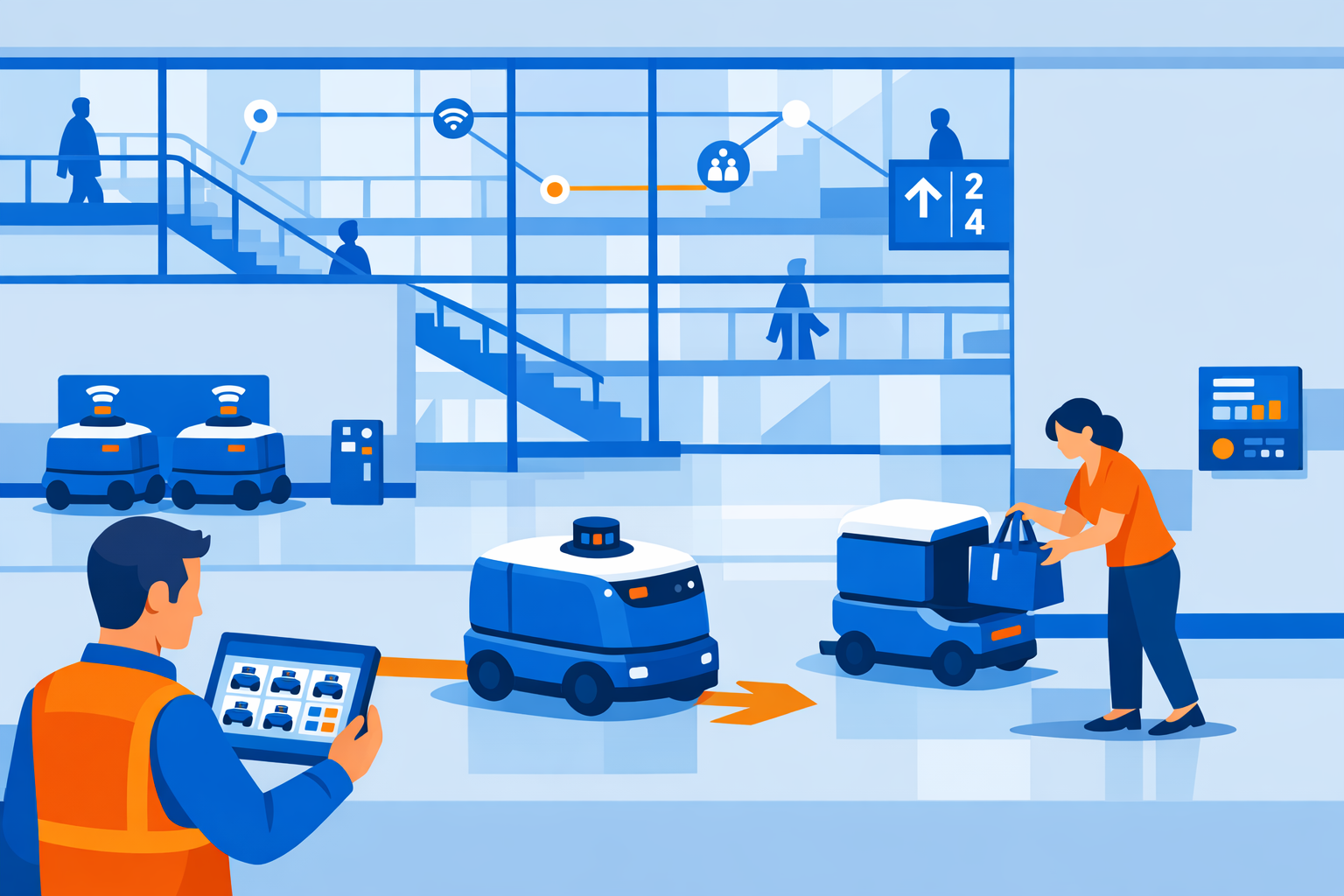
Autonomous delivery robots are advancing from pilot programs to broad deployment across office campuses, retail complexes, and mixed-use developments as of early 2026. This transition is introducing new operational requirements for facilities managers, including deeper integration with building management systems (BMS) and cloud-based orchestration platforms for fleet coordination, charging management, maintenance, and staff interactions.
Background
Last-mile delivery robots-also known as autonomous mobile robots (AMRs)-have traditionally operated in controlled environments such as warehouses. Recent advancements in interoperability, fleet management software, and sensor fusion technologies are now enabling these systems to function in occupied buildings and public spaces. At LogiMAT 2026 in Stuttgart, vendors highlighted operational interoperability between AMRs and stationary robots coordinated by cloud software, demonstrating the systems' broader logistical relevance beyond traditional intralogistics[1].
Regulatory progress has played a key role; multiple jurisdictions, including Germany, have approved certified robots to navigate sidewalks alongside pedestrians, providing a legal foundation for in-building and campus deployments[2].
Details
Fleet orchestration has become increasingly complex. Current architectures feature a top management layer that integrates with enterprise resource planning (ERP), warehouse management systems (WMS), or BMS, while intermediate layers handle traffic, scheduling, charging, and coordination among diverse brands[3]. At LogiMAT, companies such as NODE Robotics demonstrated scalable software platforms like NODE.OS, which enable plug-and-perform integration, hybrid navigation, and real-time localization (RTLS) using the VDA 5050 standard. This standard helps unify automated guided vehicles (AGVs) and AMRs within mixed fleets[4].
On the hardware front, mobile transport platforms such as ek robotics' X MOVE, operating with Neura Robotics' MAiRA, showcase unified transport and tote handling. Innok Robotics introduced its Induros AMR family, coupled with centralized fleet managers for planning and optimization[5].
Safety and privacy standards are also evolving. Market data indicates that substantial investments in sensor fusion-including LIDAR units and high-resolution cameras-have reduced incident rates by 50% in urban pilot zones such as San Francisco and Berlin. This reduction strengthens regulatory confidence and commercial adoption[6].
Outlook
With deployments expanding from single-building pilots to portfolio-wide rollouts, facilities managers must evaluate BMS integration options, interoperability standards like VDA 5050, and strategies for fleet charging and maintenance. Operators should prepare for orchestration platforms that align robotic operations with building occupancy and human workflows. Ongoing attention to regulatory changes and safety certification will be essential for scaling autonomous delivery across built environments.