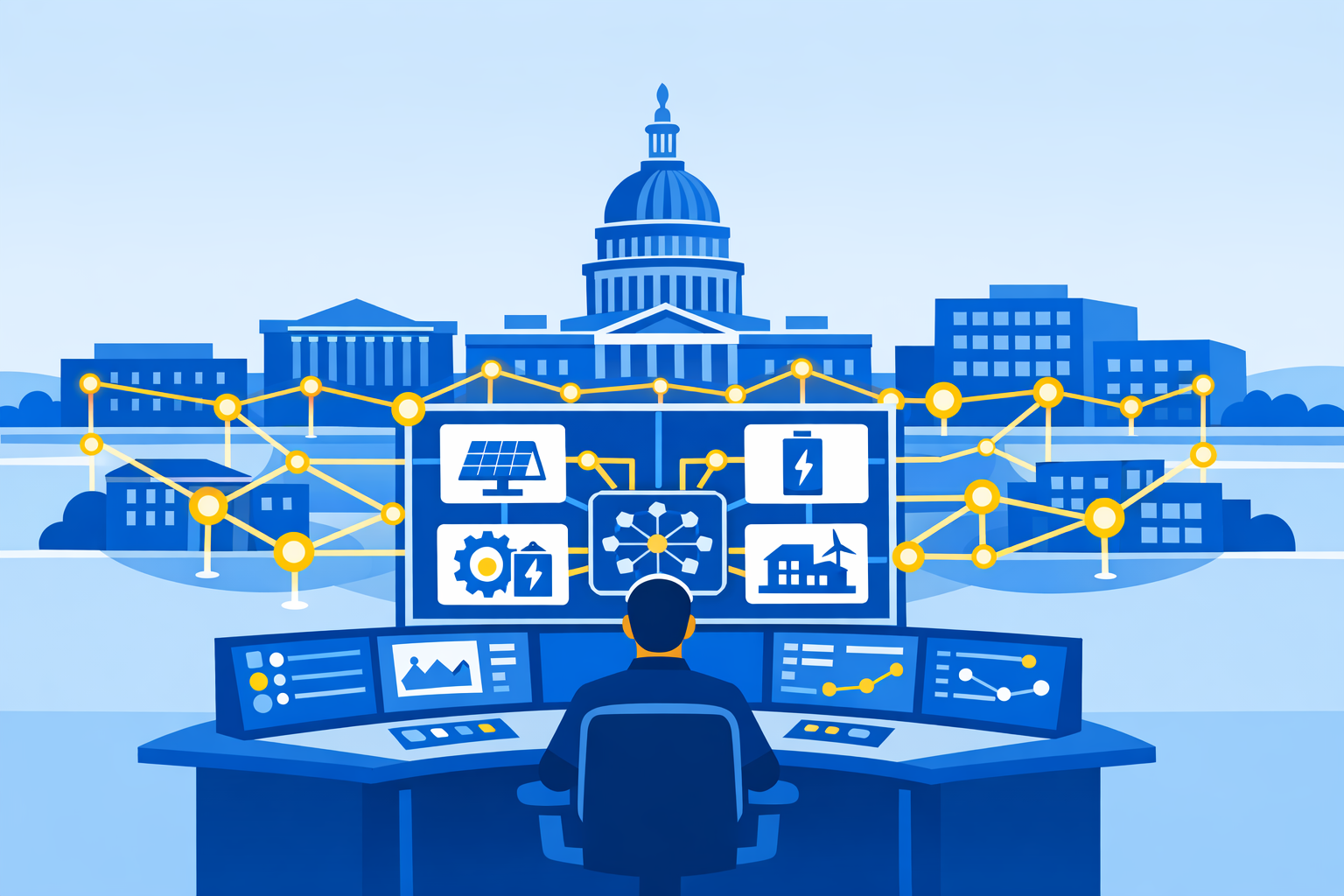
Federal agencies are sitting on some of the most significant building performance data ever assembled in the public sector. The question now is whether procurement, governance, and cybersecurity frameworks are mature enough to turn pilot-scale insights into enterprise-wide smart building deployments.
The Federal Smart Buildings Accelerator (FSBA), launched by the U.S. Department of Energy's Federal Energy Management Program (FEMP) in alignment with the Energy Act of 2020, concluded in September 2024 after two years of technical assistance, facility assessments, and grid-interactive efficient building (GEB) education across agencies including GSA, the Department of Veterans Affairs, and others. The program's final findings - documented by FEMP[2] - were candid: interest in smart building technologies is high, but implementation gaps in funding, staffing, and interoperability remain significant obstacles.
Those gaps define the core challenge for the next phase of federal building modernization. For procurement officers, system integrators, and building automation specialists working within or alongside the federal estate, the FSBA's legacy is less about what was demonstrated and more about what it revealed needs fixing.
What the FSBA Pilot Data Actually Showed
Technical assistance across the accelerator's cohort revealed several structural tensions: while interest in GEB and energy management information system (EMIS) software, on-site generation, and electric vehicles ran high, most agencies lacked the staff time to pursue adoption - and most faced funding constraints that prioritize maintenance over meaningful equipment upgrades.
The FSBA provided education, technical assistance, and facility assessments across all sizes and types of federal facilities to promote smart buildings and GEB technologies.
At the facility level, GSA's parallel $80 million smart building investment[3] - part of a broader $3.4 billion Inflation Reduction Act allocation for federal facilities - offered a clearer picture of what interoperable smart building deployment looks like in practice. Plans include a Unified User Interface for more than 150 federal buildings that will consolidate information currently spread across separate applications, improving access to equipment operation, energy usage, and sustainability performance data. GSA also committed to implementing best-in-class HVAC controls based on ASHRAE Guideline 36 for approximately 15 buildings - an investment expected to reduce energy usage and greenhouse gas emissions while improving occupant comfort.
The common thread: these outcomes require systems that communicate across vendors, expose standardized data, and can be monitored and secured at the operational technology (OT) layer. None of that is achievable without a deliberate shift in how federal solicitations are written.
How Procurement Is Shifting Toward Open Standards
The FSBA findings are accelerating a longer-running change in how federal agencies specify building automation systems (BAS). Historically, federal building procurements often resulted in proprietary, single-vendor deployments that were difficult to integrate, audit, or upgrade. That model is increasingly untenable - both operationally and from a cybersecurity standpoint.
Open standards combat market fragmentation and vendor lock-in, ensuring that enterprises are not tied to a single manufacturer's proprietary ecosystem. They encourage a competitive marketplace where organizations can select best-in-class solutions based on performance, security, cost, and feature set rather than vendor limitations.
The protocols underpinning this shift are well established. BACnet remains one of the most widely used building automation protocols worldwide - developed by ASHRAE as an open standard, it continues to evolve with innovations such as BACnet Secure Connect and ISO standardization. Meanwhile, semantic data layer standards are maturing rapidly. Key frameworks like Brick Schema, Project Haystack, and RealEstateCore are collaborating via ASHRAE 223P and other liaisons to enhance interoperability.
In 2025, an estimated 68% of new commercial construction projects in OECD countries included a specification requirement for open-protocol or standards-based building management, up from 41% in 2021. Federal procurement is part of this trend. Solicitations that once referenced only BACnet/IP now increasingly incorporate requirements for semantic data exports, open API access, and compliance with ASHRAE 223P profiles - giving agencies long-term data portability and reducing dependency on incumbent vendors at contract renewal.
Open Protocol Middleware - solutions supporting protocol translation across BACnet, Modbus, KNX, LonWorks, OPC-UA, MQTT, and REST APIs - has emerged as a critical enabler for brownfield retrofits, which represent the largest share of the addressable market given that the majority of global commercial building stock predates modern open-standard architectures.
For procurement officers specifying smart building upgrades, the practical implication is clear: solicitations should require documented interoperability evidence - such as BACnet Testing Laboratories (BTL) certification for connected devices - alongside data ownership clauses that explicitly preserve the agency's right to export and reuse operational data independent of the vendor's platform. The existing post Public Sector Is Rewriting the Rules on Open, Multi-Vendor Smart Buildings provides detailed guidance on how certification frameworks apply in tender contexts.
OT Cybersecurity: The Governance Layer That Most Pilots Skip
The interconnected nature of smart building systems - sensors, HVAC controllers, access systems, and EMIS platforms sharing network infrastructure - creates OT attack surfaces that traditional IT security frameworks were not designed to manage. The FSBA acknowledged this risk directly.
The Cybersecurity Considerations and Research Pathways for Grid-Interactive Efficient Buildings fact sheet produced under the FSBA describes how interconnected systems and smart devices should be designed with cybersecurity best practices to prevent security gaps and potential attack paths.
The regulatory backdrop for OT security in federal buildings has sharpened considerably since the FSBA began. NIST CSF 2.0, released in 2024, broadens its scope from IT systems to cyber-physical and operational technology, explicitly naming building and industrial systems - and it influences U.S. federal agencies while seeing wide adoption across healthcare, education, manufacturing, and real estate sectors. CISA's Cybersecurity Performance Goals 2.0, released in December 2025, apply to both IT and OT environments and reflect NIST CSF 2.0 updates for critical infrastructure owners and operators.
For building automation specifically, the compliance direction is clear: plaintext protocols such as standard BACnet, Modbus, and KNX no longer meet compliance expectations, and flat networks are incompatible with Zero Trust architecture. BAS networks must be divided into logical zones through micro-segmentation, device-level encryption must eliminate plaintext traffic, and access control policies must be tied to identity, role, and device posture.
Looking ahead, a new Executive Order sets January 4, 2027, as the date by which all IoT devices sold to the federal government must display the US Cyber Trust Mark, a standardized signal that a device meets rigorous federal security standards. Rather than replacing NIST SP 800-213, the Cyber Trust Mark reinforces those guidelines and turns them into a concrete, verifiable procurement requirement - agencies will soon build these secure-by-design principles into every contract and procurement decision.
In OT and industrial control system environments, visibility remains particularly difficult given legacy systems and distributed architectures. NIST's National Cybersecurity Center of Excellence (NCCoE) has responded by launching a dedicated OT visibility project[4] focused on demonstrating how to achieve asset inventory and monitoring in exactly these environments - a resource with direct applicability to federal building portfolios. The Electronics Insider analysis of OT-specific cybersecurity governance for BAS environments is covered in detail in Security-by-Design Surge in Building Automation Amid Rising Cyber-Physical Risks.
Scaling from Pilot to Enterprise: The Supply Chain Adjustment
The most underexamined dimension of the FSBA's conclusions is the supply chain challenge embedded in scaling from a single-building pilot to an agency-wide or multi-agency deployment.
Pilot projects typically benefit from dedicated integration support, bespoke configuration, and close vendor engagement that cannot be reproduced at scale. As federal agencies move toward enterprise deployments - particularly under performance contracting vehicles such as Energy Savings Performance Contracts (ESPCs) and Utility Energy Service Contracts (UESCs) - supplier requirements change materially.
Suppliers must demonstrate:
- Repeatable interoperability: products that integrate consistently across diverse legacy BMS environments, not just the specific building where a pilot was conducted
- Cybersecurity documentation: SBOMs (Software Bills of Materials), vulnerability disclosure policies, and a clear roadmap to Cyber Trust Mark compliance
- Data governance support: tools and contractual commitments that enable the agency to own, access, and migrate its operational data
- Outcome-based accountability: willingness to tie contract performance to measurable KPIs - energy savings, uptime, grid-responsiveness - rather than device installation milestones
The FSBA successfully promoted smart buildings and GEB technologies across federal agencies, laying the groundwork for future advancements in energy efficiency[1] - but the next phase requires matching that technical ambition with contracting frameworks capable of sustaining it. Agencies that ran successful pilots but relied on white-glove vendor support should treat the transition to scalable procurement as a distinct project, with its own requirements gathering, vendor qualification, and risk assessment process.
Takeaways for Stakeholders
For federal procurement and contracting officers:
- Embed open-standard protocol requirements (BACnet/SC, ASHRAE 223P) and BTL certification as minimum qualifications - not optional evaluation criteria
- Include explicit data ownership and portability clauses; avoid procurement language that ties operational data to a vendor platform
- Structure performance contracts around measurable outcomes, with defined exit criteria for pilot phases before broader rollout is authorized
For system integrators and MEP consultants:
- Anticipate that OT network segmentation and Zero Trust architecture compliance will be specified in federal solicitations; develop pre-qualified design approaches accordingly
- Treat SBOM documentation and Cyber Trust Mark roadmaps as standard deliverables in federal project proposals
- Engage early with agency IT and cybersecurity teams - BAS projects are increasingly reviewed through the same governance lens as enterprise IT procurement
For building automation vendors:
- BTL certification and BACnet/SC support are fast becoming baseline requirements, not differentiators
- Agencies will increasingly require semantic data exports in Brick Schema or ASHRAE 223P-compliant formats; proprietary data models create contractual risk
- The January 2027 Cyber Trust Mark deadline is a hard procurement barrier - not a voluntary aspiration
The federal smart buildings modernization effort is generating policy clarity faster than most agencies can absorb it. For suppliers and integrators willing to align their offerings with open standards, defensible cybersecurity governance, and outcome-based contracting, the federal estate represents a sustained and significant opportunity. For those still relying on proprietary integration advantages, the procurement landscape is narrowing rapidly.