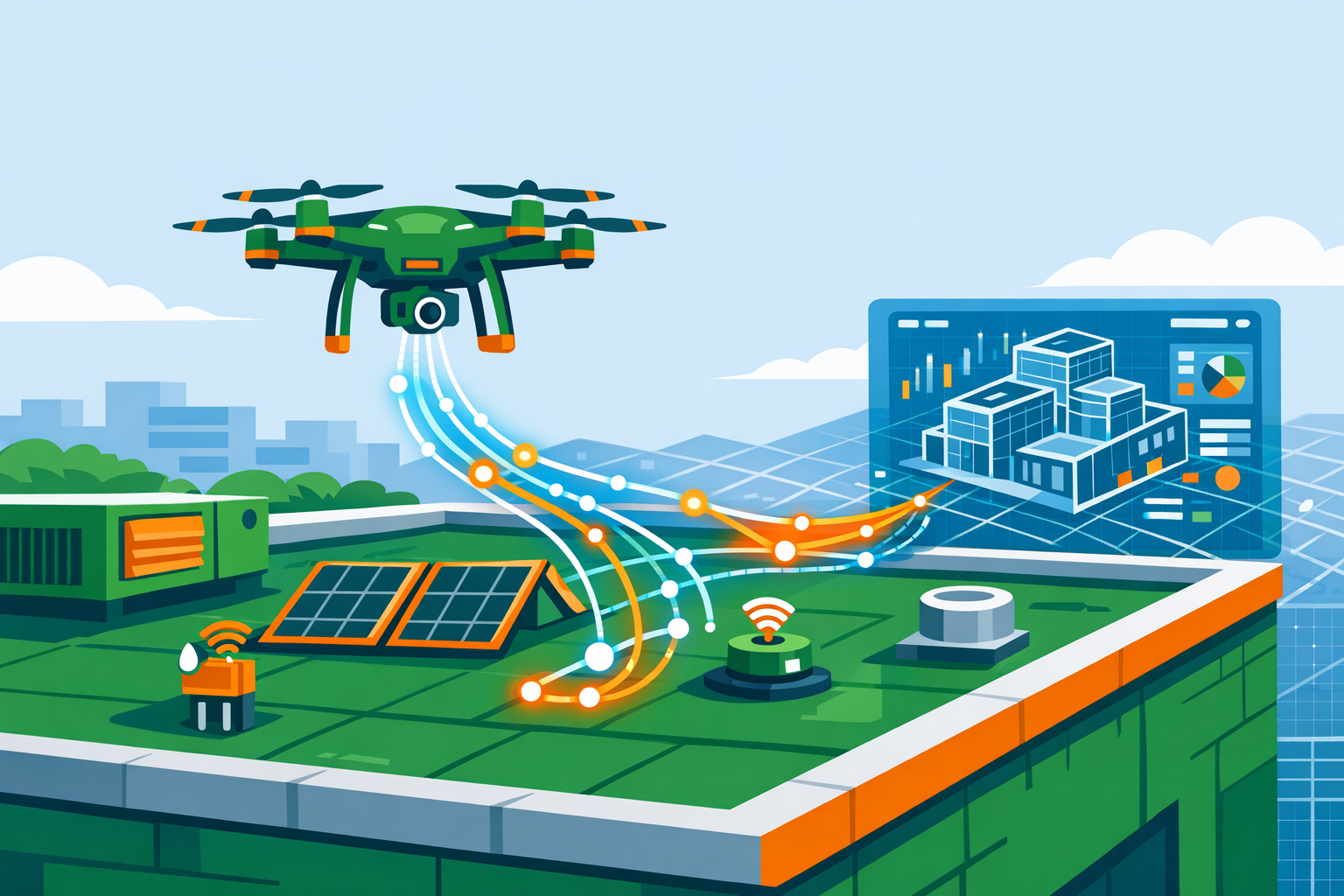
Executive summary: IoT-enabled drone roof inspections are advancing from pilot phases to systematic deployment across commercial real estate, data centers, healthcare campuses, and industrial facilities. Integration of continuous IoT asset monitoring, drone flyovers, Computerized Maintenance Management System (CMMS) integration, and digital twins is streamlining inspections, reducing costs, improving roof condition oversight, and extending asset lifespan-all within the framework of evolving regulations.
Why Roof Condition Monitoring Is Being Rethought
Roof assemblies in mission-critical and large commercial buildings are high-value assets with significant risk exposure. Premature failure may result in business interruption, safety incidents, and unplanned capital expenditures.
Moisture intrusion is identified as the top cause of early failure in commercial roof systems by building enclosure specialists[1]; many failures become evident only after internal leaks, when damage is advanced.
Key trends driving new monitoring methods include:
- Risk concentration: Large flat roofs in data centers, logistics hubs, and plants create single points of failure for IT, production, and tenant operations.
- Access and safety constraints: Conventional inspections involving rope or scaffolding are slow, expensive, and expose personnel to fall hazards.[2]
- Energy and sustainability requirements: Undetected insulation moisture and membrane defects worsen heat loss and increase HVAC loads, impacting efficiency targets.
- Portfolio scale: Multi-site owners require structured, comparable condition data across numerous buildings, which manual inspections cannot reliably deliver.
These challenges are fueling the convergence of IoT asset monitoring, drone roof inspection, and data-driven maintenance.
From Periodic Surveys to IoT-Based Roof Condition Monitoring
Continuous sensing now supplements periodic inspections. Smart roof systems provide condition insights between drone or manual surveys.
Smart roof and building IoT sensors
Industry vendors offer roof moisture monitoring solutions embedding sensors in roof assemblies.
Smart roof platforms such as VILPE Sense monitor humidity and temperature within roof structures and trigger automated alerts when thresholds are exceeded[3]
Wider building IoT deployments for asset monitoring commonly include:
- Humidity and temperature sensors around penetrations and mechanical enclosures.[4]
- Leak detection sensors in gutters, roof drains, and plant curbs.
- Vibration and tilt sensors on rooftop equipment, parapets, and structural elements to detect movement.[4]
- Energy and power quality meters to correlate envelope conditions with energy performance.[5]
These devices stream data to IoT platforms, enabling prompt anomaly detection and predictive maintenance.
Role in predictive maintenance strategies
IoT sensors facilitate a shift from reactive repairs toward condition-based maintenance:
- Humidity and leak sensor thresholds trigger events for facility teams before visible leaks occur.
- Long-term environmental data trends distinguish short-term weather spikes from persistent issues.
- Historical sensor data informs predictive maintenance models to estimate intervention timing.[6]
For roof systems, this reduces uncertainty between inspections and directs aerial surveys toward high-risk areas.
Drone Roof Inspection as a High-Fidelity Data Layer
IoT provides continuous, low-bandwidth data; drones deliver rich, high-resolution datasets on demand.
Visual and thermal inspection capabilities
Current drone workflows typically integrate:
- High-resolution RGB imagery to identify surface defects, ponding, membrane seams, and flashings.
- Thermal (infrared) imaging for detecting trapped moisture, insulation voids, and thermal bridges.[1]
- 3D models or point clouds for slope and drainage analysis, supporting digital twin initiatives.[7]
Case studies indicate drone inspections can reduce field time by 80-90% and costs by 20-50%, depending on roof complexity and site access[8]
Accelerated inspections enable greater frequency, including post-weather-event assessments, without substantially increasing labor.
Risk reduction for personnel and operations
Drone-based inspections decrease:
- Work-at-height exposure for engineers and contractors, lowering fall risk and liability.[9]
- Operational disruption, as most surveys require no interior access or major setup.
- Scaffolding and MEWP (mobile elevating work platform) needs, which can be a major inspection cost factor.[10]
For critical sites, reduced physical intrusion is as significant as cost efficiency.
Data Pipeline: From Drone and IoT Streams to CMMS and Digital Twin
The primary distinction between isolated drone surveys and portfolio-wide monitoring is the underlying data architecture.
Avoiding silos with standardized data models
Digital twin and smart building initiatives emphasize the use of standard schemas like Industry Foundation Classes (IFC) and Brick to unify asset, sensor, and spatial data.[11]
Recent research demonstrates:
Integrated frameworks can link building information models, LiDAR or photogrammetry-based maps, IoT sensor streams, and indoor positioning within a unified digital twin for real-time facility management[12]
For roof condition monitoring, this allows:
- Spatial alignment of drone imagery, point clouds, and defect annotations with the building model.
- Representation of IoT sensors and equipment as objects with attributes and time-series data.
- Correlation of alerts and analytics with precise locations, construction layers, and maintenance history.
CMMS integration and automated maintenance workflows
Inspection and sensor data can directly populate a CMMS, closing information gaps.
CMMS and industrial IoT vendors describe architectures where:
Sensor thresholds automatically create CMMS work orders via event ingestion and rules evaluation[6]
Drone data integration follows a similar pattern:
- Drone inspection platforms convert annotations into structured defect records (e.g., "wet insulation - 25 m² at grid B3").[13]
- These records link to specific assets within the register.
- CMMS work orders generated include images, severity ratings, and recommended actions.
Reference implementations are in place, combining drones, AI-powered image recognition, and IBM Maximo for semi-automated defect detection and work order generation.[14]
Feeding and maintaining digital twins
Inspection and sensor outputs underpin the ongoing integrity of digital twins for buildings and portfolios.
Industrial case studies show drones capture point clouds and imagery to maintain full-plant digital twins for ongoing maintenance and change tracking[15]
A roof-centric digital twin enables:
- Time-lapse tracking of membrane condition and interventions across sites.
- Scenario analysis for phased replacement vs. targeted repairs.
- ESG and resilience reporting by connecting roof condition to energy performance and climate risk.[11]
Regulatory and Safety Framework for Drone Roof Programs (EU Focus)
Drone deployments for roof inspections in Europe must comply with frameworks from the European Union Aviation Safety Agency (EASA).
EASA categories and operational models
Drone operations in the EU fall under Regulations (EU) 2019/947 and 2019/945, setting "Open," "Specific," and "Certified" categories by risk level[16]
Key considerations:
- Open category (A2/A3): Applies to low-risk flights with lighter drones, away from uninvolved people and sensitive areas, typically within visual line of sight (VLOS) and up to 120 m above ground.[17]
- Specific category: Required for higher-risk flights in urban areas, complex sites, or beyond VLOS (BVLOS). These need risk assessment (SORA or predefined) and national aviation authority authorization.[18]
Portfolio-wide programs often blend Open-category flights for straightforward sites with Specific-category approvals for complex ones.
On-site safety and data protection
Facility and electrical teams should integrate drone operations into existing safety management:
- Establish roof access control and communication between drone teams and facility control rooms.
- Coordinate with high- and low-voltage safety procedures near overhead lines or electrical equipment.
- Enforce data protection policies under GDPR and aviation guidelines for captured imagery, especially near neighboring properties.[16]
Cost-Benefit Comparison: Traditional vs IoT-Enhanced Drone Roof Inspections
Evidence from recent case studies
Analyses from building and infrastructure inspections provide key metrics:
- Studies show drone-based inspections reduce costs by 20-70% and surveying time by 50-90% compared to manual methods, mainly due to decreased scaffolding, smaller teams, and faster data capture[19]
- Commercial roof studies show thermal drone inspections detecting moisture in about 20% of a roof, enabling targeted $45,000 repairs versus $150,000 full replacement, saving over $100,000[20]
- Market data shows typical drone roof inspections cost $75-$500 per building, with fieldwork completed in 30-60 minutes, depending on roof size and complexity[21]
Comparative overview
| Dimension | Traditional manual survey | Drone + IoT asset monitoring |
|---|---|---|
| Access method | Scaffolding, ladders, MEWPs, rope access | Drone (UAS) flights; fixed IoT sensors on roof |
| Typical inspection duration | Hours to days per large roof | 30-60 minutes flight time plus processing per roof |
| Safety profile | Significant work-at-height exposure | Personnel remain at ground level |
| Direct inspection cost | High labor and equipment | Lower labor; minimal access equipment |
| Data richness | Notes, limited photos | High-res imagery, thermal maps, 3D models, sensor data |
| Inspection frequency | Annual/multi-year; weather-dependent | Frequent flights plus continuous IoT monitoring |
| Integration with CMMS/DT | Mostly manual data entry | APIs and connectors for CMMS and digital twin integration |
In mission-critical settings, added advantages include expedited post-storm assessments and reduced downtime risk in maintenance decision-making.
Implementation Challenges and Governance Considerations
Despite technical and economic advantages, several barriers can affect large-scale adoption.
Data integration complexity
Digital twin and smart building research frequently cite difficulties harmonizing data-from BIM, IoT, BMS, and inspections-into coherent operational dashboards.[11]
For drone and IoT roof monitoring, these challenges involve:
- Aligning coordinate systems across point clouds, CAD/BIM models, and sensor placements.
- Normalizing defect taxonomies and severity ratings between vendors and service partners.
- Managing lifecycle, storage, and retrieval for large image and 3D data sets.
Cybersecurity and resilience
Drone and IoT networks expand the building systems' attack surface:
- Secure wireless links between drones, controllers, and cloud services.
- Segment IoT sensors from critical operational technology (OT) networks and require strong authentication.
- Implement data governance for retention, encryption, and incident response.
Best practices mirror those for OT and building automation, with added needs for managing mobile assets and outside service providers.
Data ownership and access rights
Portfolio programs may present issues such as:
- Ownership and use of images, models, and analytics-by the building owner, operator, or service provider.
- Data sharing with insurers, tenants, or contractors-under defined terms.
- Retention of historical inspection data when switching vendors or CMMS platforms.
Clearly defined contracts and governance models support continuity, value retention, and analytics longevity.
Practical Steps for Electrical and Facility Teams
For organizations planning or expanding IoT-enabled drone roof initiatives, a phased approach can help:
Define use cases and KPIs
- Prioritize portfolios where leaks or outages pose high risks.
- Set measurable goals: reduced leaks, fewer emergency repairs, improved inspection cycle time, or energy savings.
Map existing data and systems
- Inventory current assets, CMMS, BMS data, and active IoT sensors.
- Identify gaps in spatial data (e.g., BIM or 3D models) required for a digital twin.
Pilot integrated workflows
- Test end-to-end pilots combining drone inspections, IoT sensors, and CMMS integration.
- Validate data quality, detection accuracy, and work order automation.
Standardize data models and reporting
- Use common location references and defect taxonomies across vendors.
- Demand API and export capabilities from drone and IoT platforms.
Plan for regulatory compliance and safety
- Involve internal health, safety, legal, and data protection teams early.
- Develop procedures aligned with EASA categories, local regulations, and site hazards.
Scale through governance and training
- Create governance teams for IT/OT security, data management, and operations.
- Build skills in drone oversight, data analytics, and digital twin utilization, even when outsourcing flights.
Frequently Asked Questions
How often should commercial roofs be inspected when using drones and IoT sensors?
Operators typically perform at least one comprehensive aerial inspection annually, supplemented after major weather events. Continuous IoT monitoring enables earlier anomaly detection and may extend intervals between full surveys when data indicates stable conditions. Inspection frequency should align with codes, warranty terms, and risk tolerance.
Can BVLOS drone operations be used to inspect multiple sites in a single mission?
Beyond Visual Line of Sight (BVLOS) operations can support multi-site inspections but usually fall under the Specific EASA category, requiring detailed risk assessments and authorization.[22] In built-up areas, operators typically use Visual Line of Sight (VLOS) missions per site, optimized with standard flight plans and automation.
What types of sensors are most useful on roofs for IoT asset monitoring?
Common sensors include:
- Embedded humidity and temperature probes in roofing assemblies.
- Leak detection cables or point sensors near drains, penetrations, and roof equipment.
- Vibration and displacement sensors for structural health and equipment monitoring.
- Power and energy meters on rooftop infrastructure to link performance with envelope issues.[3]
How does CMMS integration change day-to-day maintenance workflows?
Proper integration allows CMMS systems to receive:
- Automatically generated work orders from IoT threshold events.
- Structured defect entries from drone inspections with images and precise locations.
This automation streamlines planning and scheduling, providing richer data for defining repair scopes and briefing contractors. Historical data further supports decisions on inspection intervals and capital planning.
Do digital twins of roofs require full-building models?
No. Many projects begin with a partial or domain-specific digital twin focused on roofs and associated plant. This combines simplified geometry, sensor locations, and inspection history. Over time, these may expand into full-building twins covering interiors and systems, using industry standards.