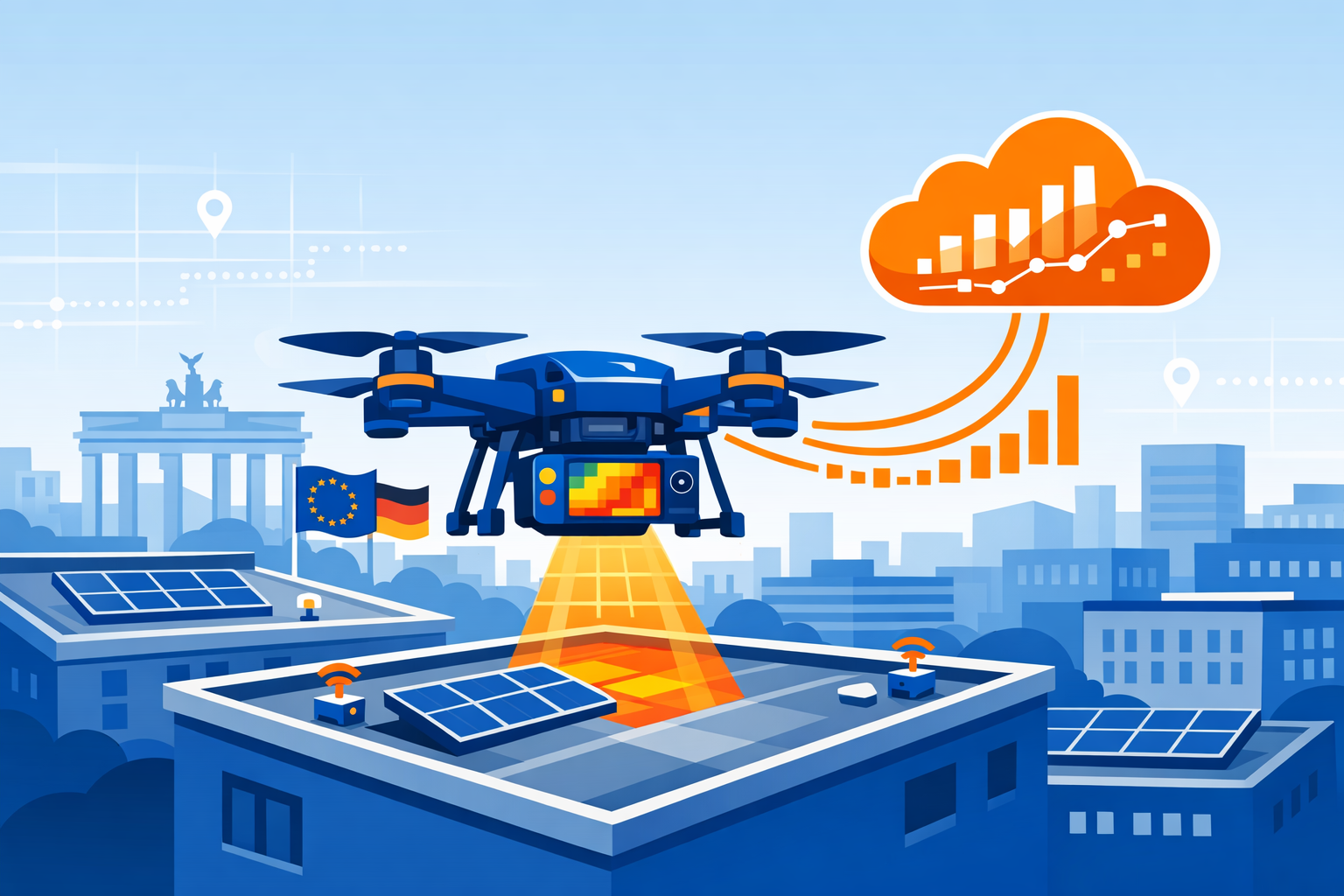
Property management and building automation firms are increasingly using drones equipped with Internet of Things (IoT) sensors to conduct roof inspections on commercial building portfolios. This shift is driving efficiency gains in predictive maintenance workflows. Recent regulatory changes in Germany and the European Union (EU) are shaping the adoption of these unmanned aerial vehicles (UAVs) in smart buildings by introducing requirements such as remote identification and pilot certification.
Background
Drone-assisted inspections present a scalable alternative to traditional roof assessments, which often require costly scaffolding, manual labor, and exposure to safety risks. In Germany, UAVs weighing more than 250 grams must be labeled with the owner's information, and operators need pilot certification for drones over 2 kilograms. Flights exceeding 5 kilograms or conducted at night require additional permissions from the federal aviation authority (BAF) . Since 2023, drones classified as C1 to C3 must comply with remote identification rules, transmitting operator identity and flight data via radio to promote airspace transparency . These evolving regulations directly affect the integration of drone-based workflows in smart facility management.
Details
Case studies show notable cost savings and operational benefits. At one commercial facility, a thermal drone assessment reduced traditional roof inspection costs from $150,000 to $45,000 for targeted repairs, resulting in over $103,800 in avoided replacement expenses . Another building portfolio recorded a 75% reduction in inspection costs-from $1,500 to $400 per site-and a similar reduction in inspection time . In Germany, drone inspections are priced between €150 and €400, depending on property size, which is significantly less than scaffold-based methods that often exceed €1,800 . Technical platforms now centralize high-resolution imagery, thermal data, LiDAR measurements, and IoT-derived metrics to enhance predictive maintenance across building portfolios .
Service providers are integrating drone inspections with artificial intelligence (AI) analytics and cloud-based systems to improve monitoring consistency for widely distributed assets. Industry sources report that fleets using drones and AI enable property managers to conduct more frequent, standardized inspections, cutting costs by 30-50% and reducing operational downtime by around 20% compared to traditional approaches .
Outlook
As building owners expand drone-assisted inspection networks, the need for interoperable data standards and robust security controls grows. Regulatory changes-especially those governing UAV remote identification and operating permissions-will continue to shape strategies for smart building asset monitoring.