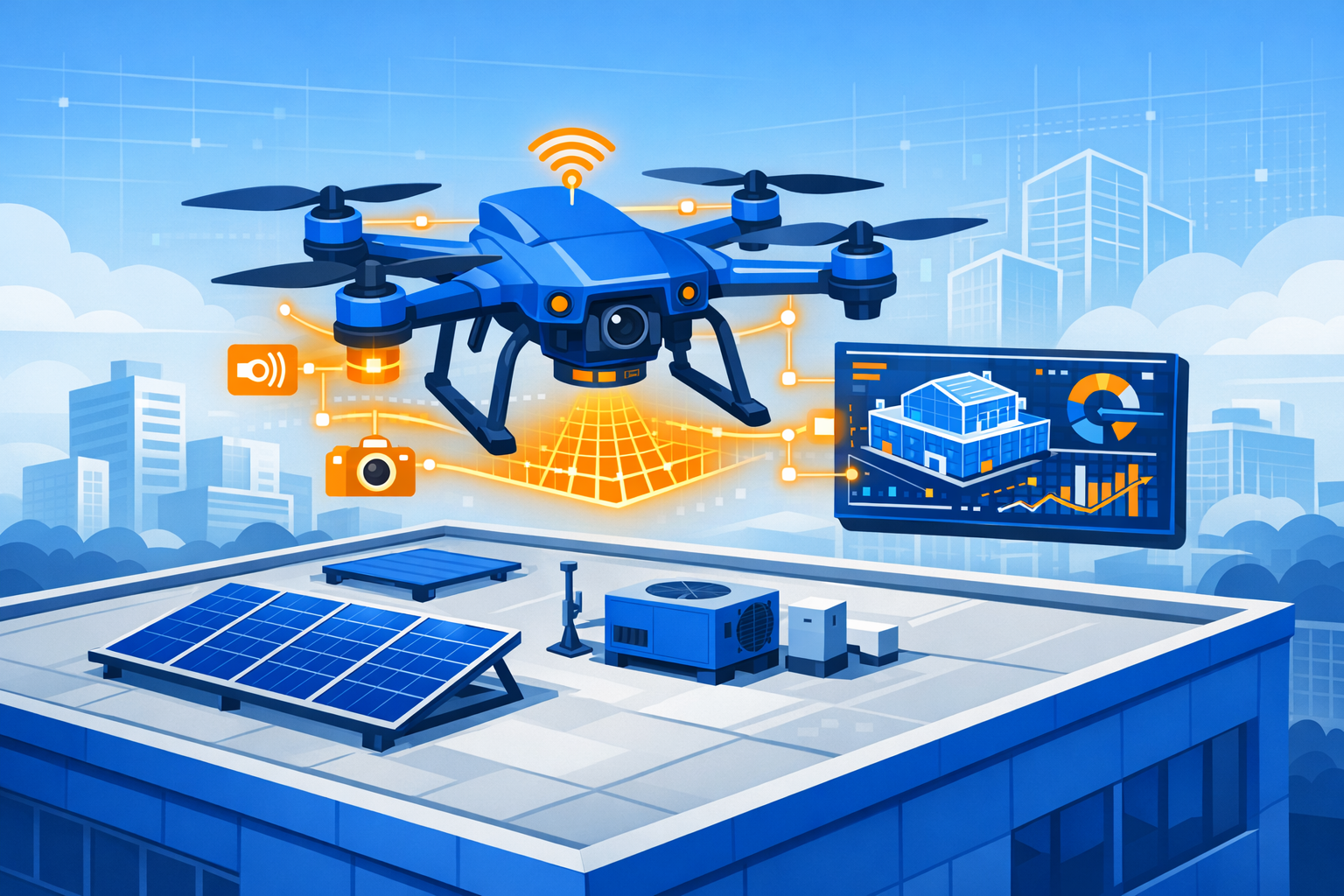
Facility managers and insurers are increasingly deploying drones equipped with Internet of Things (IoT) sensors for rooftop and façade inspections, integrating real-time data with building management systems (BMS). These IoT-enabled operations provide automated, high-resolution imagery and analytics, streamlining asset tracking, enhancing safety, reducing costs, and enabling predictive maintenance across diverse building portfolios. Advances in artificial intelligence (AI) analytics and digital twin integration contribute to scalability and operational resilience.
Background
IoT-enabled drones combine unmanned aerial vehicle (UAV) platforms with sensor networks and data analytics, transforming routine visual inspections into ongoing asset health monitoring. Traditional inspections often require manual access with scaffolding or elevated platforms, which increase costs and safety risks. Incorporating high-resolution imaging, thermal cameras, LiDAR, and machine learning, drones autonomously collect and analyze condition data, then integrate it with existing BMS technology, improving trend tracking and enabling informed, proactive maintenance.
Details
Platforms such as Asseti allow drones to capture detailed imagery of roofs and façades, integrating this information into asset management systems for continuous condition monitoring. This enables maintenance teams to detect trends and plan interventions at an early stage, according to Asseti's documentation. Drone inspections enable comprehensive roof and façade surveys without the need for access equipment, produce repeatable imagery for trend analysis, support early detection of issues such as damage, corrosion, or water ingress, and enable real-time monitoring with faster response coordination.
Technology providers report notable efficiency gains. Studies on industrial drone inspections indicate a 75-85% reduction in inspection time, operational cost savings of 30-70%, and a 20-30% decrease in insurance risk due to improved safety and auditability. Drone solutions cut inspection time by 75% to 85% and reduce operational costs by up to 70%; integrated drone technology can lower total cost of risk by 20% to 30%. These efficiencies result from accelerated risk assessment and reduced exposure to hazardous environments.
In Europe, drones help achieve compliance with regulations such as the UK's Building Safety Act 2022, which requires comprehensive external inspections every five years for structures over 18 meters. Drones provide compliant photographic evidence mapped by location, input directly into asset management systems, supporting insurance claims and warranty tracking. Drone surveys provide the detailed photographic evidence and condition reports required for building safety documentation under mandatory inspection regimes.
Service providers such as Leadec in Germany use multi-rotor drones equipped with 20-megapixel cameras and 4K video for preventive roof and façade inspections, integrating results into Computer-Aided Facility Management (CAFM) systems. This approach facilitates routine autonomous flights, rapid analysis of surface conditions, and expedited repair initiation, particularly in challenging seasonal environments. Leadec's high-resolution drone inspections integrate into CAFM systems; drones can fly semi-autonomously in winter to monitor snow-covered roofs and feed real-time imagery for quick repair initiation.
Outlook
As drone inspection adoption increases, facility teams and insurers are expected to further integrate drone-generated data with building automation platforms, using AI to guide maintenance prioritization and support uptime planning. Evolving regulatory frameworks and digital twin models will accommodate automated inspection records. Future IoT-enabled drone systems may advance toward 'drone-in-a-box' deployments with beyond-visual-line-of-sight (BVLOS) capabilities, allowing for autonomous, scheduled monitoring across property portfolios.