AI-driven energy management is transitioning from a cost-optimization tool to a safety-critical control layer in data centers, telecom hubs, and large commercial campuses. As vendors such as Qcells expand AI- and cloud-based power management frameworks for hyperscale data centers, operators now treat AI energy management systems (EMS) as high-risk infrastructure subject to formal safety and cybersecurity benchmarks.
This article examines how emerging safety benchmarks for AI energy management may reshape risk governance, procurement criteria, and operational practices in critical facilities. Qcells' recent initiatives provide an indication of broader market trends.
1. Why AI Energy Management Has Become Safety-Critical
AI energy management systems now intersect with grid reliability, cybersecurity, and business continuity.
In 2024, data centers were estimated to consume around 415 TWh of electricity-about 1.5% of global demand-with the International Energy Agency (IEA) projecting this may exceed 945 TWh by 2030. This surge, largely driven by AI workloads, is straining local grids and interconnection queues.
Simultaneously, AI is being integrated across the energy stack:
- Demand response and load shaping in data centers and campuses
- AI-based predictive maintenance for photovoltaic (PV), storage, and low/medium-voltage (LV/MV) equipment
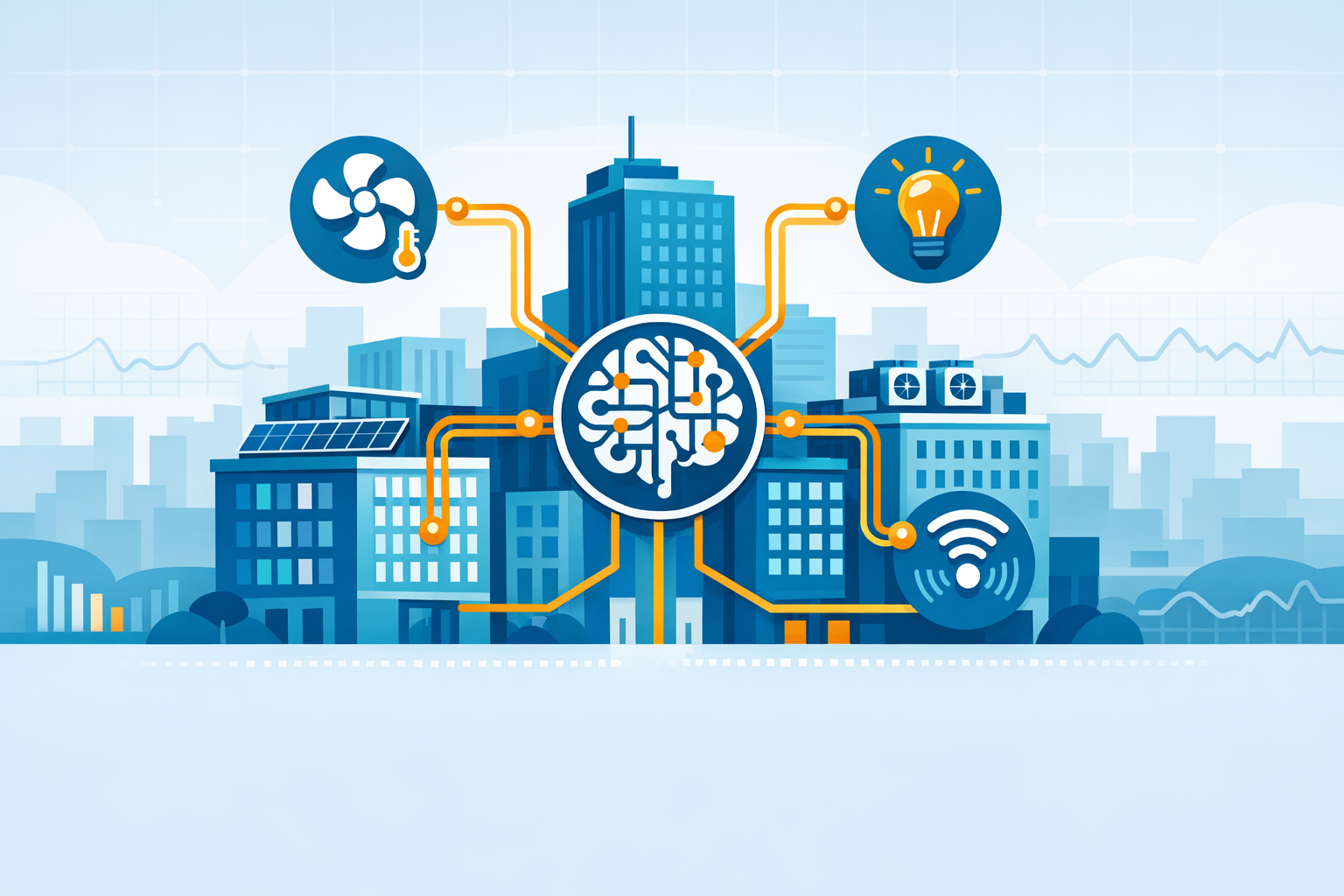
- Optimization of building energy management systems (BEMS) for HVAC, lighting, and distributed resources
- Real-time grid support with smart inverters and storage controllers
The global building energy management systems market is projected to grow from about USD 4.5 billion to roughly USD 14.6 billion by 2033, implying a compound annual growth rate near 12.5%. This trend indicates increasing delegation of control decisions in commercial buildings to software, including AI models.
Concurrently, attackers are pivoting from traditional IT perimeters to operational technology (OT). Research indicates attacks on building automation protocols rose from roughly 2% of industrial protocol attacks in 2023 to 9% in 2024, highlighting building and campus systems as part of the critical threat landscape.
Within this context, any EMS using AI to autonomously curtail loads, dispatch batteries, or control on-site generation becomes a safety-critical component, not merely an efficiency tool.
2. Regulatory and Standards Backdrop: AI Act, NIS2, and IEC 62443
2.1 EU AI Act: High-Risk Classification for Energy Infrastructure AI
The EU AI Act establishes a risk-based framework for AI, with defined requirements for "high-risk" systems.
AI systems managing critical infrastructure-such as electricity, gas, and other essential services-are classified as high-risk under the EU AI Act, mandating strict compliance by August 2026 in areas like risk management, data governance, transparency, and human oversight.
In critical facilities, AI-enabled EMS must provide:
- Documented risk management covering foreseeable misuse, failures, and cascading grid impacts
- High-quality, representative training data with documented lineage
- Human-in-the-loop controls, including override and emergency shutdown functions
- Technical documentation and logs suitable for regulatory audits
2.2 NIS2: Board-Level Cybersecurity Accountability in Energy
The NIS2 Directive revises EU cybersecurity obligations for essential and important entities.
NIS2 expands mandatory cybersecurity and incident-reporting requirements to 18 sectors, including energy, and introduces explicit board-level accountability and minimum controls for business continuity, incident handling, supply-chain security, and access control.
For operators of data centers, telecom networks, and large campuses, this means:
- Energy management platforms and AI components now fall within the scope of cybersecurity risk management
- Supplier risk-including EMS vendors and cloud providers-is a regulatory issue
- Inadequate controls or delayed incident reports can lead to significant penalties and personal liability for leadership
2.3 IEC 62443, ISO 27001, and Sector Standards
IEC 62443 defines cybersecurity requirements for industrial automation and control systems (IACS), and is increasingly relevant for smart grid and energy applications.
Together with ISO/IEC 27001 (information security management systems) and grid standards such as IEC 61850 or IEEE 1547 for distributed energy resources (DER), these standards provide the foundation for an AI energy management safety benchmark.
Key considerations for facility and energy managers:
- AI EMS should be mapped explicitly to IEC 62443 security requirements (e.g., 62443-3-3) for segmentation, access control, and monitoring
- Vendor development practices should conform with secure product development guidance (e.g., IEC 62443-4-1) and be evidenced through process artifacts
- Cloud-hosted EMS components should be included in ISO 27001 and NIS2 compliance scopes
3. Qcells' Emerging Role in AI Energy Management Governance
Qcells, historically recognized for PV modules and storage, is now offering integrated energy and smart building solutions.
Qcells now provides "fully integrated clean-energy solutions," including intelligent energy management systems, and has partnered with Microsoft to develop AI- and cloud-based power management software targeted at data center energy management standards.
Though details of any formal "industry-first" AI safety benchmarks are not public, Qcells' actions highlight market trends:
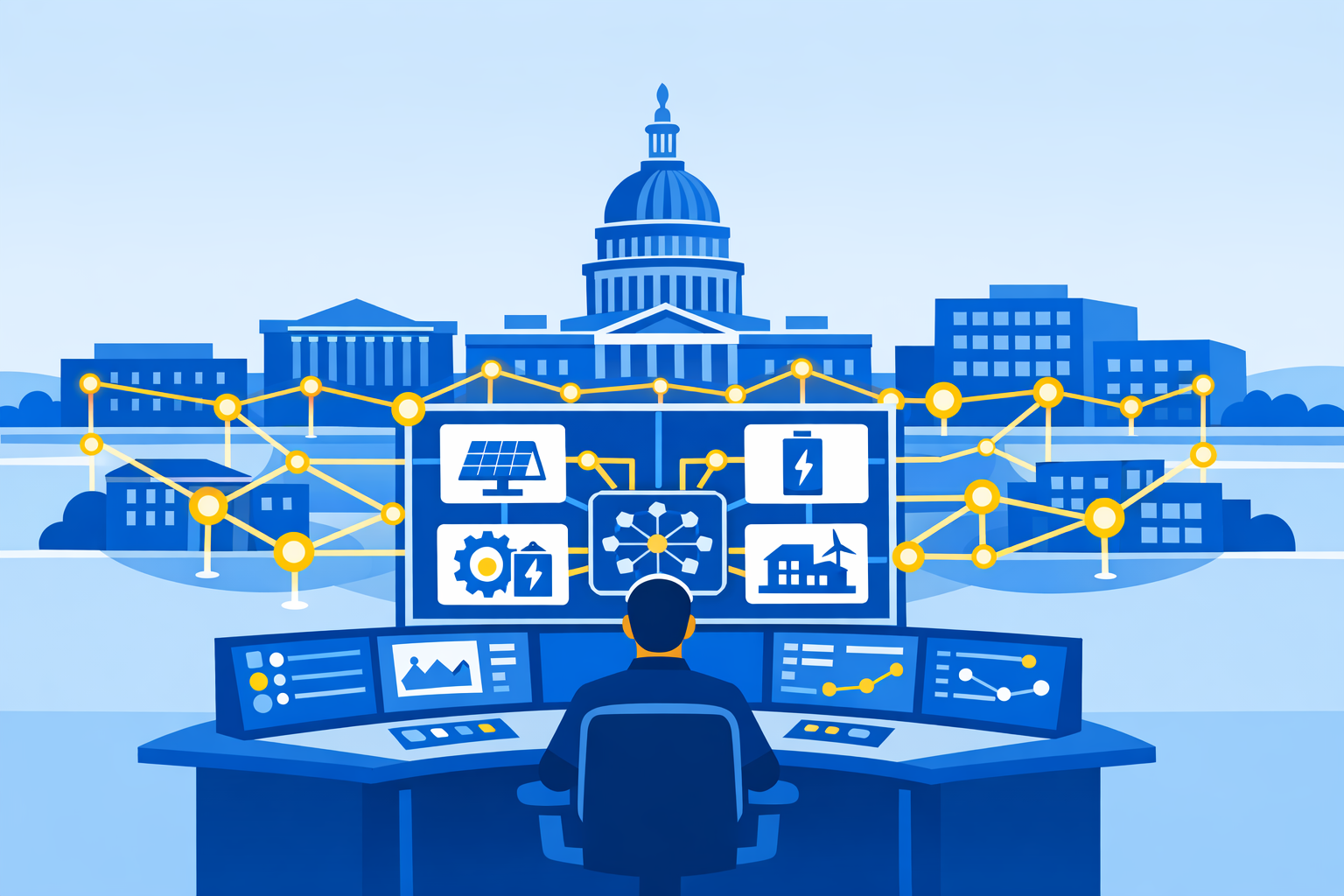
- AI-assisted data center power orchestration to align IT loads with available power
- Integration of renewables, storage, and flexible loads under a unified AI control framework
- Emphasis on grid-supportive behavior-including peak-shaving, frequency services, and capacity reservation
For operators, these developments indicate that large vendors expect AI EMS evaluations to consider not only energy efficiency but also evidence-based safety, cybersecurity, and compliance.
4. What an AI Energy Management Safety Benchmark Should Cover
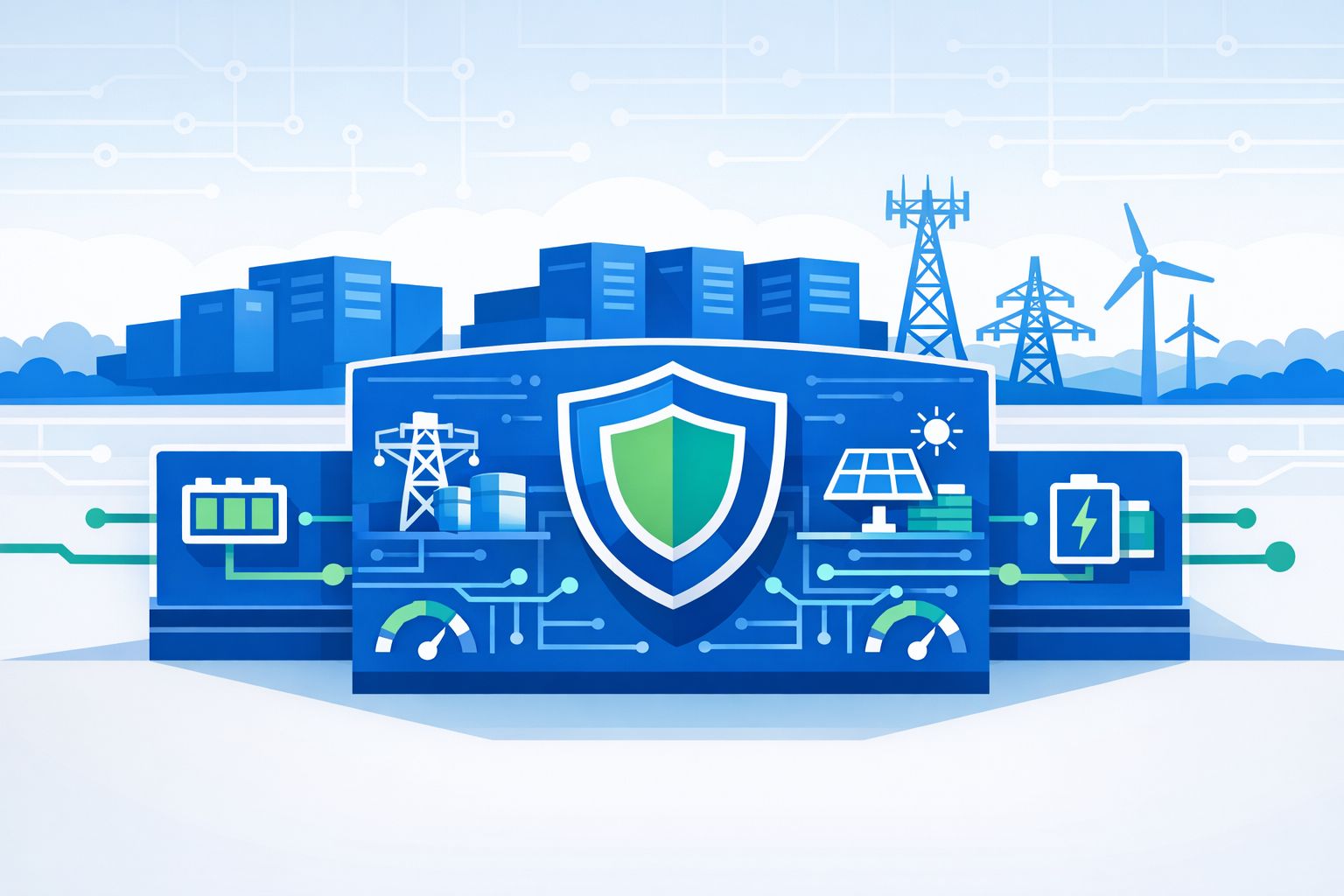
A safety benchmark for AI EMS would likely be structured on four technical pillars:
- Data and model governance
- Cybersecurity and adversarial resilience
- Explainability and operator trust
- Fail-safe behavior and grid contingencies
4.1 Data and Model Governance
AI EMS safety hinges on data quality and model management.
Key controls:
- Data provenance and integrity: secure telemetry, cryptographic signing, and anomaly detection
- Bias and drift monitoring: automated checks for concept drift and out-of-distribution scenarios
- Versioned models and rollbacks: managed model promotion, staged rollouts, and rapid fallback if performance degrades
- Offline validation: stress-testing models against historical incidents before deployment
AI-based PV performance and fault detection studies report mean daily energy estimation errors near 6% and fault-classification accuracies above 80%, contingent on training and validation with quality operational data. Such accuracy is only meaningful with robust data governance.
4.2 Cybersecurity and Adversarial Resilience
AI EMS expand the attack surface, introducing risks like data poisoning, model theft, and adversarial control signals.
Required controls:
- Compliance with IEC 62443 hardening for OT environments
- Strong authentication and least-privilege authorization between EMS, field devices, and cloud
- Encrypted communications (e.g., TLS with certificates) for all control and telemetry channels
- Segmentation and zero-trust principles between IT, OT, and AI infrastructure
- Regular penetration tests and red-team exercises addressing AI-specific threats
4.3 Explainability and Operator Trust
Operators must understand and question AI decisions in critical settings.
Research indicates that explainable AI frameworks for building energy management improve user trust and facilitate error detection through clear explanations of optimization actions.
A benchmark should require:
- Human-readable rationales for significant control actions
- Dashboards showing feature importance for key decisions
- Model documentation ("model cards") explaining data sources, limitations, and validated regimes
- Procedures to allow operators to override or escalate actions when explanations conflict with observed reality
4.4 Fail-Safe Behavior and Grid Contingencies
AI EMS must default to safe states during faults or cyber incidents.
Core criteria:
- Defined safety envelope: restrictive bounds on allowable AI control changes
- Graceful degradation: automatic fallback to deterministic schedules on model or communications failure
- Local autonomy during WAN outages with approved safety profiles
- Black-start and islanding policies to protect grid integrity during contingencies
Hybrid security architectures that pair AI-driven anomaly detection with tamper-resistant logs improve malicious event detection and data integrity in smart grids. Such practices help prevent propagation of corrupted control data.
4.5 Summary Table: Benchmark Dimensions and Buyer Questions
| Benchmark Dimension | Example Requirements / Evidence | Relevant Standards / References |
|---|---|---|
| Data & Model Governance | Data lineage docs, drift dashboards, tested rollbacks | EU AI Act, ISO 27001 |
| Cybersecurity & Resilience | Segmentation diagrams, pen-test reports, IEC 62443 mapping | NIS2, IEC 62443, ISO 27001 |
| Explainability & Transparency | Model cards, operator explanations, audit logs | EU AI Act |
| Fail-Safe & Contingency Handling | Safety envelope specs, fallback modes, incident runbooks | Grid codes, IEC 62443 |
5. Operational Impact on Critical Facilities
5.1 Data Centers and Hyperscale Campuses
Data centers anchor the AI-energy relationship.
IEA projects global data center electricity demand could rise from roughly 415 TWh in 2024 to nearly 945 TWh by 2030, with AI workloads accelerating this trend.
For operators, safety benchmarks affect:
- Connection agreements and grid codes: Demonstrated safe behavior during curtailment or frequency events may be required
- Capacity planning: AI-enabled demand response must not endanger critical loads
- Energy contracts: Market participation may demand explainability and traceable AI setpoints
5.2 Telecom and Edge Facilities
Telecom POPs, central offices, and edge sites now support compute and storage for latency-sensitive services.
AI EMS benchmarks impact:
- Site classification for load-shedding program participation
- Battery and rectifier controls balancing uptime and grid support
- Cyber-physical incident playbooks, as EMS often shares infrastructure with network management systems
5.3 Large Commercial and Campus Environments
Hospitals, universities, airports, and corporate campuses operate complex BEMS with multiple stakeholders.
AI-based predictive maintenance for renewables can cut scheduled maintenance waste by 30-40% and halve repair costs through earlier fault detection.
Absent a safety benchmark, potential drawbacks include:
- Inadequate governance of building controls, raising cyber risk
- Opaque logic potentially conflicting with life-safety systems
- Challenges in incident forensics without proper AI decision logging
6. Translating Benchmarks into Procurement and Governance
6.1 Embedding Safety Criteria into RFPs and Contracts
Procurement teams can reflect AI EMS benchmarks in explicit requirements.
Key RFP areas:
- Architecture and Standards Alignment
- Demonstrate EMS alignment with IEC 62443 and ISO 27001
- Provide network diagrams showing segmentation and remote access controls
- Model Governance and Explainability
- Detail lifecycle management, training data sources, validation, and promotion
- Supply examples of operator-facing explanations
- Security Assurance and Testing
- Provide third-party security assessments or certifications
- Commit to regular penetration testing and vulnerability disclosure
- Incident Response and Rollback
- Define MTTR objectives for disabling or rolling back AI controls
- Clarify responsibilities for incident investigations, log retention, and access
Contracts may enforce these via:
- Service-level objectives (SLOs) for EMS availability and fail-safe modes
- Indemnity and liability based on security requirements
- Audit rights over controls and model governance
6.2 Integrating with Internal Governance Structures
Facility and energy managers should incorporate AI EMS benchmarks into internal governance.
Recommended actions:
- Designate AI EMS as high-risk systems, adhering to AI Act and NIS2
- Integrate EMS into change- and configuration-management
- Link EMS monitoring with Security Operations Center (SOC) and OT platforms
- Form cross-functional steering groups for oversight
6.3 Continuous Monitoring and Assurance
Benchmarks require continuous validation.
Operators should implement:
- Key Risk Indicators (KRIs) such as model rollbacks, unexplained deviations, near-miss events
- Automated policy checks to keep AI within defined safety bounds
- Regular scenario-based exercises on cyber, grid, and facility risk
7. Actionable Conclusions and Next Steps
- Reclassify AI EMS as safety-critical under risk frameworks.
- Ensure coverage under AI Act, NIS2, and OT security policies.
- Apply an explicit AI EMS benchmark across four pillars: data/model governance, cybersecurity, explainability, and fail-safe behavior.
- Use standards (IEC 62443, ISO 27001, grid codes) as foundations.
- Update procurement and supplier qualification for AI-specific safety.
- Require documented governance, independent security testing, and tested rollback and response procedures.
- Integrate AI EMS operations with SOC and OT monitoring.
- Consolidate logs, alerts, and diagnostics within central workflows.
- Engage vendors, such as Qcells, early in benchmark development.
- Participate in co-design and validation to align with site-specific risk and regulatory needs.
For critical facilities, the objective is to standardize the safety and governance of AI energy management to ensure that efficiency gains do not compromise reliability, compliance, or security.
Frequently Asked Questions
How does the EU AI Act affect AI-enabled energy management systems in buildings and campuses?
The EU AI Act classifies AI systems that manage critical infrastructure, such as electricity and related services, as high-risk. For building and campus EMS, this requires:
- A documented risk management system covering AI components
- High-quality, representative training data with maintained governance artifacts
- Human oversight and override mechanisms for key controls
- Comprehensive technical documentation and logs for audits and investigations
Operators should map each AI EMS function to the Act's requirements and prepare for compliance ahead of enforcement deadlines.
What is the difference between a traditional BEMS and an AI-enabled EMS from a safety perspective?
Traditional BEMS rely on fixed schedules, rule-based logic, and bounded control states. Their predictability focuses safety analysis on hardware, network, and logic conflicts.
AI-enabled EMS introduce:
- Data-driven decisions that adapt over time
- Potential for unexpected behaviors under rare or adversarial events
- Dependencies on cloud services, data pipelines, and model updates
Safety analysis must cover not only logic but also model training, data integrity, and lifecycle management, with safeguards for drift, adversarial inputs, and mis-generalization.
Which cybersecurity standards are most relevant to AI energy management in critical facilities?
Key standards include:
- IEC 62443 for industrial automation and control systems
- ISO/IEC 27001 for information security management, including cloud-hosted components
- NIS2-based regulations for essential infrastructure
AI EMS implementations should map controls to these standards and provide evidence-such as audit reports, certification scopes, and technical artifacts-to facility owners.
How can operators evaluate vendor claims about "AI safety" for energy management platforms?
Suggested steps:
- Request a formal threat model and risk assessment focused on AI components
- Review model cards and data governance documentation for training data, validation, and limitations
- Examine penetration tests and security assessments from independent third parties
- Verify presence of tested rollback and safe-mode procedures with evidence of exercises
Verifiable documentation is a reliable indicator of AI safety maturity.
What immediate steps should a facility take before deploying an AI-driven EMS in a critical site?
Before deployment, facilities should:
- Conduct a joint hazard and operability (HAZOP)-style review covering AI failures and cyber-physical interactions
- Validate and test fallback control strategies
- Integrate EMS telemetry and alerts into the existing SOC and OT monitoring stack
- Update incident response plans for AI-specific events (e.g., model corruption, data poisoning)
These measures provide a minimal safety baseline while broader AI governance and benchmarks evolve.