On the evening of July 29, 2025, over 100,000 California homes dispatched 535 megawatts of electricity to the grid[1] in a virtual power plant (VPP) test administered by Sunrun - enough to meet half San Francisco's energy demand at that moment. The event was not a technical curiosity. It was a signal that residential solar has entered a fundamentally different era: one where rooftop generation is the entry point to a platform, not the product itself.
The transition from single-asset solar installation to holistic home energy management is accelerating across North America and Europe. For electrical engineers, system integrators, and energy managers specifying or deploying these systems, the implications are significant - spanning interoperability architecture, financing structures, cybersecurity obligations, and utility program design.
From Single Asset to Platform: The Defining Shift
For most of the past two decades, residential solar was evaluated as a standalone generation asset. The economic case rested on net metering credits and a payback period measured against avoided grid consumption. That framing is no longer sufficient.
Rapid growth in solar PV installations is reshaping electricity generation, increasing volatility in power pricing and creating significant challenges for grid stability. Homeowners with solar PV now face an environment where traditional energy management practices fall short. With declining feed-in tariffs, export limits, and increasingly flexible grid fees and electricity tariffs, homeowners must adapt or risk underutilizing their PV systems.
The response to these market pressures is the Home Energy Management System (HEMS) - a software and hardware platform that coordinates energy flows across a household's distributed assets. HEMS software optimizes the use of in-home energy assets, enabling consumers to maximize self-consumption and capitalize on fluctuating electricity tariffs. By coordinating resources such as solar, batteries, electric vehicles, and heat pumps, HEMS helps households navigate the complexities of modern electricity consumption. This orchestration drives significant cost savings and unlocks new revenue streams in electricity markets.
Residential energy management has evolved beyond simple programmable thermostats to encompass comprehensive home energy optimization. Modern systems manage solar panels, battery storage, EV charging, and smart appliances to minimize energy costs and maximize renewable utilization. Advanced applications include participation in virtual power plants, peer-to-peer energy trading, and integration with home automation systems for full smart home functionality.
The Platform Stack in Practice
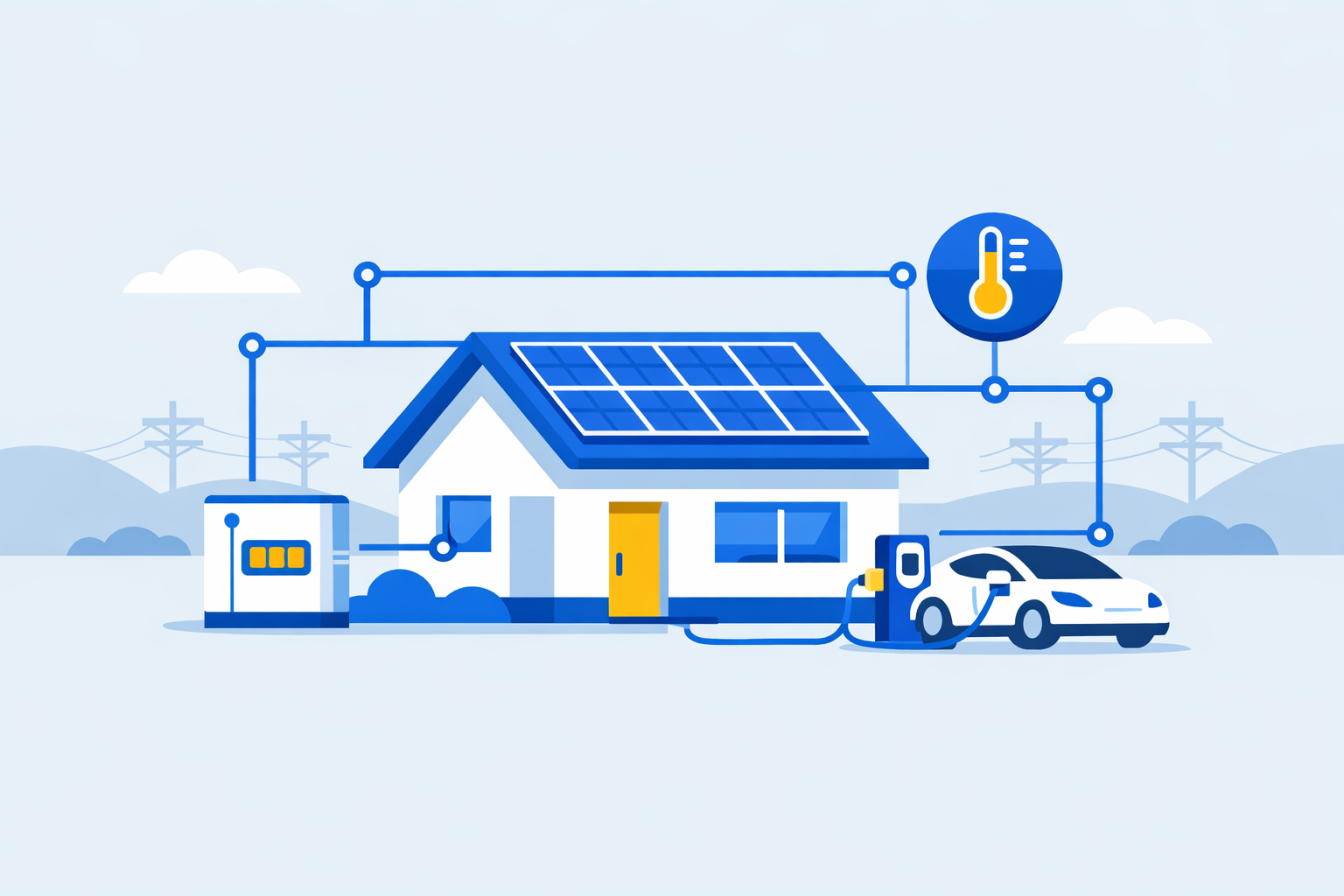
A fully integrated home energy platform typically comprises the following layers:
- Generation: Rooftop solar PV with a smart inverter capable of bidirectional communication
- Storage: Behind-the-meter battery system (e.g., 10-15 kWh lithium-ion) for self-consumption and resilience
- Electromobility: EV charger with bidirectional (V2H/V2G) capability, managed to prioritize solar charging
- Demand-side flexibility: Smart thermostat, heat pump, and controllable appliances participating in load shifting
- Software orchestration: HEMS gateway that integrates telemetry, price signals, weather forecasts, and utility demand-response commands into automated dispatch decisions
In some HEMS configurations, monitoring and controlling the entire energy system can be done seamlessly through a single app, where users check real-time solar production, track energy consumption, or adjust battery settings. With the right energy management system, the data supports informed decisions - or the system operates fully automated without user intervention.
Interoperability Standards: The Technical Backbone
The degree to which these assets communicate reliably - with each other and with utility back-end systems - determines the realized value of the platform. Fragmented, proprietary integrations remain a significant deployment barrier.
Modern HEMS enhance energy management in three key areas: interoperability, dynamic tariff response, and advanced grid interaction. They can increase the operability of home energy assets, such as adjusting hot water heating or EV charging in response to solar generation. HEMS can also automatically manage energy flows in response to dynamic tariffs by shifting consumption to lower-cost periods - for example, charging energy storage or EVs during the cheapest hours of the day.
Key interoperability standards shaping the sector include:
| Standard | Scope | Role in HEMS |
|---|---|---|
| IEEE 2030.5 (SEP 2.0) | Utility-to-DER communication | Smart inverter control, demand-response dispatch, grid compliance |
| OpenADR 3.0 | Demand-response messaging | Automated event signaling between utilities and HEMS gateways |
| OCPP | EV charger management | Rate limiting, scheduling, V2G command and control |
| Matter | Smart home device layer | Appliance energy attributes, occupancy data, local control |
In California, IEEE 2030.5 is already mandated under Rule 21, which requires distributed energy resources (DERs), including smart inverters and EV chargers, to communicate with the utility grid using this standard. The standard is also gaining traction in Australia through the CSIP-Aus framework. As cybersecurity concerns grow, IEEE 2030.5 is being updated with robust encryption and authentication protocols, and CSIP 3.0 development is expected to introduce further refinements.
The emergence of big data, cloud computing, the Internet of Things, and advanced metering infrastructure has transformed the conventional grid into a smart grid. These technological requirements drove the evolution of the conventional energy management system (EMS) into an integrated EMS. While a conventional EMS can be predictive or real-time, an integrated EMS leverages advances in technology and communication to combine predictive and real-time controls, initiating both supply and demand responses to balance load and power supply.
For specifiers and system integrators, the practical takeaway is clear: interoperability protects the investment because technology changes faster than roofs and panels. Device selections should align with modern standards - Matter for common appliances, OpenADR for demand-response messaging with utilities, and OCPP for EV charging control and scheduling. These standards make devices discoverable, enable consistent reporting of energy attributes, and expose safe commands for control.
Standalone Solar vs. Integrated Platform: A Capability Comparison
The contrast between a traditional solar-only installation and a fully integrated HEMS platform illustrates the scale of the shift underway:
| Capability | Standalone Solar PV | Integrated HEMS Platform |
|---|---|---|
| Energy Optimization | Generation only | Coordinates solar, storage, EV, HVAC, and loads |
| Grid Interaction | One-way export | Bidirectional: demand response & VPP participation |
| Tariff Response | Static net metering | Dynamic time-of-use and real-time price signals |
| EV Charging | Unmanaged | Solar-prioritized, TOU-scheduled, V2H-capable |
| Resilience | Grid-dependent | Island mode via battery storage |
| Revenue Streams | Export credits | VPP incentives, performance payments, bill savings |
| Data & Monitoring | Basic inverter data | Whole-home sub-circuit monitoring + utility telemetry |
EV Integration: From Energy Consumer to Grid Asset
The integration of electric vehicles into the residential energy platform represents one of the highest-value opportunities - and one of the most technically demanding implementation challenges.
Integrated systems combining solar PV, home battery storage, and EV V2H chargers have reached 54,000 installations across Europe, Japan, and North America, with over 21% of new rooftop PV setups including EV V2H functionality. In 2024 alone, more than 68% of all new EV charging installations supported bidirectional AC vehicle-to-home operations, reflecting a 32% increase compared to 2022.
The logic is straightforward: a HEMS can intelligently coordinate household loads, the home battery, and the EV in real time so that surplus power flows directly into the EV. Integrating an EV with a HEMS protects battery longevity by adding a layer of intelligence and control, transforming the EV from a simple power source into a strategically managed energy asset. A HEMS optimizes usage by dispatching EV power only during outages as a last resort, prioritizing solar or a stationary home battery first, which dramatically reduces charge-discharge cycles on the EV battery.
From a grid perspective, households equipped with V2H systems shifted an average of 5-7 kW of load from grid peak times, reducing stress on grid infrastructure.
Virtual Power Plants and Demand Response: Grid-Scale Impact
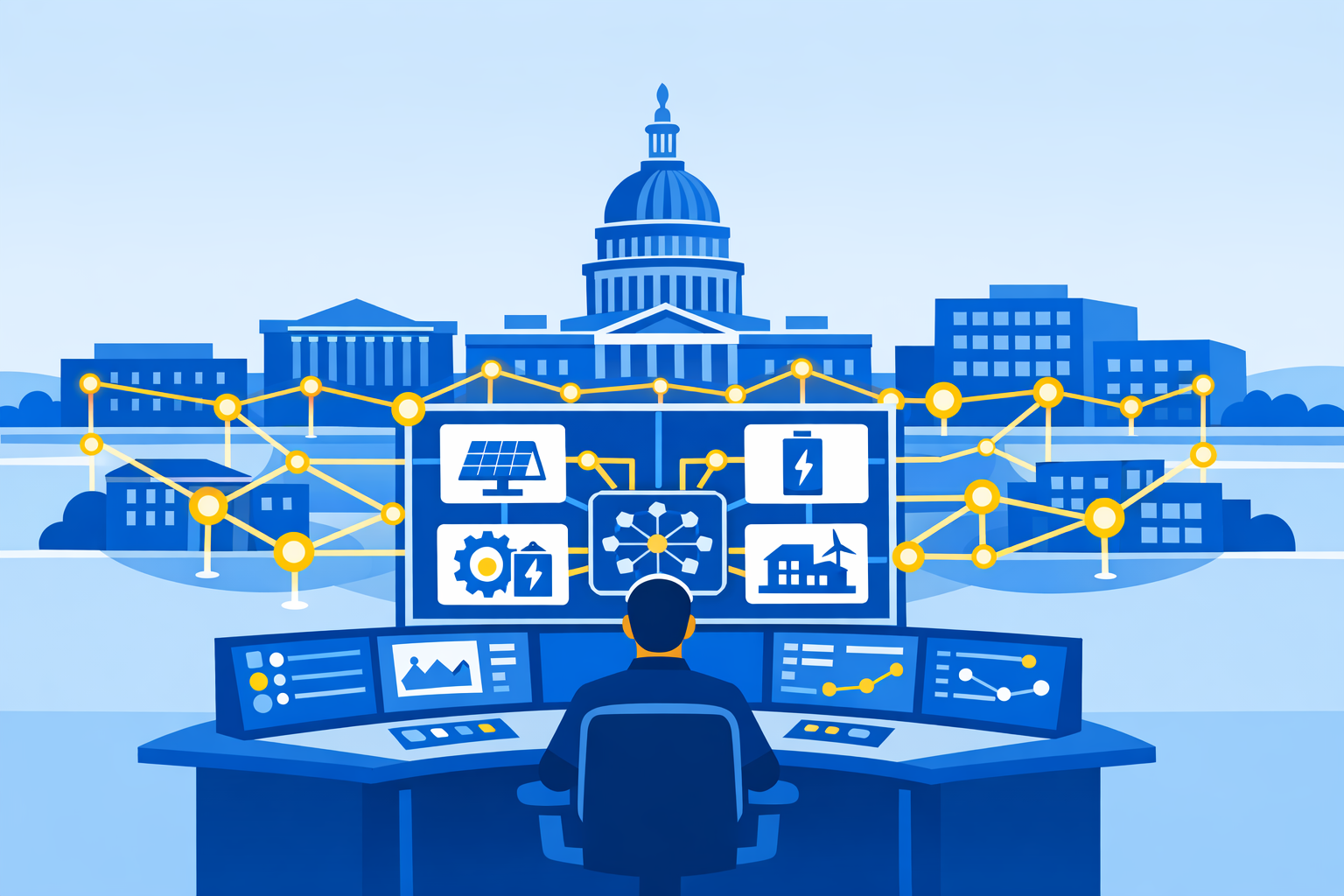
The aggregation of residential HEMS platforms into VPPs is no longer theoretical. U.S. states and utilities are increasingly prioritizing VPPs to meet challenges posed by rapid load growth. The North American VPP market has reached 37.5 gigawatts of flexible, behind-the-meter capacity - a 14% increase over 2024 - while the number of active VPP deployments, monetized programs, and unique offtakers each rose by more than 33% during the same period.
In 2024, VPPs reached 33 gigawatts of capacity across 30 states. The U.S. Department of Energy projects that VPPs can supply 10% to 20% - 80 to 120 gigawatts - of U.S. peak demand by 2030.
The appeal to utilities is a faster, lower-cost capacity procurement path. VPPs can meet peak demand at lower cost than conventional resources and defer costly transmission and distribution system investments. They can be deployed in as little as 6 to 12 months and are highly adaptable.
Utility program activity is expanding rapidly. Active examples include:
- Georgia Power's 2025 integrated resource plan includes a new 50-MW customer-side solar-plus-storage pilot for residential and small commercial customers, divided between customer-directed and utility-directed models.
- Illinois Commerce Commission opened a docket to consider Commonwealth Edison's proposed Rider BYODLR - a Bring Your Own Device Load Reduction Program providing an annual incentive to customers with smart thermostats available for remote control during load-reduction events - and Rider VPP, which offers an annual incentive to customers with energy storage who commit to system injections directly or through an Aggregation Service Provider.
- Arizona Public Service's Cool Rewards program has enrolled 90,000 thermostats, equivalent to removing 140 megawatts from the grid during peak demand - enough to serve 22,000 Arizona homes.
This growth connects directly with the broader smart building energy management trend and with commercial-sector precedents set by smart EMS deployments for EV grid coordination.
Financing and Incentive Landscape: Navigating the Post-25D Era
The financing environment for integrated residential energy platforms has shifted materially following the passage of the One Big Beautiful Bill Act in mid-2025. The historically most important solar incentive - the federal clean energy tax credit providing up to 30% of installation costs - officially expired on December 31, 2025. The 30% Residential Clean Energy Credit (Section 25D) is no longer available for systems purchased in 2026.
EnergySage's H2 2025 Home Electrification Marketplace Report revealed how the looming expiration reshaped the U.S. residential solar market, driving a 205% increase in homeowner engagement with solar installers on the platform - a spike driven by the July 2025 passage of legislation eliminating the 30% federal tax credit for purchased residential systems.
The post-25D incentive landscape now rests on several replacement mechanisms:
- Third-party ownership (TPO): With the expiration of the 25D credit for purchased systems, the market is expected to shift heavily toward TPO models like leases and prepaid power purchase agreements, which still qualify for commercial tax credits.
- VPP performance payments: Homeowners are turning to utility-based performance incentives and VPPs to offset costs. Most programs require homeowners to allow the utility to dispatch their battery during peak periods in exchange for ongoing monetary credits or an annual participation payment.
- State-level battery incentives: Some states still offer point-of-sale rebates, including California's SGIP program and equity-based rebates in the Northeast. Performance payment programs such as ConnectedSolutions pay homeowners based on the average power their battery contributes during high-demand events.
The gap in immediate storage adoption for cash-purchased systems could signal growing homeowner willingness to enroll in battery-as-a-service or VPP programs. This trajectory aligns with a broader shift toward subscription-based and performance-based HEMS service models.
Cybersecurity and Data Privacy: An Emerging Compliance Layer
As residential energy platforms collect granular household data and expose controllable loads to utility back-end systems, cybersecurity and data privacy have moved from peripheral to central concerns for deployers and regulators alike.
A HEMS platform operating at full functionality aggregates occupancy patterns, appliance usage schedules, EV charging behavior, and real-time energy flows. This data set, communicated via open APIs to utility DERMS (Distributed Energy Resource Management System) platforms, represents both a grid optimization asset and a potential attack surface.
IEEE 2030.5 enables two-way communication, demand response, and V2G functionality, ensuring that electric vehicles can be seamlessly integrated into the modern energy grid. As adoption grows globally, the standard will play a pivotal role in shaping smart energy systems - making EVs not just consumers of electricity but active participants in grid stability.
Key risk categories for system integrators to address include:
- Unauthorized access to controllable loads - remote manipulation of battery dispatch or EV charging via compromised APIs
- Behavioral data exfiltration - granular occupancy and usage profiles exposing sensitive household information
- Integrity of demand-response signals - spoofed or manipulated grid commands affecting distributed asset dispatch
Regulatory frameworks addressing these risks are advancing at the state level, though a unified federal standard for consumer-facing energy software cybersecurity has yet to emerge - a gap that presents both risk and opportunity for the systems integration community.
Outlook: Residential Solar as a Grid Infrastructure Asset
The structural shift from standalone solar to platform-based energy management is now clearly defined by market data, regulatory frameworks, and live utility programs. The relevant question for engineers, integrators, and energy managers is no longer whether integration will happen, but at what pace and through which pathways.
The HEMS market is still in its infancy in revenue terms; however, rapid growth is expected. The global installed capacity of distributed energy resource units - including solar inverters, energy storage, EV charging units, and heat pumps - is projected to quadruple from 144 million in 2025 to 570 million by 2035.
Growing at a CAGR of 22.8%, the installed base of HEMS in Europe is estimated to reach 10.6 million systems by the end of 2029. North American adoption, while currently at lower penetration rates, is being accelerated by the post-25D incentive pivot toward performance-based and subscription models.
Key takeaways for professionals specifying or deploying residential energy platforms:
- Design for interoperability from the outset. Specify inverters, storage, and EV chargers that support IEEE 2030.5, OpenADR, and OCPP. Proprietary integrations limit VPP participation and future flexibility.
- Account for VPP program requirements in system sizing. Minimum dispatch capacity thresholds and connectivity standards vary by utility program - early alignment avoids costly retrofits.
- Treat cybersecurity as a specification criterion, not an afterthought. Assess API security, authentication protocols, and data handling policies across every vendor in the HEMS stack.
- Counsel clients on the post-25D financing landscape. TPO models, performance payments, and subscription HEMS services are becoming the primary value pathways for new installations in 2026.
- Monitor state-level VPP and DER aggregation regulation closely. The regulatory environment is evolving faster at the state level than federally - smart building adoption dynamics offer a parallel precedent for anticipating policy trajectory.
Frequently Asked Questions
What is a Home Energy Management System (HEMS)? A HEMS is a software and hardware platform that monitors, coordinates, and optimizes energy flows across a home's distributed assets - including rooftop solar, battery storage, EV chargers, smart thermostats, and grid-connected loads. Advanced HEMS platforms respond to real-time price signals, weather forecasts, and utility demand-response events to minimize costs and maximize self-consumption.
Which interoperability standards enable cross-device communication in residential energy systems? Key standards include IEEE 2030.5 (SEP 2.0) for utility-to-DER communication and smart inverter control, OpenADR 3.0 for demand-response messaging, OCPP for EV charger management, and Matter for smart home device interoperability. California's Rule 21 mandates IEEE 2030.5 compliance for grid-connected DERs.
How does the expiry of the Section 25D federal tax credit affect residential solar adoption? The 30% Residential Clean Energy Credit expired on December 31, 2025. Systems purchased in 2026 do not qualify for the federal credit. The market is pivoting toward third-party ownership models, utility performance payments, and VPP participation as replacement value drivers.
What is a Virtual Power Plant (VPP) and how can homeowners participate? A VPP is an aggregation of residential DERs - batteries, solar, EV chargers, smart thermostats - coordinated by a utility or aggregator to provide grid services at scale. Homeowners enroll assets and receive monetary credits or annual incentive payments in exchange for allowing dispatch of stored energy or curtailment of flexible loads during peak demand.
What cybersecurity risks apply to residential energy management platforms? Key risks include unauthorized remote access to controllable loads, data exfiltration of behavioral profiles, and manipulation of grid-interactive commands. IEEE 2030.5 includes robust encryption and authentication protocols, and regulatory guidance for consumer-facing energy software cybersecurity is an active policy focus at the state level.