University researchers propose on-chip monitors to catch bit-flip attacks in AI accelerators at runtime
Researchers from UF, UT Dallas, and RPI published BARE-AI on 6 October 2026 - a runtime framework that detects and repairs bit-flip attacks in AI accelerators with under 4% area overhead at 28 nm.
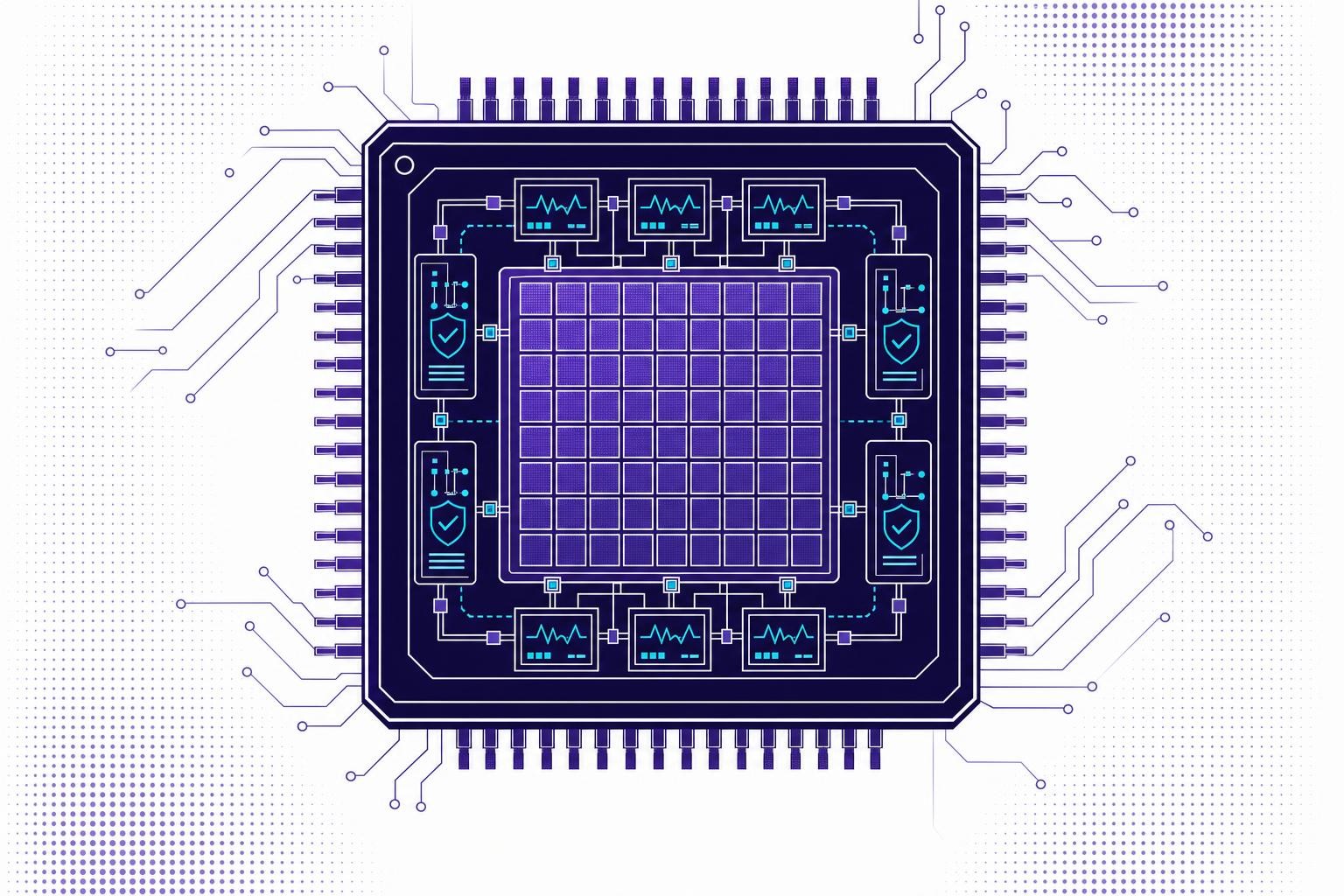
Researchers at the University of Florida, University of Texas at Dallas, and Rensselaer Polytechnic Institute submitted a paper on 6 October 2026 describing BARE-AI, a runtime framework that detects, localises, and repairs bit-flip attacks in AI accelerator hardware[1]. Synthesised at the 28 nm node, the monitoring infrastructure adds less than 4% area overhead and less than 3% energy overhead, with inference latency rising by roughly 10% at the default operating point and by about 6% at a lower-cost configuration[1].
Why bit-flip attacks matter for AI hardware
Bit-flip attacks exploit physical memory vulnerabilities - most commonly the Rowhammer effect - to induce unauthorised changes in DRAM cells. Attackers deterministically induce bit flips in model weights to compromise DNN inference accuracy by exploiting the Rowhammer vulnerability. The threat is not confined to servers: it is exacerbated in edge devices, which lack hardware redundancy, and in cloud settings, where Rowhammer can be launched from co-located virtual machines.
The consequences can be severe. Researchers have proved that Rowhammer attacks work on GPU memory, dropping AI model accuracy from 80% to 0.1% with a single bit flip. Recent research demonstrated that even a single bit flip can significantly degrade or alter the performance of neural networks, highlighting the sensitivity of AI model inference to hardware-level perturbations. Existing countermeasures - error-correcting codes, weight retraining, and static analysis - each carry a significant drawback: existing defenses incur significant hardware overhead, depend on retraining, or fail against targeted flips.
How BARE-AI works
The framework has two hardware components embedded in the accelerator datapath[1]:
- AI Performance Counters (APCs) - lightweight monitors that capture per-layer activation statistics including sparsity, entropy, kurtosis, and spectral shift during inference.
- PULSE (Predictive Unit for Layer Security Evaluation) - a compact ensemble classifier trained offline and realised on-chip as a small neural engine that analyses APC output in real time.
When PULSE flags an anomaly, a third component takes over. The Activation Shift Index (ASI) provides layer-level fault localisation, and a z-score-based repair resets anomalous weights toward clean layer statistics. Crucially, the monitoring cost does not scale with attack intensity: unlike error-correcting codes, whose redundancy grows linearly with the number of tolerated flips, BARE-AI's overhead remains constant regardless of how many bits an adversary flips[1].
Detection results across model types
The team evaluated BARE-AI against random, targeted, adaptive, and magnitude-based bit-flip attacks across three model families. BARE-AI achieves up to 98% detection accuracy on vision models and between 74% and 95% on language models, and restores near-clean accuracy for CNNs and Vision Transformers[1]. Recovery for large language models is partial. The framework is model-agnostic and requires no architectural modification to the protected DNN, no weight inspection, and no retraining[1].
The paper characterises hardware cost through 28 nm synthesis, positioning BARE-AI for deployment in resource-constrained, safety-critical edge applications such as autonomous systems and medical devices[1]. Whether the approach scales cleanly to leading-edge nodes - and how it performs against multi-bit adaptive attacks on quantised LLMs - will be the tests that determine whether it moves from preprint to silicon.
Written by Electronics Insider's automated desk from the sources above and published automatically. How we work.
Related
 Design & EDA
Eric Hong outlines Mixel's mixed-signal IP strategy after Silvaco acquisition
Mixel VP of Engineering Eric Hong discusses the company's PHY and SerDes roadmap, its TSMC N2P debut, and how the Silvaco acquisition is reshaping its IP strategy.
14 Oct 2026 Design & EDA
VSORA chair Sandra Rivera tells Bloomberg that AI inference demand is durable but consolidation is coming
VSORA chair Sandra Rivera appeared on Bloomberg's The Close on 24 July 2026, arguing that AI inference demand is real and durable - but that not every chip startup will survive the shakeout.
14 Oct 2026 Semiconductors
Applied Materials opens its $5 billion EPIC Center in Sunnyvale on 12 October
Applied Materials unveiled its $5 billion EPIC Center in Sunnyvale on 12 October 2026 - the world's largest facility for collaborative semiconductor equipment R&D, with TSMC, Intel, Samsung, Micron and SK hynix as founding partners.
14 Oct 2026