HARTING's Han HC DCT contacts carry up to 20% more current through a dual-path design
HARTING's new Han HC DoubleContact Technology contacts route current through two parallel paths, delivering up to 20% higher capacity with improved safety and easier installation.
HARTING announced on 17 September 2026 a new range of high-current contacts under the Han HC DoubleContact Technology (DCT) name[1]. Laboratory testing of the DCT CU 18, DCT CU 22 and DCT CU 30 contacts - named for their diameters in millimetres - showed current-carrying capacity up to 20% higher than the company's previous standard contacts[1]. The series extends HARTING's existing HC-Modular line, which already covers 250 A, 350 A and 650 A ratings for rail vehicles and outdoor equipment[1].
How the dual-path design works
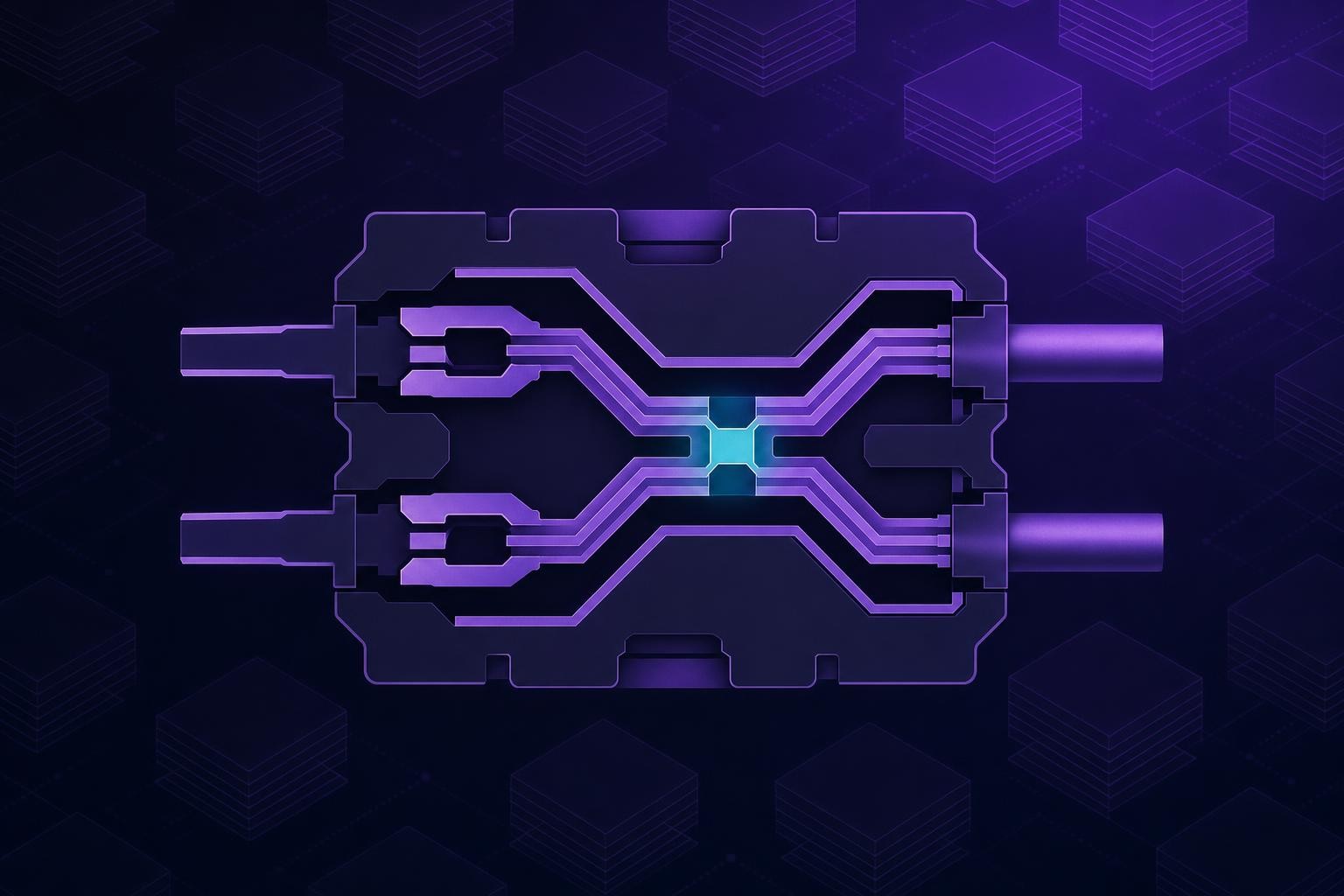
The central change is a larger effective contact area that splits current across two parallel routes[1]. One path runs through an internal pin inside the socket contact; the other travels through a surrounding tab that engages the mating pin contact[1]. The result is lower contact resistance and better thermal performance compared with a single-path arrangement[1].
Product Manager Maik Iphöfer described the practical benefit: "Thanks to the new performance classes, we now have a wider range of current ratings, allowing customers to select a contact that best suits their application instead of choosing an oversized design."[1] For system designers, that means a contact sized for the actual load rather than the next available rating up - a meaningful consideration when weight and envelope matter, as they do in rail and industrial power distribution.
Safety and installation changes
HARTING has also revised the protection and assembly features of the series. Key changes include:
- Touch protection on both the pin and socket sides, where the previous design protected only the female side[1]
- Rotatable contacts that lock into the insulating body with an audible click but remain free to rotate after locking, compensating for mechanical tensile loads in the cable[1]
- Fewer frame components and an efficient coding system intended to reduce installation effort[1]
The rotatable contact is a practical detail for field assembly: cable runs rarely arrive at a connector at a perfectly neutral angle, and a contact that can spin freely after seating removes a common source of assembly stress.
Target applications
The DCT series is positioned as a modular solution across several high-power industries[1]. HARTING has already shown the DCT CU 18, CU 22 and CU 30 contacts as options within its Han HPR VarioShell housings for rail inter-car jumper cables, where the existing HC-Modular 250, 350 and 650 A contacts are also available. The IP 68/69-rated VarioShell housings extend the contacts' reach to outdoor and trackside environments.
The immediate question for the market is how the DCT contacts perform across the full temperature and vibration envelope that rail certification demands. HARTING has published laboratory current-capacity figures; independent qualification data under IEC/EN 61373 vibration and shock conditions - the standard its existing HC-Modular line already meets - will determine how quickly the new contacts move from design-in to volume deployment.
Written by Electronics Insider's automated desk from the sources above and published automatically. How we work.
Related
 Design & EDA
Eric Hong outlines Mixel's mixed-signal IP strategy after Silvaco acquisition
Mixel VP of Engineering Eric Hong discusses the company's PHY and SerDes roadmap, its TSMC N2P debut, and how the Silvaco acquisition is reshaping its IP strategy.
14 Oct 2026 Design & EDA
VSORA chair Sandra Rivera tells Bloomberg that AI inference demand is durable but consolidation is coming
VSORA chair Sandra Rivera appeared on Bloomberg's The Close on 24 July 2026, arguing that AI inference demand is real and durable - but that not every chip startup will survive the shakeout.
14 Oct 2026 Semiconductors
Applied Materials opens its $5 billion EPIC Center in Sunnyvale on 12 October
Applied Materials unveiled its $5 billion EPIC Center in Sunnyvale on 12 October 2026 - the world's largest facility for collaborative semiconductor equipment R&D, with TSMC, Intel, Samsung, Micron and SK hynix as founding partners.
14 Oct 2026