Wiley publishes a practical guide to phase noise and its effects on RF system performance
A new Wiley whitepaper explains how oscillator phase noise degrades RF systems through spectral regrowth, reciprocal mixing, and constellation rotation - and how to measure it accurately.
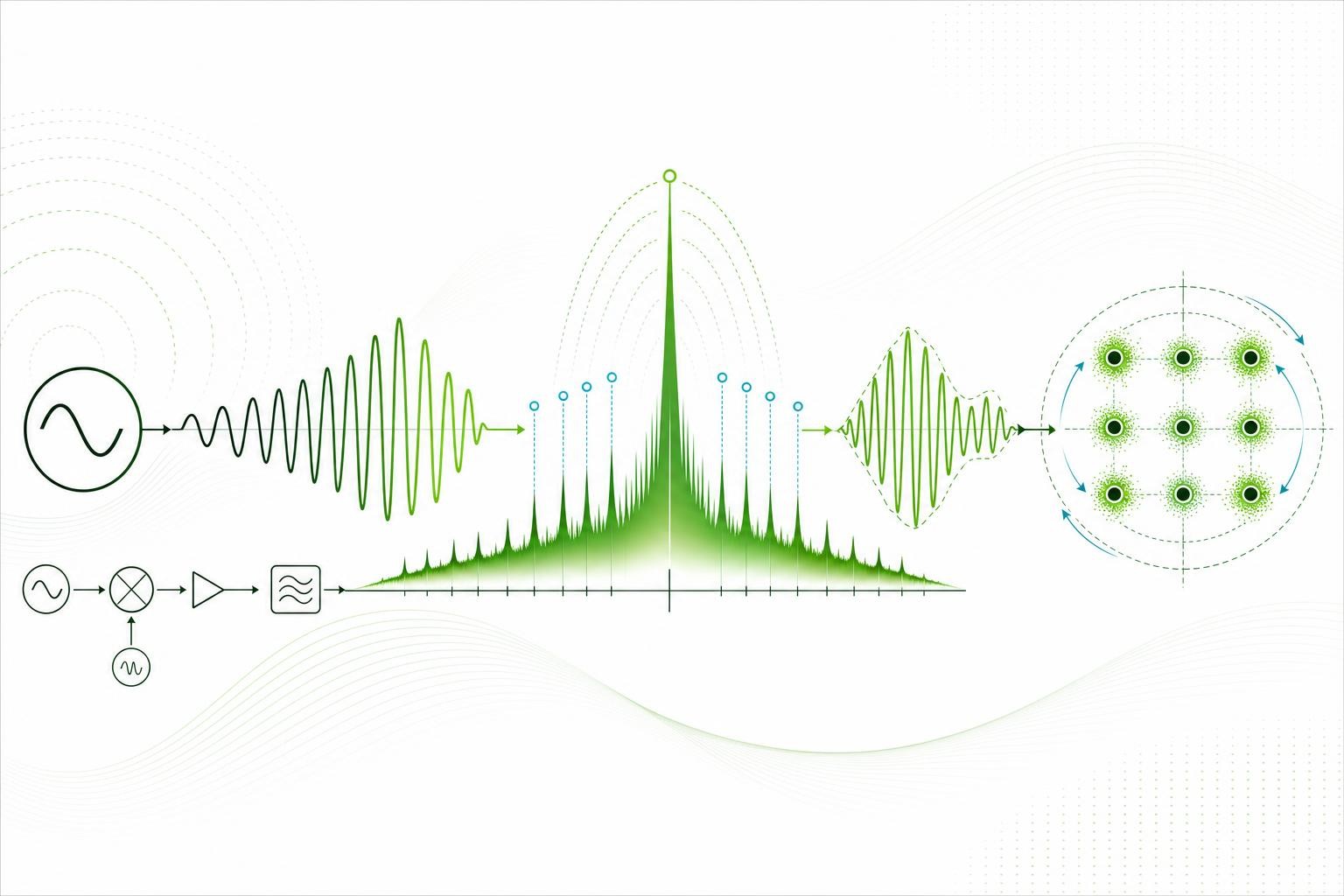
Wiley's Knowledge Hub published a free whitepaper on 4 June 2026 covering the fundamentals of phase noise in RF systems, walking engineers through why oscillator instability matters, how it degrades system performance, and what measurement techniques are available to characterise it[1].
Why phase noise dominates over amplitude noise
Real-world oscillators produce both amplitude and phase variations over time, but phase variations typically have a much greater impact on system performance than amplitude variations[1]. In the frequency domain those phase fluctuations appear as sidebands around the carrier; in the time domain they manifest as jitter.
An ideal oscillator produces a signal whose frequency, amplitude, and phase do not vary over time. Phase noise describes the short-term variations in frequency or phase of signals produced by real-world oscillators. The phase-noise spectral density is defined as the ratio of the noise in a 1 Hz bandwidth at a specified frequency offset to the oscillator's signal amplitude at the carrier frequency. Phase noise is expressed in units of dBc/Hz, with values always negative - the further from the carrier, the lower the noise floor.
Three ways phase noise degrades a system
Excessive phase noise causes three principal impairments in RF systems: spectral regrowth, reciprocal mixing, and constellation rotation[1].
Spectral regrowth. If the local oscillator has low phase noise, the signal is mostly contained in its assigned channel with very little power leaking into adjacent channels. As phase noise increases, the signal grows wider and spreads further into adjacent channels; at high levels the adjacent channel leakage can become severe and cause significant interference. Wideband standards including LTE, 5G NR, and Wi-Fi are particularly susceptible to spectral regrowth from oscillator phase noise[1].
Reciprocal mixing. An excessive amount of phase noise can cause problems when working with an IF filter because it spreads the energy of an unwanted signal into the filter, making it problematic to recover the smaller signal. During down-conversion in a receiver, reciprocal mixing of the phase noise of a local oscillator with an unwanted blocker signal deposits additive noise on top of the wanted signal.
Constellation rotation. Most modern wireless technologies use modulation schemes represented using constellation diagrams, and phase noise causes a rotation of this constellation, with higher phase noise causing greater rotation and a higher bit error rate. This limits the use of higher-order modulation schemes that require tight phase accuracy.
How phase noise is measured
The spectrum analyzer method measures the power of the carrier as an absolute value in dBm, moves to a given frequency offset, measures the noise power within a 1 Hz bandwidth, and subtracts the carrier power from the noise power to yield phase noise in dBc/Hz. Results are typically presented as a single sideband plot showing phase noise as a function of carrier offset, and as spot noise at specific offsets.
For lower noise floors, cross-correlation can only be implemented in dedicated phase noise analyzers, not in traditional single-path spectrum analyzers. Increasing the number of correlations reduces the level of uncorrelated instrument noise, providing increased sensitivity and allowing accurate measurement of even very low levels of phase noise.
Beyond these two core techniques, the whitepaper covers integrated phase noise - expressed as an RMS phase deviation in radians - and additive (residual) phase noise. Residual phase noise measurement cancels the effect of external noise sources such as power supplies or input clocks, as opposed to absolute phase noise measurement, which includes noise from those sources; a residual setup isolates and measures a device's additive phase noise. Using this information, designers can select individual devices in the signal chain to meet the phase noise requirements of the complete system.
As 5G NR deployments push into millimeter-wave bands and 6G standardisation work accelerates, oscillator phase noise requirements are tightening further. Engineers specifying local oscillators for next-generation front-ends will need to move beyond spot-noise figures and engage with integrated phase noise budgets and residual noise characterisation of every active component in the signal chain.
Written by Electronics Insider's automated desk from the sources above and published automatically. How we work.
Related
 Semiconductors
Token spend is becoming a line item in EDA project budgets, DAC roundtable finds
A closed-door DAC 2026 roundtable with Cadence, Synopsys, Siemens EDA, Keysight, and ChipAgents found token cost has moved from an afterthought to a formal budget concern in chip design projects.
10 Sept 2026 Design & EDA
Cadence's Amol Borkar explains why AI voice at the edge demands a rethink of SoC architecture, not just faster processors
Semiconductor Engineering's interview with Cadence's Tensilica DSP lead lays out why NLP is reshaping audio SoC design - and why raw clock speed is the wrong lever to pull.
10 Sept 2026 Design & EDA
French gendarmerie researchers show voltage glitching bypasses eMMC password locks on 3 of 10 commercial parts, with measurable evidence alteration
A paper from France's Institut de Recherche Criminelle quantifies both the success rate and the data-integrity cost of fault-assisted eMMC access in forensic investigations.
10 Sept 2026