Signaloid founder Phillip Stanley-Marbell steps down from Cambridge chair to run probabilistic computing startup full-time
SemiWiki's CEO interview with Phillip Stanley-Marbell traces his path from Bell Labs and Apple to founding Signaloid, a Cambridge spinout whose C0-ASIC targets 1000× performance-per-watt gains.
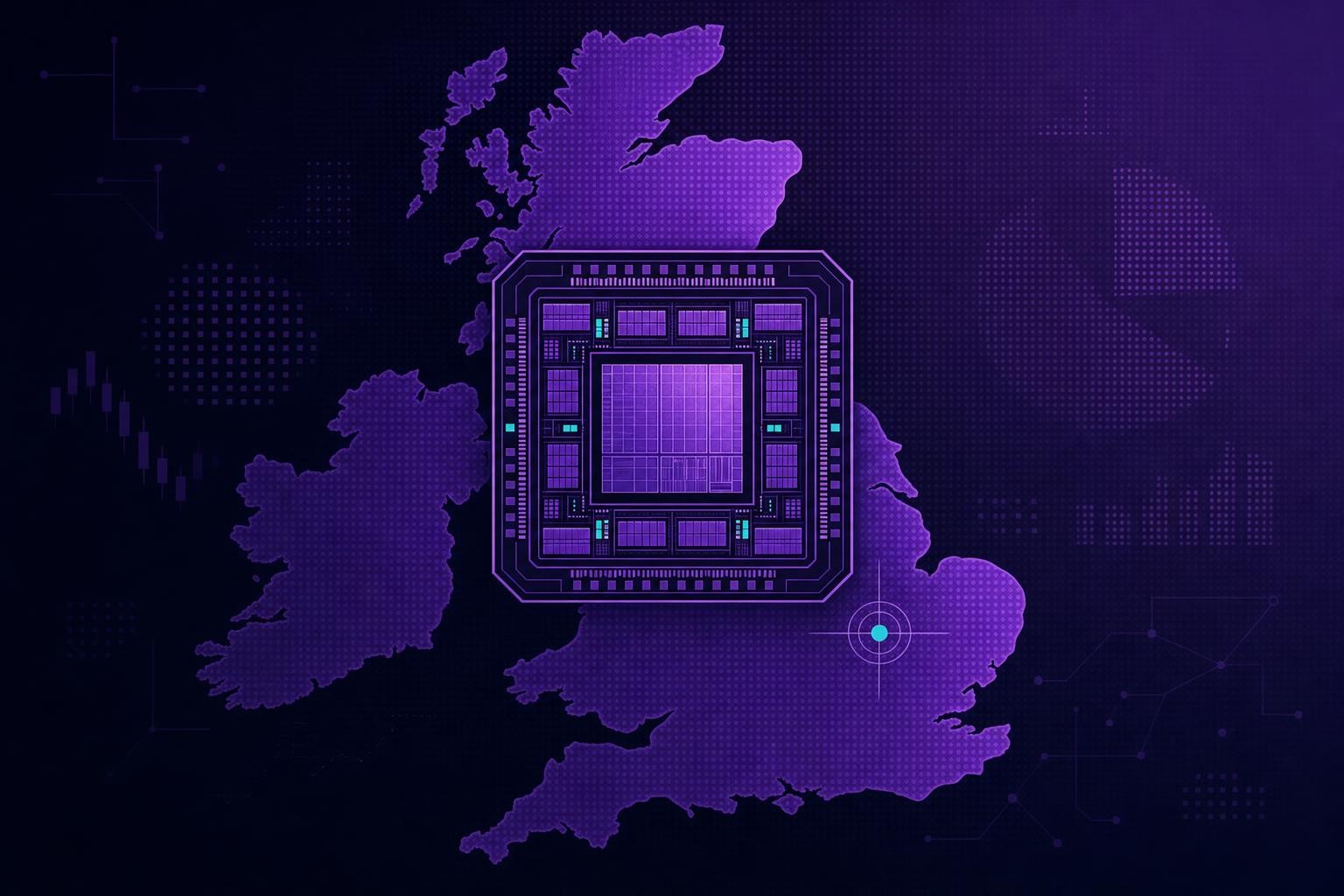
SemiWiki has published a CEO interview with Phillip Stanley-Marbell, founder of Signaloid, a University of Cambridge spinout building hardware for uncertainty-tracking computation[1]. The interview arrives as the company ships its first silicon: the C0-ASIC, taped out with TSMC in partnership with IC-Link by imec and Cadence, is projected to deliver up to 1000× better performance-per-watt in key physical AI workloads, with engineering samples due to the first customer in Q3 2026.
From Cambridge chair to full-time CEO
Stanley-Marbell stepped down from his full professorship - the Chair of Physical Computation in the Electrical Engineering Division at the University of Cambridge - in September 2025 to lead Signaloid as a full-time executive[1]. His academic career at Cambridge began in 2017, when he joined as an assistant professor; he received tenure in 2020 and was promoted to full professor in 2022. Before academia, he held positions at Bell Labs, IBM Research Zurich, Apple, and MIT, and completed his PhD at Carnegie Mellon University.
He incorporated Signaloid in 2019, self-funding it for two years before raising angel investment in 2021 and completing a seed round in January 2023. The company has since grown to serve more than 3,000 users across 18 countries, with hardware available through Mouser Electronics and DigiKey.
What the technology does
Signaloid's core product is UxHw (Uncertainty Hardware), a distribution-extended compute architecture that tracks statistical probability distributions through arithmetic operations, transparently to the running application. The practical effect is that workloads which would ordinarily require repeated Monte Carlo sampling - particle filters, sensor fusion, quantitative finance simulations - can instead be executed in a single pass.
Benchmarks on the cloud platform, integrated with AWS, show the following claimed speedups against Intel Xeon-class hardware at equivalent power:
- Over 580× for Heath-Jarrow-Morton swaptions pricing
- Over 430× for Value at Risk on geometric Brownian motion processes
- Over 80× for radiation transport simulations
- Over 600× for infrared sensor data analysis
Named cloud customers include Boeing and CERN. The UxHw technology and its implementation are covered by a portfolio of over 90 intellectual property filings in the US, China, Taiwan, Japan, and the EU.
The C0-ASIC and ARIA backing
The C0-ASIC - internally named C0-Dreadnought - is the first silicon implementation of UxHw. The UK Advanced Research and Invention Agency (ARIA) commissioned the chip for evaluation in randomized numerical linear algebra and probabilistic computing workloads as part of its Scaling Compute programme. FPGA-based systems implementing the ASIC's RTL design are also under discussion for deployment in the UK and Switzerland later in 2026.
Cadence supplied Artisan SRAM memories for the design; IC-Link by imec managed the path to TSMC production. The chip is targeted at robotics, physical AI, aerospace, and quantitative finance - workloads where uncertainty is inherent in the input data and where conventional floating-point pipelines discard distributional information at every arithmetic step.
The next milestone to watch is delivery of engineering samples in Q3 2026 and whether ARIA's evaluation of second-order methods on the C0-ASIC produces publishable benchmark results - data that would give the broader design community its first independent view of the architecture's performance claims at silicon level.
Written by Electronics Insider's automated desk from the sources above and published automatically. How we work.
Related
 Semiconductors
Token spend is becoming a line item in EDA project budgets, DAC roundtable finds
A closed-door DAC 2026 roundtable with Cadence, Synopsys, Siemens EDA, Keysight, and ChipAgents found token cost has moved from an afterthought to a formal budget concern in chip design projects.
10 Sept 2026 Design & EDA
Cadence's Amol Borkar explains why AI voice at the edge demands a rethink of SoC architecture, not just faster processors
Semiconductor Engineering's interview with Cadence's Tensilica DSP lead lays out why NLP is reshaping audio SoC design - and why raw clock speed is the wrong lever to pull.
10 Sept 2026 Design & EDA
French gendarmerie researchers show voltage glitching bypasses eMMC password locks on 3 of 10 commercial parts, with measurable evidence alteration
A paper from France's Institut de Recherche Criminelle quantifies both the success rate and the data-integrity cost of fault-assisted eMMC access in forensic investigations.
10 Sept 2026