Amphenol extends its H4 solar connector platform to 2000 V DC with the new H4 Plus P2KV
Amphenol Industrial Operations has added a 2000 V DC connector to its H4 Plus family, targeting utility-scale PV and solar-plus-storage systems moving beyond 1500 V architectures.
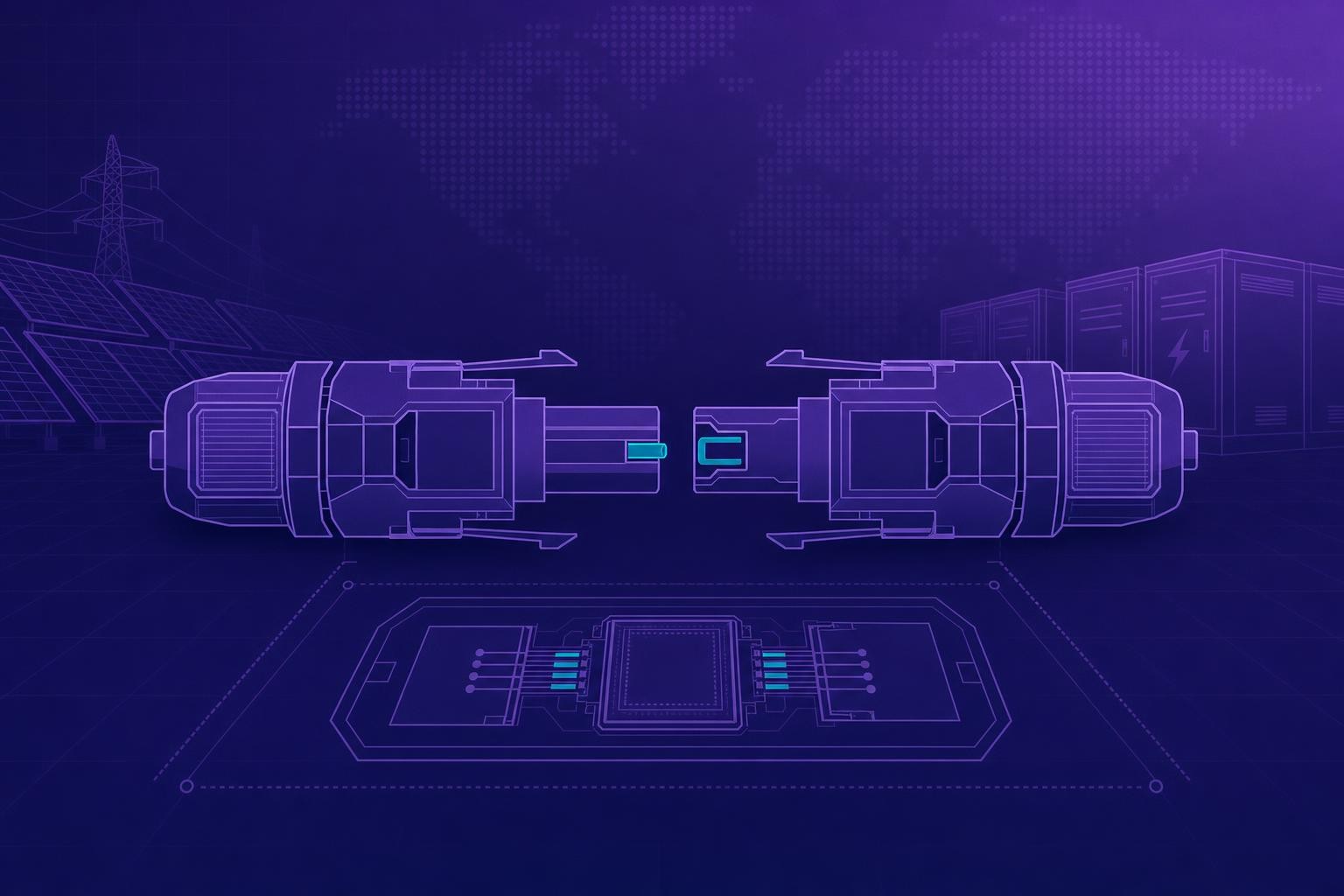
Amphenol Industrial Operations has added a 2000 V DC connector to its established H4 solar platform. The H4 Plus P2KV, announced in late August 2026, is designed for next-generation photovoltaic and energy storage systems that are moving beyond the 1500 V DC architectures that have dominated utility-scale solar since roughly 2017[1].
Electrical ratings and contact performance
The H4 Plus P2KV is rated at 65 A under ETL certification and 70 A under TÜV certification, both at 85°C[1]. Typical contact resistance is specified at no more than 0.25 mΩ[1], a figure that matters at utility scale where large numbers of connector interfaces accumulate losses across a string. The connector is designed around 6 AWG / 16 mm² photovoltaic cable[1], with an approved cable outside diameter of 8.38 mm to 11.0 mm. It also carries a rated impulse voltage of 16 kV under applicable IEC criteria.
The P2KV is certified under UL 6703, the standard governing connectors used in photovoltaic systems, and meets RoHS and REACH requirements.
Environmental protection for outdoor deployment
Solar connectors must sustain electrical and mechanical performance through years of UV exposure, temperature cycling, and moisture ingress. The H4 Plus P2KV addresses this with:
- IP65 and IP68 protection when properly mated; IP2X when unmated[1]
- UV-resistant thermoplastic housing with UL94-V0 flame classification[1]
- Availability in both field-installable and preassembled versions, giving EPCs and module manufacturers options for factory or on-site integration[1]
- A dedicated toolset covering stripping, crimping, inspection, torque control, and unlocking to support repeatable installation quality[1]
Where 2000 V fits in the solar architecture shift
The industry's voltage progression has followed a consistent pattern: residential systems started at 300-400 V, commercial ground-mount moved to 1000 V after 2014, and utility-scale standardised at 1500 V from around 2017 onward. The move to 2000 V is now underway across the supply chain. GE Vernova launched a 6 MVA, 2000 V DC utility-scale inverter in September 2024, with a multi-megawatt pilot in North America. Trinasolar's 2000 V Vertex N module has been evaluated against 1500 V systems in Black & Veatch modelling for a hypothetical 125 MW project, with the higher-voltage architecture showing a lower LCOE. 1500 V DC has been the norm for the last several years, but many companies are now planning a shift to 2000 V DC, where the operating range would be between 1500 V and 2000 V DC.
For Amphenol, the P2KV extends the H4 platform rather than replacing it. The existing H4 Plus family is dual-certified at 1500 V DC to UL 6703 and IEC 62852; the P2KV adds a higher-voltage variant within the same connector family, preserving compatibility with Amphenol's H4 tooling and installation ecosystem[1].
Amphenol is positioning the connector for module string connections, combiner and junction boxes, compatible inverter DC interfaces, and solar-plus-storage systems[1]. The key question for project developers is how quickly inverter and module suppliers complete their own 2000 V certifications - connector availability is a necessary but not sufficient condition for system-level adoption at scale.
Written by Electronics Insider's automated desk from the sources above and published automatically. How we work.
Related
 Design & EDA
ETH Zürich and NYU show JEDEC test loops miss worst-case HBM2 power by 23.6%
Researchers at ETH Zürich and NYU tested 36 real HBM2 chips and found JEDEC measurement loops understate peak power by 23.6%, with read ops and data-bus toggling as the main drivers.
15 Oct 2026 Design & EDA
FlowAccel's Joel Jorgensen argues chip teams must design their workflows before AI can help them hit tape-out
Joel Jorgensen of FlowAccel argues that AI tools alone won't save a tape-out schedule - teams must first design the cross-team workflows that let those tools compound into real gains.
15 Oct 2026 Semiconductors
ETH Zürich and NYU find JEDEC test loops underestimate HBM2 power by up to 35.4%
Researchers at ETH Zürich and NYU tested 36 real HBM2 chips and found JEDEC-specified current loops can underestimate peak power by up to 35.4%, with implications for AI accelerator thermal design.
15 Oct 2026