binder extends its M12 portfolio with an angled PCB connector designed for tubular sensor housings
binder's new angled M12-A connector mounts flush with the PCB plane rather than stacking above it, targeting compact sensors and industrial automation devices built into narrow cylindrical housings.
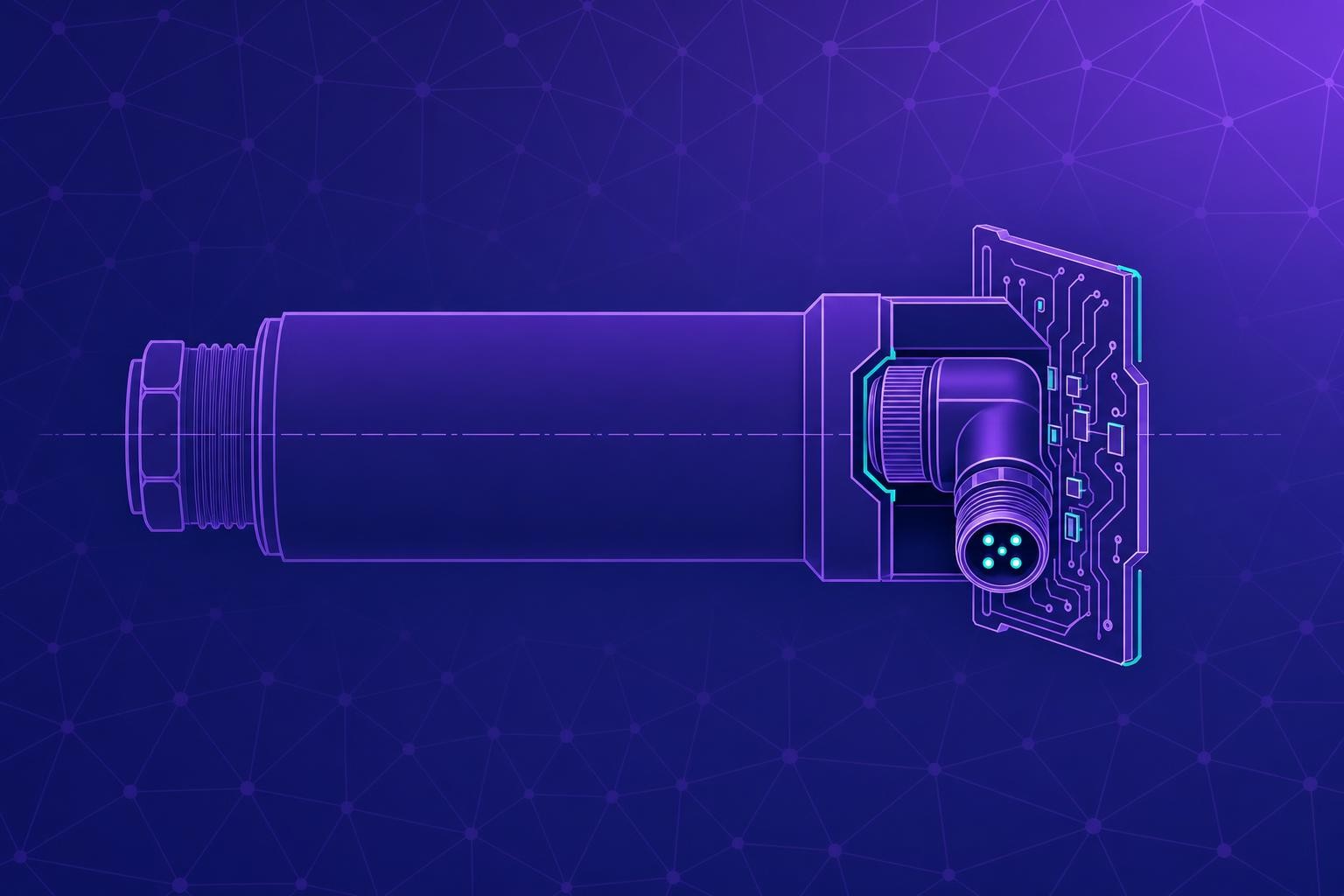
binder has added an angled panel-mount M12-A connector to its PCB connector range, placing the connector axis in the same plane as the board rather than perpendicular to it.[1] The part is aimed at compact industrial electronics - particularly sensors and automation devices built into narrow cylindrical housings - where every millimetre of axial depth is contested.[1]
What the midmount geometry changes
Conventional PCB-mounted connectors add their full body height to the component stack above the board.[1] binder's new design instead receives the PCB at its front edge, with contacts extending through the board from above and below, so the connector axis aligns with the housing's centre axis in a tubular enclosure.[1] The design accommodates PCB thicknesses from 1 mm to 2 mm.[1]
That geometry has two practical consequences. First, the PCB can be inserted connector-first into a tubular housing while keeping the electrical interface centred at the front - no offset, no angled wire runs.[1] Second, removing the connector stack-up either frees room for more electronics or allows a move to a smaller enclosure diameter.[1] The design can also replace panel-mount connectors with straight contacts hand-soldered to wires, eliminating a manual assembly step.[1]
Target applications listed by binder include:
- Level, distance and pressure sensors
- Light barriers and position switches
- Measuring transducers
- Fieldbus and peripheral devices[1]
THR termination and SMT-line compatibility
binder is offering the connector with through-hole reflow (THR) termination, so it can be soldered during a standard reflow cycle rather than requiring a separate hand-soldering or wave-solder pass.[1] An integrated pick-up surface allows automated handling by pick-and-place equipment, meaning the part can move through an existing SMT line with the rest of the board assembly.[1] For volume manufacturers that translates directly to reduced manual labour and more consistent solder-joint quality.[1]
Specification summary
The connector is A-coded and complies with DIN EN 61076-2-101, available in four- and five-pin versions, shielded and unshielded, with or without an O-ring.[1] Key ratings:
- Rated voltage: 60 V, with a 1,500 V impulse withstand voltage
- Protection: IP68 when mated and locked
- Operating temperature: -40 °C to +85 °C
- Mating cycles: more than 100[1]
Philipp Zuber, Head of Product Management at binder, framed the design intent plainly: "Anyone who has to fit sensor electronics into a tubular housing fights for every millimeter. With the angled M12-A for centric PCB mounting, we take exactly that millimeter out of the equation - without the customer having to touch their production line."[1]
The connector addresses a gap that has historically pushed designers toward hand-wired panel-mount solutions or custom PCB cutouts. Whether the combination of SMT-line compatibility and IP68 sealing is enough to displace those workarounds at volume will depend on how quickly sensor manufacturers qualify the part into their production flows.
Written by Electronics Insider's automated desk from the sources above and published automatically. How we work.
Related
 Design & EDA
ETH Zürich and NYU show JEDEC test loops miss worst-case HBM2 power by 23.6%
Researchers at ETH Zürich and NYU tested 36 real HBM2 chips and found JEDEC measurement loops understate peak power by 23.6%, with read ops and data-bus toggling as the main drivers.
15 Oct 2026 Design & EDA
FlowAccel's Joel Jorgensen argues chip teams must design their workflows before AI can help them hit tape-out
Joel Jorgensen of FlowAccel argues that AI tools alone won't save a tape-out schedule - teams must first design the cross-team workflows that let those tools compound into real gains.
15 Oct 2026 Semiconductors
ETH Zürich and NYU find JEDEC test loops underestimate HBM2 power by up to 35.4%
Researchers at ETH Zürich and NYU tested 36 real HBM2 chips and found JEDEC-specified current loops can underestimate peak power by up to 35.4%, with implications for AI accelerator thermal design.
15 Oct 2026