Delmic co-founder Sander den Hoedt built a TU Delft spinoff into a three-product electron microscopy company over 15 years
SemiWiki's CEO interview with Sander den Hoedt traces how a 2010 TU Delft patent became Delmic's SECOM, FAST-EM, and METEOR product lines for nanoscale imaging.
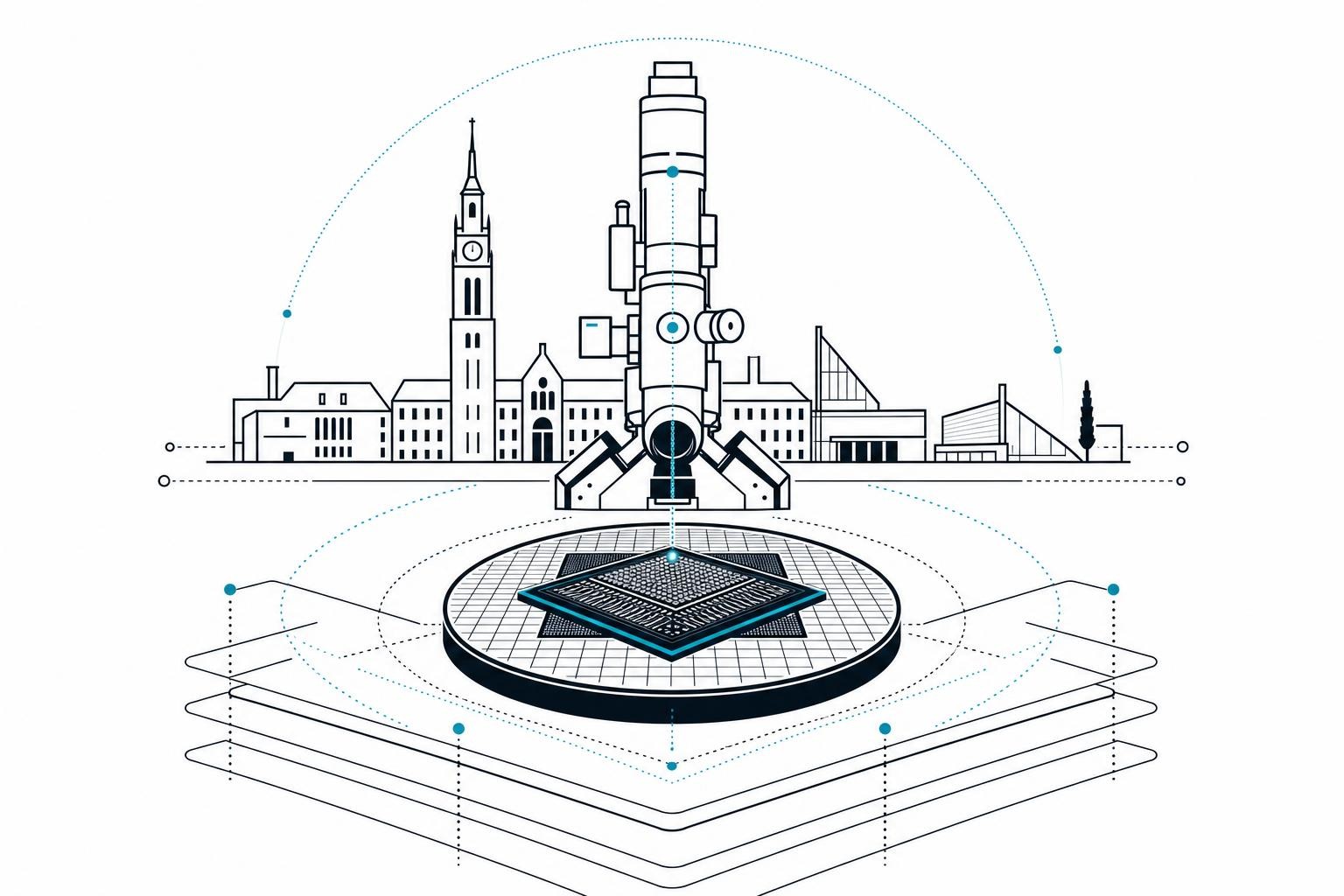
SemiWiki published a CEO interview with Sander den Hoedt of Delmic on 6 September 2026, tracing how an Applied Physics graduate from TU Delft turned a university patent into a Delft-based microscopy company with three distinct product lines[1].
From a business-plan competition to a company
Den Hoedt studied Applied Physics at TU Delft and worked at a semiconductor startup during his studies before deciding that founding a company was the most interesting career path[1]. In 2010, a TU Delft professor suggested combining light and electron microscopy, and den Hoedt and co-founder Andries Effting took the underlying patent and entered the YES!Delft business-plan competition - which they won[1]. Delmic was formally incorporated on 24 December 2010, with den Hoedt describing the decision at the time as: "This is also a career, right? We can just try this."
The company spun out of the Charged Particle Optics group at TU Delft and the NWO-Institute AMOLF in Amsterdam, and its first commercial product was the SECOM - the world's first commercially available integrated correlative light and electron microscopy (iCLEM) solution. The SECOM integrates a fluorescence microscope directly into a scanning electron microscope, combining the labelling power of fluorescence with the nanoscale resolution of electron imaging. A cathodoluminescence detector called SPARC followed shortly after.
Three product lines, one throughput problem
Den Hoedt's central argument, repeated across multiple interviews, is that electron microscopy has long been bottlenecked not by instrument resolution but by workflow speed and accessibility. "Researchers often base their work on very limited data, simply because the measurements take too long," den Hoedt has said. The company's current portfolio addresses that constraint across three areas:
- SECOM / DELPHI - integrated correlative light and electron microscopy for life science and materials research
- METEOR 2.0 - a cryo-fluorescence microscope retrofitted into a cryo-FIB/SEM that reduces the lamella preparation workflow from 22 steps to 7 by eliminating sample transfers between instruments
- FAST-EM - a multibeam scanning transmission electron microscope that fires 64 electron beams in parallel, sustaining throughputs up to 100 times higher than a conventional single-beam SEM
FAST-EM was developed through a consortium that included Thermo Fisher, TU Delft, and Technolution, and is marketed exclusively by Delmic. The system generates roughly 10 gigabytes of data per second during continuous operation, requiring a dedicated streaming data-acquisition platform.
Automation as the long-term bet
The SemiWiki interview positions Delmic's direction as one of progressive automation rather than incremental hardware improvement[1]. Den Hoedt draws an analogy to DNA sequencing: once throughput crossed a threshold, the field shifted from measuring individual samples to generating statistically significant datasets at scale. Delmic's software layer - the ODEMIS environment, which controls SEM, FIB, fluorescence imaging, and correlation from a single interface - is central to that ambition.
The company has received funding from the European Innovation Council and, in April 2023, closed a €4 million round from Value Creation Capital and the EIC Fund. Den Hoedt's next test is whether the FAST-EM's multibeam architecture can extend beyond life-science volume imaging into semiconductor inspection workflows, where multi-beam electron optics are already a standard tool at the leading edge. The SemiWiki interview does not disclose a timeline or revenue figures for that transition.
Written by Electronics Insider's automated desk from the sources above and published automatically. How we work.
Related
 Design & EDA
ETH Zürich and NYU show JEDEC test loops miss worst-case HBM2 power by 23.6%
Researchers at ETH Zürich and NYU tested 36 real HBM2 chips and found JEDEC measurement loops understate peak power by 23.6%, with read ops and data-bus toggling as the main drivers.
15 Oct 2026 Design & EDA
FlowAccel's Joel Jorgensen argues chip teams must design their workflows before AI can help them hit tape-out
Joel Jorgensen of FlowAccel argues that AI tools alone won't save a tape-out schedule - teams must first design the cross-team workflows that let those tools compound into real gains.
15 Oct 2026 Semiconductors
ETH Zürich and NYU find JEDEC test loops underestimate HBM2 power by up to 35.4%
Researchers at ETH Zürich and NYU tested 36 real HBM2 chips and found JEDEC-specified current loops can underestimate peak power by up to 35.4%, with implications for AI accelerator thermal design.
15 Oct 2026