Elektor extends ESP32 by Example course with AI coding tools and M5Stack hardware for its 26 August live session
Elektor Engineering Insights #62 on 26 August 2026 adds AI-assisted coding and M5Stack CoreS3 hardware to the ESP32 by Example learning course, with Villanova professor Jim Solderitsch.
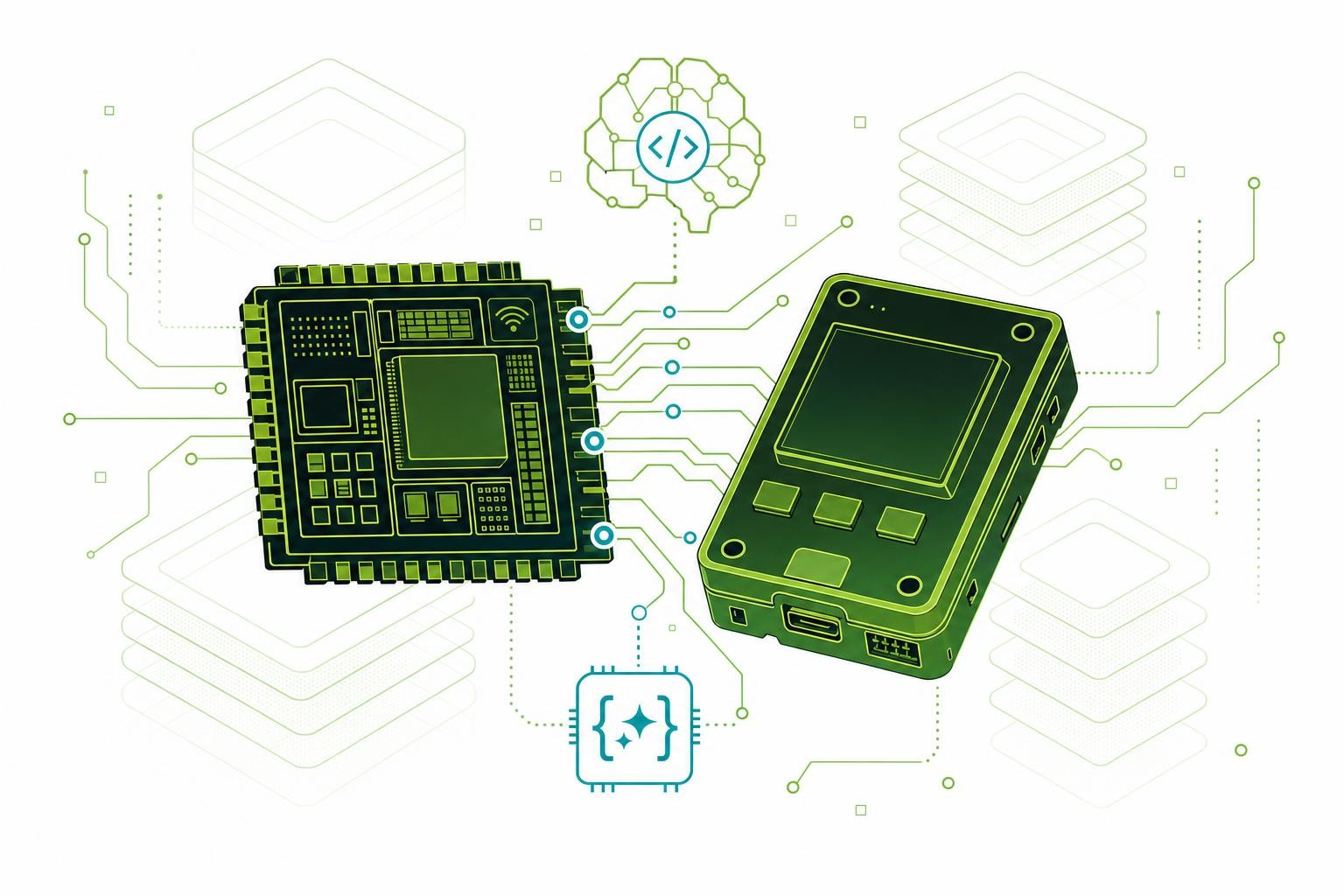
Elektor is expanding its ESP32 by Example learning course beyond its original book-and-kit format, adding AI-assisted development and M5Stack hardware to the discussion in Elektor Engineering Insights #62 on 26 August 2026[1]. The live programme starts at 16:00 CEST (14:00 UTC / 10:00 EDT) and will feature author James Solderitsch, an adjunct professor in Villanova University's Department of Computing Sciences, alongside Elektor editor Brian Tristam Williams[1].
The existing course
The ESP32 by Example course combines a 384-page book, an ESP32 by Example Kit (EEK), an Adafruit HUZZAH32 board, a display board, sensors, and online material[1]. Its modules progress through:
- GPIO, PWM, displays, and motion sensing
- Wi-Fi and cloud connectivity
- Bluetooth and drone control
- Python[1]
The approach is built around a stable hardware setup so learners can modify and break known-working examples rather than continually rebuilding the platform[1]. The discussion will also cover how versions of the material are being used in Villanova coursework, and whether the same example-led structure can be packaged for additional university courses and professional training[1].
AI coding tools under the microscope
The session will examine how example-led instruction changes when generative AI can produce working code in seconds[1]. Solderitsch and Williams plan to look at AI coding tools including Claude Code and Ollama, with the emphasis on where generated examples can accelerate teaching and where they still require verification[1].
That verification question is not trivial in embedded development. AI-generated code carries the highest risk in areas involving direct hardware register manipulation, interrupt timing, and DMA configuration. Common failure modes include interrupt priority misconfigurations, timing violations in SPI, I2C, and UART communications, and register manipulation errors that can damage hardware peripherals. Most AI models are trained on generic datasets and do not account for MCU-specific constraints, interrupt latency, or safety-critical standards. For a teaching context, where the goal is to build genuine understanding rather than just working output, that gap between plausible-looking code and verified code is precisely the territory the session intends to map.
M5Stack CoreS3 and StackChan as new targets
Solderitsch is exploring extensions based on M5Stack's CoreS3 and StackChan[1]. CoreS3 uses Espressif's ESP32-S3 with a dual-core Xtensa LX7 processor running at 240 MHz, 16 MB of Flash, and 8 MB of PSRAM, together with a 2.0-inch touch display, camera, microphones, and motion sensors[1]. StackChan builds on the same controller and adds servos, a 550 mAh battery, 12 RGB LEDs, infrared transmitter and receiver, and a three-zone touch panel, providing a substantially more integrated target for examples involving displays, audio, sensing, and physical movement.
The richer peripheral set of both boards raises the stakes for AI-generated code: more peripherals means more configuration paths where a plausible but incorrect suggestion can fail silently or damage hardware.
What to watch
One viewer will receive the complete course bundle during the live show[1]. The more consequential question is whether the session produces a clear framework for when AI tools genuinely accelerate embedded teaching and when human verification remains non-negotiable - a distinction that will matter well beyond the ESP32 platform as generative AI tools become standard in engineering curricula.
Written by Electronics Insider's automated desk from the sources above and published automatically. How we work.
Related
 Semiconductors
Token spend is becoming a line item in EDA project budgets, DAC roundtable finds
A closed-door DAC 2026 roundtable with Cadence, Synopsys, Siemens EDA, Keysight, and ChipAgents found token cost has moved from an afterthought to a formal budget concern in chip design projects.
10 Sept 2026 Design & EDA
Cadence's Amol Borkar explains why AI voice at the edge demands a rethink of SoC architecture, not just faster processors
Semiconductor Engineering's interview with Cadence's Tensilica DSP lead lays out why NLP is reshaping audio SoC design - and why raw clock speed is the wrong lever to pull.
10 Sept 2026 Design & EDA
French gendarmerie researchers show voltage glitching bypasses eMMC password locks on 3 of 10 commercial parts, with measurable evidence alteration
A paper from France's Institut de Recherche Criminelle quantifies both the success rate and the data-integrity cost of fault-assisted eMMC access in forensic investigations.
10 Sept 2026