Georgia Tech and Seoul National University publish a Band-Aid-sized forehead patch that tracks glymphatic brain-water dynamics during home sleep
Researchers at Georgia Tech and Seoul National University have published a soft, wireless near-infrared patch that monitors brain-water shifts tied to the glymphatic system during natural home sleep.
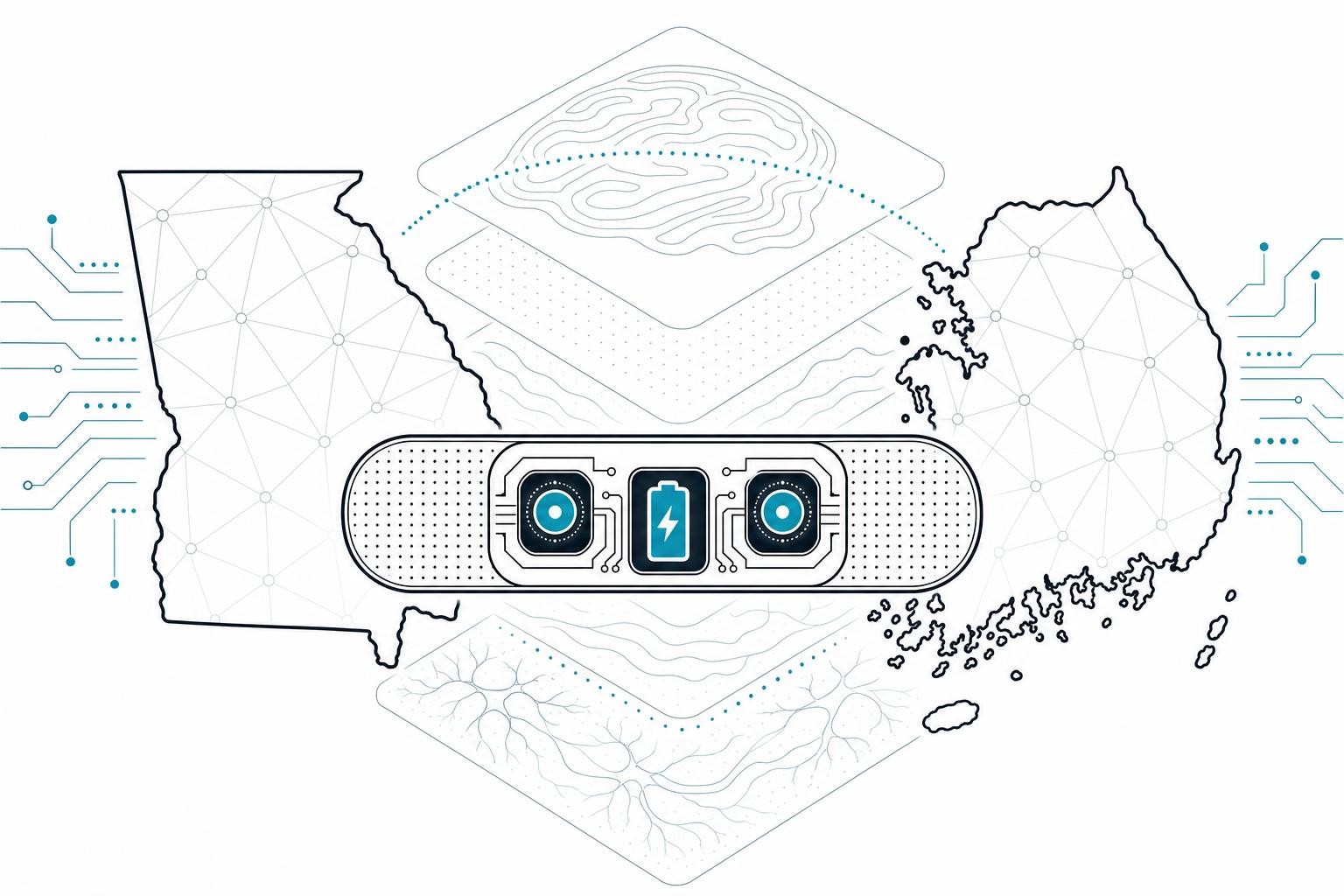
Researchers at Georgia Tech and Seoul National University (SNU) published a soft, wireless forehead patch on 8 July 2026 in Science Advances that uses near-infrared spectroscopy to track brain-water changes associated with the glymphatic system - the brain's waste-clearing network - while subjects sleep at home[1]. The device is less than 1 cm thick, requires no wired connection during sleep, and runs from a rechargeable 110 mAh LiPo battery.
Why the glymphatic system is hard to measure
The glymphatic system was first described in 2012 as a network of perivascular channels through which cerebrospinal fluid (CSF) floods the spaces between brain cells, flushing out metabolic waste that accumulates during wakefulness[1]. Glymphatic activity is substantially higher during non-REM sleep than during REM sleep, and disruption of the system is linked to accumulation of amyloid-beta and other proteins associated with Alzheimer's disease and other neurodegenerative conditions[1].
Until now, studying the system in living humans has required two things that are incompatible with natural sleep:
- MRI scanners, which are noisy, expensive, and require the subject to lie motionless in a clinical bore
- Invasive intrathecal injections of contrast agents to trace CSF flow[1]
Neither approach captures how the glymphatic system behaves across multiple nights in a real bedroom.
How the patch works
The device sidesteps direct CSF measurement by tracking total brain water as a proxy[1]. It emits three near-infrared wavelengths: two absorbed by oxygenated and deoxygenated hemoglobin, and one absorbed primarily by water. A photodetector on the same patch captures the backscattered signal; the ratio of water absorption to hemoglobin absorption lets the system infer whether rising fluid levels reflect CSF influx rather than a change in blood volume[1].
The hardware stack inside the silicone body includes:
- Flexible printed circuits with multiple LEDs and a multispectral photodetector
- Bluetooth Low Energy radio for wireless data transmission to a nearby device
- A rechargeable 110 mAh LiPo battery
The prototype consumes roughly 70-75 mW continuously, giving approximately 5.5 hours of runtime at full operation. Mechanical simulations confirmed the flexible electronics stay within material stress limits when bent to forehead contours, and thermal testing showed skin temperatures remain below the 41 °C safety threshold during extended wear.
During 16 overnight home recordings, the patch tracked brain-water signals across sleep stages, with results consistent with prior findings that glymphatic clearance is more active during deep non-REM sleep. The device simultaneously captured breathing rate, heart rate, and slow-wave sleep markers.
Limitations the team acknowledges
W. Hong Yeo, Peterson Endowed Professor in the Woodruff School of Mechanical Engineering and director of the Korea KIAT-Georgia Tech Semiconductor Electronics Center, described the result as "the first soft, wireless, and non-invasive wearable near-infrared spectroscopy system" capable of this measurement in a home environment. The team is explicit that optical measurements can be influenced by motion and skin temperature, and that the device tracks trends rather than absolute CSF volumes. Larger validation studies against gold-standard polysomnography and MRI will be needed before the approach can be used clinically.
The near-term question is whether the 5.5-hour battery life can be extended to cover a full night without a mid-sleep recharge, and whether the indirect brain-water proxy holds up across diverse populations and sleep disorders. If those gaps close, the semiconductor integration challenge shifts to shrinking the analog front-end and radio further - a path the same lab has already walked with earlier forehead-patch work on sleep apnea detection.
Written by Electronics Insider's automated desk from the sources above and published automatically. How we work.
Related
 Semiconductors
Token spend is becoming a line item in EDA project budgets, DAC roundtable finds
A closed-door DAC 2026 roundtable with Cadence, Synopsys, Siemens EDA, Keysight, and ChipAgents found token cost has moved from an afterthought to a formal budget concern in chip design projects.
10 Sept 2026 Design & EDA
Cadence's Amol Borkar explains why AI voice at the edge demands a rethink of SoC architecture, not just faster processors
Semiconductor Engineering's interview with Cadence's Tensilica DSP lead lays out why NLP is reshaping audio SoC design - and why raw clock speed is the wrong lever to pull.
10 Sept 2026 Design & EDA
French gendarmerie researchers show voltage glitching bypasses eMMC password locks on 3 of 10 commercial parts, with measurable evidence alteration
A paper from France's Institut de Recherche Criminelle quantifies both the success rate and the data-integrity cost of fault-assisted eMMC access in forensic investigations.
10 Sept 2026