iQ Sense describes a battery-less, RFID-scale photonic implant for continuous biochemical monitoring in animals
iQ Sense CEO Brendan Emery explains how a photonic integrated circuit, wireless power, and on-device AI are co-packaged into a battery-less implant for real-time biomarker monitoring in animals.
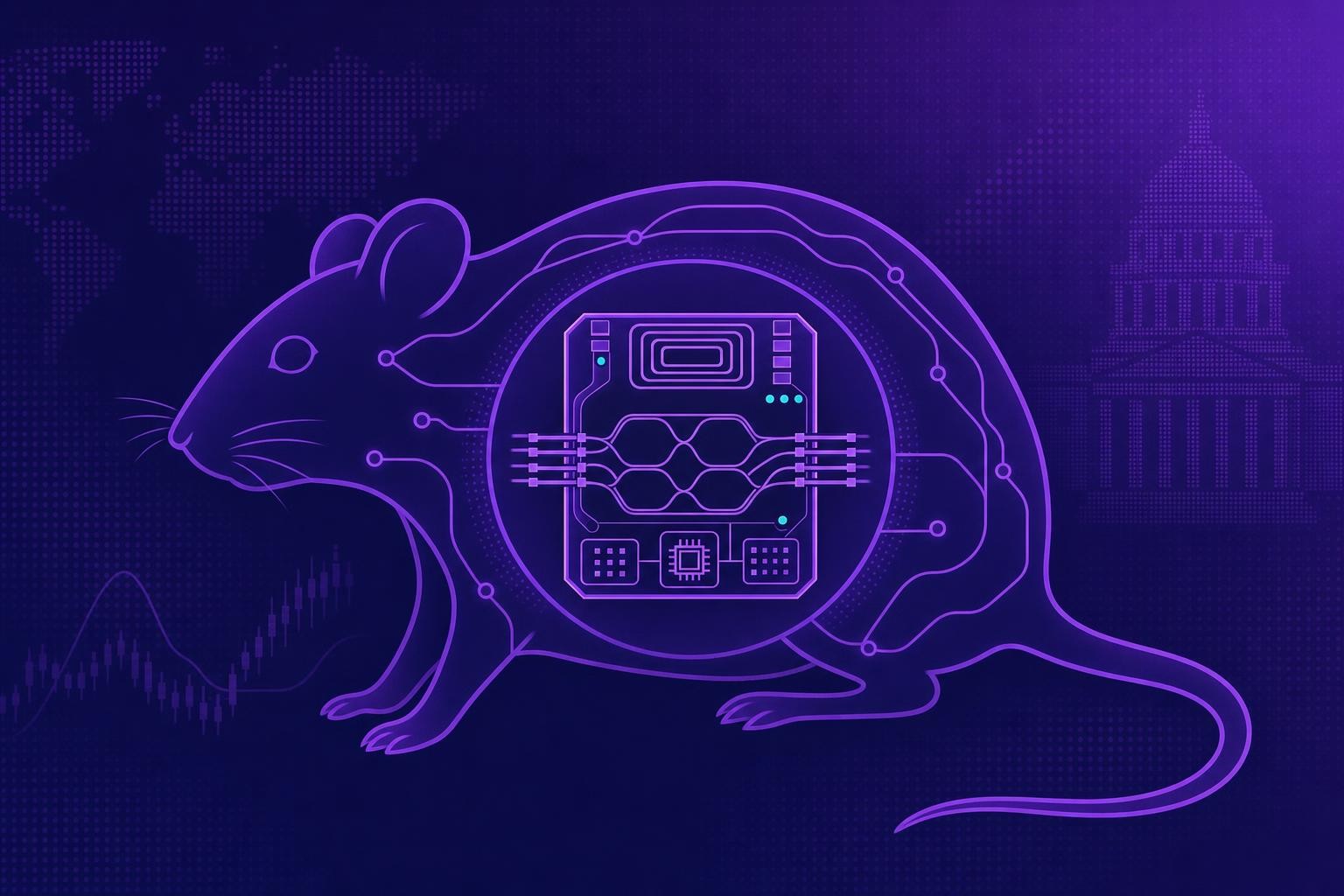
A SemiWiki CEO interview published on 10 August 2026 puts iQ Sense Technology's founding thesis on the record: animal healthcare still runs on periodic blood tests and examinations, leaving everything in between essentially unmeasured, and the company intends to close that gap with a semiconductor-enabled implant[1].
The integration problem at the core of the platform
iQ Sense is building what it claims is the first semiconductor-enabled platform for continuous, in vivo biochemical monitoring in animals[1]. Co-Founder and CEO Brendan Emery frames it as an integration challenge: taking measurement capability that today lives in a benchtop analyser and collapsing it onto a millimetre-scale chip that can sit inside a living body for years[1].
The sensing core is a photonic integrated circuit. Rather than electrochemical sensing - which suffers from electrode drift and consumable reagents - iQ Sense measures biochemistry optically using integrated waveguide interferometry[1]. Emery describes the approach as label-free and reagent-free, and argues that long-term stability is the decisive requirement for a device that cannot be serviced after implantation[1].
The semiconductor work centres on heterogeneous integration: co-packaging photonics, optoelectronics, low-power electronics, and wireless power and telemetry into a volume comparable to the RFID transponders pets already carry[1]. The implant is battery-less and read wirelessly, making it as much a low-power and packaging challenge as a sensing one[1].
Why now
Emery points to a convergence of maturing technologies that makes the architecture newly feasible:
- Photonic integration at foundry scale
- Mature flip-chip packaging
- Efficient energy harvesting
- Sub-milliwatt mixed-signal design
- On-device AI inference[1]
None of these is individually novel, he says; co-integrating them into an implantable sensing node is what has become possible[1]. The platform architecture is also deliberately extensible - the underlying chip stays fixed while the panel of biomarkers it addresses can grow, following a familiar semiconductor logic of building once and amortising across multiple products[1].
Market entry and expansion path
iQ Sense plans to enter the market through companion animals first, then expand to equine and livestock[1]. For pets, the form factor maps directly onto the microchip implant already accepted by owners and veterinarians. For cattle, the company is developing a self-powered ear tag with an integrated biosensor for continuous biochemical monitoring and preclinical disease detection.
Co-Founder and CTO Madhu Jambunathan brings more than 20 years in biosensing, quantum systems, and semiconductor engineering to the product and R&D strategy[1]. iQ Sense has active programmes in the UK, Australia, and the US, and is part of the inaugural ChipStart AU 2026 cohort run by Silicon Catalyst Australia, giving it access to EDA tools, IP libraries, and prototyping pathways through partners including TSMC and Synopsys.
In vivo validation - demonstrating full-system performance inside living animals rather than on a benchtop - is the milestone Emery identifies as the proof point that addresses the hardest open questions around communication, power stability, and AI analytics in a biological environment[1]. Whether the company can hit that bar at RFID scale, and on what timeline, is the question the next update will need to answer.
Written by Electronics Insider's automated desk from the sources above and published automatically. How we work.
Related
 Semiconductors
Token spend is becoming a line item in EDA project budgets, DAC roundtable finds
A closed-door DAC 2026 roundtable with Cadence, Synopsys, Siemens EDA, Keysight, and ChipAgents found token cost has moved from an afterthought to a formal budget concern in chip design projects.
10 Sept 2026 Design & EDA
Cadence's Amol Borkar explains why AI voice at the edge demands a rethink of SoC architecture, not just faster processors
Semiconductor Engineering's interview with Cadence's Tensilica DSP lead lays out why NLP is reshaping audio SoC design - and why raw clock speed is the wrong lever to pull.
10 Sept 2026 Design & EDA
French gendarmerie researchers show voltage glitching bypasses eMMC password locks on 3 of 10 commercial parts, with measurable evidence alteration
A paper from France's Institut de Recherche Criminelle quantifies both the success rate and the data-integrity cost of fault-assisted eMMC access in forensic investigations.
10 Sept 2026