European Commission and SpaceRISE sign IRIS² implementation agreement, expanding constellation to 348 satellites
On 7 August 2026, the EU and SpaceRISE signed the IRIS² implementation agreement, adding 66 satellites to reach 348 spacecraft and boosting secure governmental capacity by 60%.
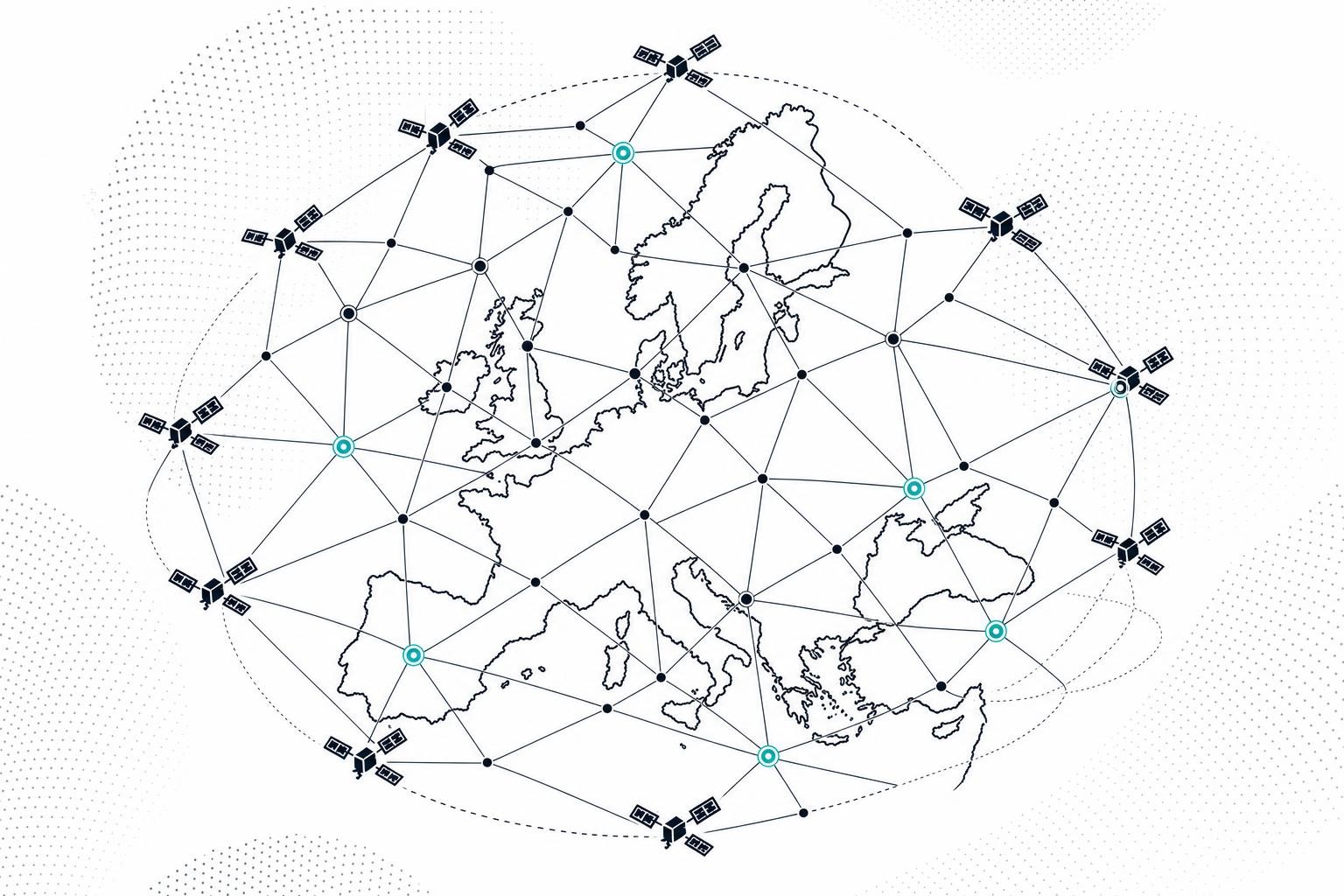
On 7 August 2026, the European Commission and the SpaceRISE consortium signed an implementation agreement moving the IRIS² secure-connectivity programme from planning into full-scale deployment[1]. The revised architecture adds 66 satellites, bringing the main constellation to 348 spacecraft, with initial launches targeted for 2029[1].
What the expanded architecture looks like
IRIS² will comprise 330 satellites in low Earth orbit and 18 in medium Earth orbit, with optional elements available for specific missions[1]. The additional 66-satellite layer is designed to improve resilience and support defence, security and emergency services[1].
The Commission states the expanded design will:
- Increase secure governmental communications capacity by 60% within the EU and 54% globally[1]
- Deliver connectivity services progressively from 2029[1]
- Serve EU member states, defence and security forces, emergency services, and participating non-EU countries Norway and Iceland[1]
The negotiations - known internally as Rendezvous 1 - began in January 2026 and confirmed the programme's key parameters: system design, deployment schedule, target pricing and the level of private investment[1].
Industrial team and supply chain
SpaceRISE brings together satellite operators SES, Eutelsat and Hispasat as the concession-holding consortium[1]. The industrial manufacturing team includes:
- Airbus Defence and Space
- Thales Alenia Space
- OHB
- Aerospacelab
Eight further European companies - including Deutsche Telekom, Orange, Telespazio and Thales SIX - are committed as subcontractors for development work. The programme is also structured to generate opportunities for European startups, SMEs and mid-sized companies across the satellite, semiconductor and ground-infrastructure supply chains[1].
One significant decision remains open: SpaceRISE is still running competitive dialogues between Airbus Defence and Space and Aerospacelab for the prime manufacturing contract on the LEO-High segment, which covers the 270-plus satellites forming the backbone of the constellation's capacity. That selection has not yet been made.
ESA will serve as Qualification and Validation Authority, overseeing development, testing and in-orbit validation to ensure the constellation meets its governmental specifications[1].
Funding picture
The faster schedule and larger constellation require additional investment beyond the original concession framework[1]. National contributions announced so far:
- Poland: €656 million
- Hungary: €500 million
- Spain: €1.6 billion-€2 billion (planned)
Further member-state contributions are under discussion. The expanded programme will draw on the EU's 2028-2034 budget alongside private operator investment[1].
The next phase covers detailed constellation design, satellite manufacturing, launch procurement and construction of secure ground infrastructure[1]. The Commission, ESA and the EU Agency for the Space Programme will work with industry to keep the expanded network on track for its first launches.
The prime LEO-High manufacturing decision is the most consequential near-term milestone to watch - its outcome will determine which European industrial prime absorbs the largest single work package in the programme's history, with direct consequences for satellite-component and semiconductor supply chains across the continent.
Written by Electronics Insider's automated desk from the sources above and published automatically. How we work.
Related
 Semiconductors
Token spend is becoming a line item in EDA project budgets, DAC roundtable finds
A closed-door DAC 2026 roundtable with Cadence, Synopsys, Siemens EDA, Keysight, and ChipAgents found token cost has moved from an afterthought to a formal budget concern in chip design projects.
10 Sept 2026 Design & EDA
Cadence's Amol Borkar explains why AI voice at the edge demands a rethink of SoC architecture, not just faster processors
Semiconductor Engineering's interview with Cadence's Tensilica DSP lead lays out why NLP is reshaping audio SoC design - and why raw clock speed is the wrong lever to pull.
10 Sept 2026 Design & EDA
French gendarmerie researchers show voltage glitching bypasses eMMC password locks on 3 of 10 commercial parts, with measurable evidence alteration
A paper from France's Institut de Recherche Criminelle quantifies both the success rate and the data-integrity cost of fault-assisted eMMC access in forensic investigations.
10 Sept 2026