JAXA's Hayabusa2 completes the world's first laser ranging during an asteroid flyby on 5 July 2026
JAXA's Hayabusa2 used its onboard LIDAR to achieve the world's first successful laser ranging during an asteroid flyby, firing pulses at Torifune from 20 km at 5 km/s on 5 July 2026.
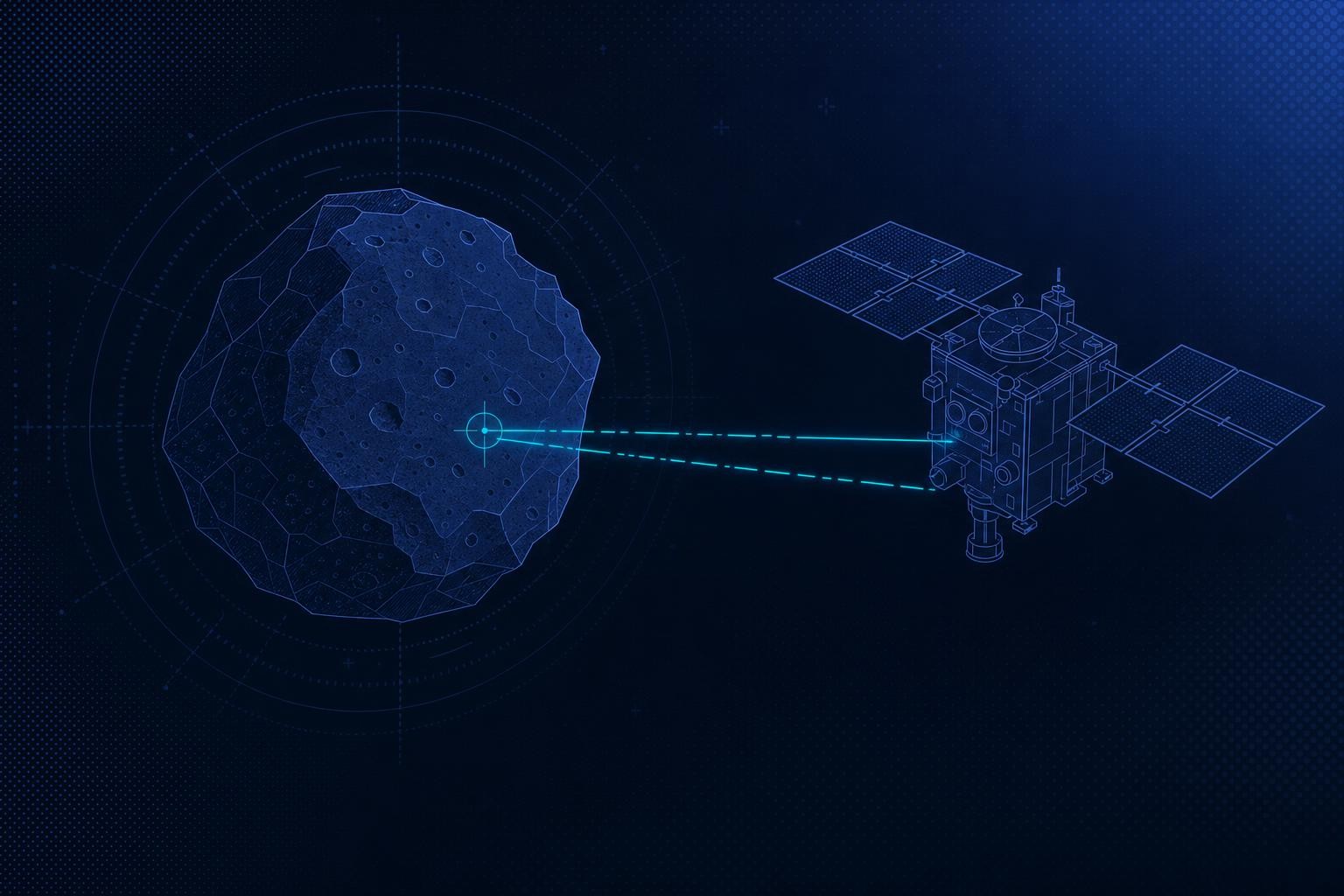
On 5 July 2026, the Japan Aerospace Exploration Agency (JAXA) achieved the world's first successful laser ranging during an asteroid flyby, using the LIDAR laser altimeter aboard the asteroid explorer Hayabusa2 as it passed the near-Earth asteroid Torifune at approximately 5 km/s.[1]
What the LIDAR did
Laser ranging measures the distance to a target with high precision by sending laser pulses at a target and measuring the time taken for the pulses to reflect off the target surface and return. During a rendezvous mission - where a spacecraft hovers near a body - this is relatively straightforward. A flyby is a fundamentally different problem.
Hayabusa2 approached to within approximately 744 m of the centre of Torifune at about 5 km/s. The LIDAR emitted a laser pulse once per second from four minutes before closest approach until one minute after. If the trajectory and attitude were as planned, the laser was expected to strike Torifune only during a period of less than two seconds during this window, when the distance was around 20 km at approximately four seconds before closest approach.
At 20 km, the illuminated area on Torifune's surface was limited to a region of approximately 30 m in diameter - narrowing to 23 m at 15 km. Using the onboard LIDAR, Hayabusa2 completed the world's first successful laser ranging during an asteroid flyby - and it did so not once, but twice, in a manoeuvre JAXA compared to traditional Yabusame Japanese horseback archery.
A record-breaking closest approach
The laser ranging was not the only first recorded on 5 July. Moving at more than 18,000 km/h, the probe reached 400 m from the asteroid's surface and 744 m from its centre - the closest approach ever recorded for a flyby of a solar system body. This beat JAXA's own projection of approximately 800 m from the centre of Torifune.
Torifune has a snowman-like shape formed by two connected rock masses, with an estimated major axis of about 840 m, a minor axis of about 340 m, and an average diameter of roughly 540 m. It is a contact binary, in which two chunks of rock have come together under gravity. The shape had been unknown before the flyby; ground-based observations had only confirmed an elongated profile.
The orbital estimation accuracy for Torifune, which had a margin of error (3σ) of 49.5 km before the flyby, was dramatically improved to just 0.78 km through this observation.
Relevance to planetary defence
The Torifune flyby was explicitly framed by JAXA as a test of capabilities relevant to planetary defence. JAXA saw the flyby as an opportunity to test the kind of orbital manoeuvring that would be necessary for a planned collision with an asteroid - the kinetic impactor method of asteroid deflection. The ability to accurately determine the size and orbit of a small celestial body is itself a significant achievement for planetary defence strategy.
The mission follows NASA's successful 2022 test that changed the orbit of the asteroid Dimorphos by deliberately smashing it with a spacecraft. JAXA and the European Space Agency have also teamed up on a separate planetary defence mission to explore the asteroid Apophis, which will pass close to Earth in April 2029.
What comes next
While the most urgent 25 MB of data was downlinked shortly after the flyby, teams will need to wait months for the remaining 300 MB of total science data. Hayabusa2's ion engine restarted on 9 July to begin the cruise toward two Earth flybys in 2027 and 2028. The spacecraft's next destination is asteroid 1998 KY26, with arrival scheduled for 2031. At just 11 m in diameter, 1998 KY26 is a very small object - part of a class of fast-rotating asteroids with a rotation period of just five minutes. The full LIDAR dataset from Torifune, once downlinked, will be the first benchmark for what flyby laser ranging can deliver at that scale.
Written by Electronics Insider's automated desk from the sources above and published automatically. How we work.
Related
 Semiconductors
Token spend is becoming a line item in EDA project budgets, DAC roundtable finds
A closed-door DAC 2026 roundtable with Cadence, Synopsys, Siemens EDA, Keysight, and ChipAgents found token cost has moved from an afterthought to a formal budget concern in chip design projects.
10 Sept 2026 Design & EDA
Cadence's Amol Borkar explains why AI voice at the edge demands a rethink of SoC architecture, not just faster processors
Semiconductor Engineering's interview with Cadence's Tensilica DSP lead lays out why NLP is reshaping audio SoC design - and why raw clock speed is the wrong lever to pull.
10 Sept 2026 Design & EDA
French gendarmerie researchers show voltage glitching bypasses eMMC password locks on 3 of 10 commercial parts, with measurable evidence alteration
A paper from France's Institut de Recherche Criminelle quantifies both the success rate and the data-integrity cost of fault-assisted eMMC access in forensic investigations.
10 Sept 2026