MIT engineers build a stroke rehabilitation robot that learns physical assistance from therapists
MIT's Newman Laboratory has published a generative AI system that trains a KUKA robot to replicate the force and touch decisions of human physiotherapists during stroke rehabilitation.
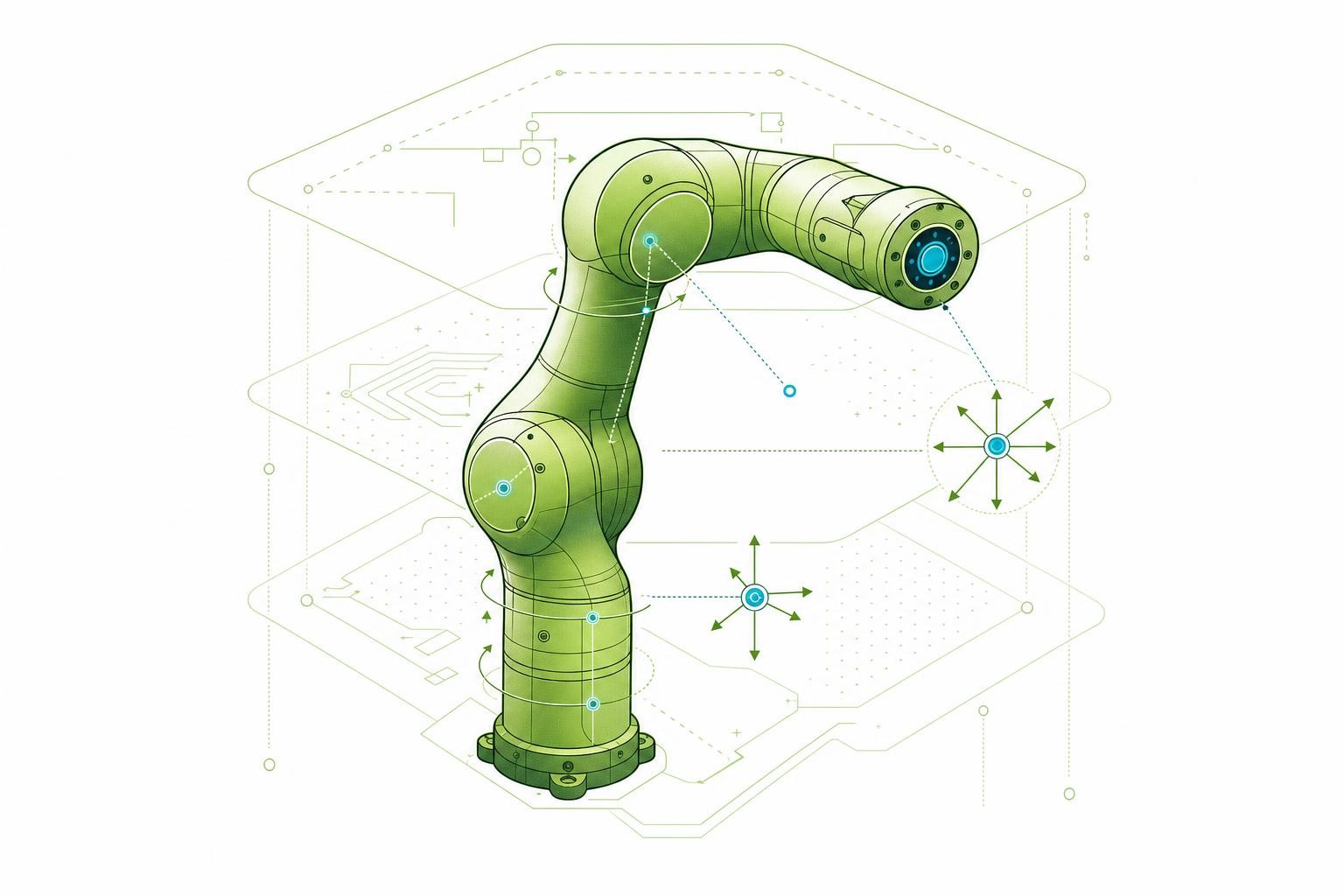
Researchers at MIT's Newman Laboratory for Biomechanics and Human Rehabilitation published a generative AI system on 5 August 2026 that trains a robot to replicate the physical assistance decisions of human physiotherapists during stroke rehabilitation.[1] The paper, "Diffusion-Based Impedance Learning for Contact-Rich Manipulation Tasks," appeared in IEEE Transactions on Robotics and describes the system running on a KUKA LBR iiwa collaborative arm.[1]
What the system does differently
Most robot-control systems for rehabilitation focus on reproducing a fixed motion trajectory. The MIT approach also models the physical interaction between robot and patient - specifically, how much force to apply and how stiff or compliant the arm should feel at any moment.[1] A transformer-based diffusion model, conditioned on real-time force and moment measurements, drives an impedance-control layer that adjusts the robot's stiffness and damping in response to the patient's own effort and resistance.[1]
The system achieved sub-millimetre positional accuracy and sub-degree rotational accuracy from tens of thousands of training samples.[1] In separate peg-in-hole manipulation tests, the controller also generalised to tasks it had not seen during training, demonstrating that the underlying control technique transfers beyond the therapy context.[1]
How training data were collected
Demonstrations were captured through teleoperation using Apple Vision Pro, which tracked the operator's hand motion in six degrees of freedom without external markers.[1] Healthy participants performed movements including arm lifting and out-of-plane reaching under three conditions:
- Passive - subjects relaxed and allowed the robot to move the arm without resistance.
- Cooperative - subjects actively minimised interaction forces, matching the robot's motion.
- Mixed - subjects alternated between relaxing and cooperating.
These conditions were designed to capture the range of participation levels a therapist encounters in clinical practice.[1] The work builds on earlier research in the Newman Laboratory, directed by Neville Hogan, which had been confined to planar reaching; the new system extends to a broader set of three-dimensional actions.
The clinical study now under way in Munich
The next stage is a collaboration with Cristina Piazza's laboratory at the Technical University of Munich and the Pfennigparade outpatient rehabilitation centre.[1] Physical and occupational therapists are being recorded while treating patients, using cameras and force-sensing gloves to capture both movement and physical interaction. Those data will train models that reflect the assistance style of individual therapists, with a longer-term clinical study planned for patients who previously received manual therapy.[1]
The distinction matters: the system has demonstrated adaptive physical interaction in the laboratory, but the MIT announcement does not yet report improved rehabilitation outcomes in stroke patients. The researchers frame the goal as extending the reach of therapists rather than replacing them - a relevant framing given that stroke affects 15 million people each year and leaves 5 million with long-term impairments, while community stroke services in the UK alone are operating with 26% fewer physiotherapists than national guidance recommends.[1]
The clinical study in Munich will be the first test of whether therapist-specific models translate from the laboratory to patients with actual impairments. Results from that study, and whether the system can be validated across different therapist styles, will determine how quickly the approach moves toward routine clinical use.
Written by Electronics Insider's automated desk from the sources above and published automatically. How we work.
Related
 Semiconductors
Token spend is becoming a line item in EDA project budgets, DAC roundtable finds
A closed-door DAC 2026 roundtable with Cadence, Synopsys, Siemens EDA, Keysight, and ChipAgents found token cost has moved from an afterthought to a formal budget concern in chip design projects.
10 Sept 2026 Design & EDA
Cadence's Amol Borkar explains why AI voice at the edge demands a rethink of SoC architecture, not just faster processors
Semiconductor Engineering's interview with Cadence's Tensilica DSP lead lays out why NLP is reshaping audio SoC design - and why raw clock speed is the wrong lever to pull.
10 Sept 2026 Design & EDA
French gendarmerie researchers show voltage glitching bypasses eMMC password locks on 3 of 10 commercial parts, with measurable evidence alteration
A paper from France's Institut de Recherche Criminelle quantifies both the success rate and the data-integrity cost of fault-assisted eMMC access in forensic investigations.
10 Sept 2026