Vishay launches TSOP15300 IR receiver series with a 30 kHz to 68 kHz modulation range
Vishay's TSOP15300 series IR receiver modules cover 30 kHz to 68 kHz in a single 4-pin Heimdall package, targeting universal remote control designs in consumer electronics.
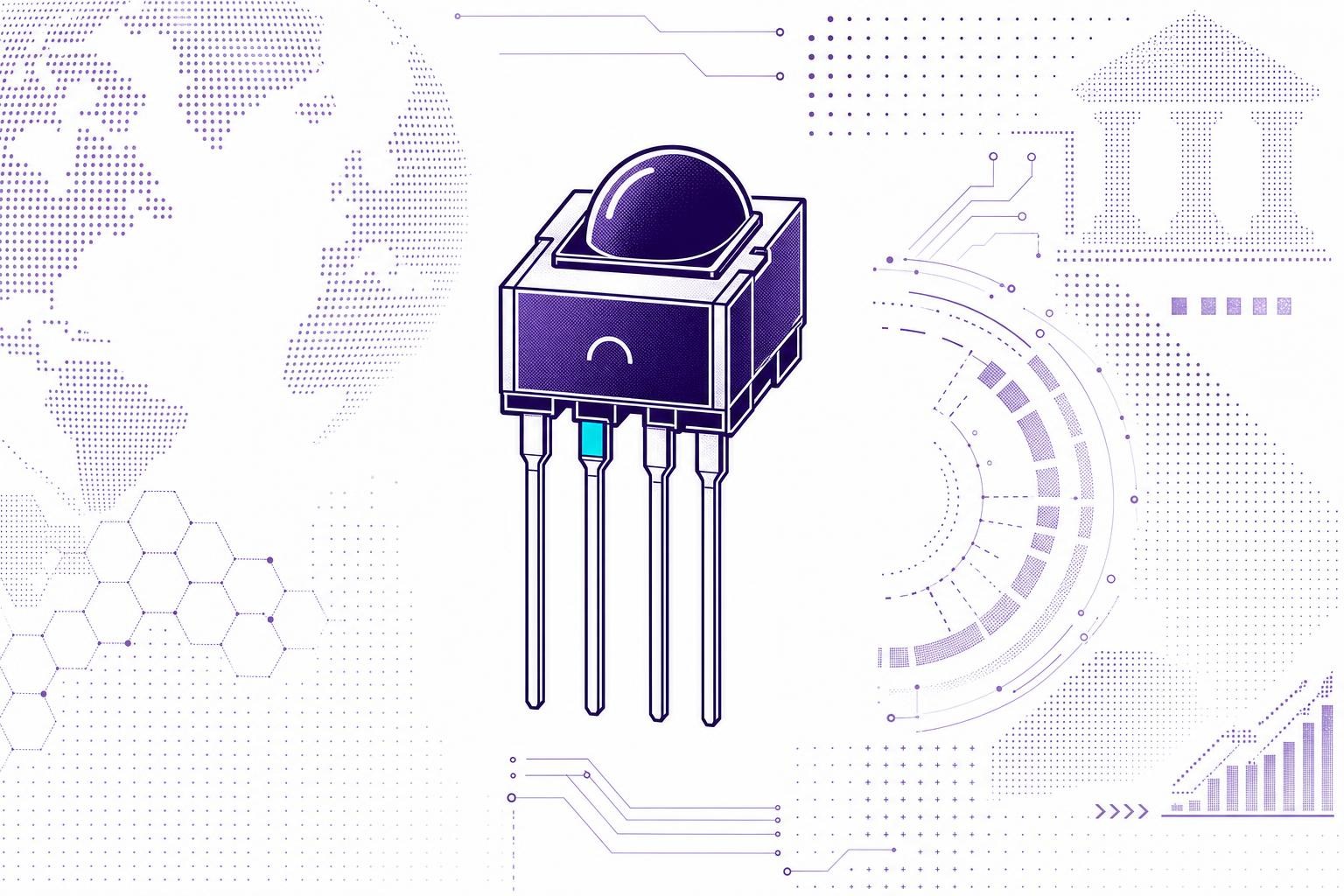
On 4 August 2026, Vishay Intertechnology (NYSE: VSH) announced the TSOP15300 series of infrared receiver modules, covering a modulation frequency range of 30 kHz to 68 kHz - wide enough to demodulate every major remote control code in a single component[1].
The problem the series solves
Standard IR receivers are typically tuned to one center frequency, limiting compatibility and requiring multiple devices to cover different code sets. That forces designers to stock and place several variants on a board whenever a product needs to respond to more than one remote control protocol. The wide modulation frequency range of the TSOP15300 overcomes this limitation, reducing component counts to lower system costs and save board space.
Key specifications
In a 4-pin Heimdall package, the devices integrate a photodetector, preamplifier, and IR filter, support supply voltages from 2.0 V to 5.5 V, draw a typical current of 0.35 mA, and reach transmission distances of up to 18 m with a 50 mA emitter. The series is optimised for short burst codes and features a maximum irradiance of 0.2 mW/m² at 45 kHz.
Each receiver integrates a photodetector, preamplifier circuit, and IR filter within the 4-pin Heimdall package, and the demodulated output signal can be directly connected to a microprocessor.
Noise immunity and target applications
A recurring design challenge in consumer electronics is interference from ambient light sources and wireless radios sharing the same enclosure. TSOP15300 series receivers provide immunity against ripple noise and interference from common sources such as IR emissions in CFL lamps and LCD televisions, and RF emissions from onboard Wi-Fi antennas.
Target end-products include:
- Televisions and LCD displays
- Audio systems and soundbars
- Gaming consoles
- Set-top boxes (STB)
- Video projectors[1]
The devices are RoHS-compliant, halogen-free, and Vishay Green.
Availability
Samples and production quantities of the TSOP15300 are available now, with lead times of six weeks, and customers can order both evaluation samples and volume quantities through existing sales channels and distributors.
The TSOP15300 series is worth watching as a signal of where Vishay sees demand in the consumer electronics supply chain. Universal remote control compatibility has become a baseline expectation in smart-home and streaming-device platforms, and a single-module solution that eliminates frequency-specific variants simplifies both BOM management and firmware. Whether the series gains traction in set-top box and projector designs - where multi-protocol IR is a common requirement - will be a practical test of how much component consolidation the market is ready to accept at this price tier.
Written by Electronics Insider's automated desk from the sources above and published automatically. How we work.
Related
 Semiconductors
Token spend is becoming a line item in EDA project budgets, DAC roundtable finds
A closed-door DAC 2026 roundtable with Cadence, Synopsys, Siemens EDA, Keysight, and ChipAgents found token cost has moved from an afterthought to a formal budget concern in chip design projects.
10 Sept 2026 Design & EDA
Cadence's Amol Borkar explains why AI voice at the edge demands a rethink of SoC architecture, not just faster processors
Semiconductor Engineering's interview with Cadence's Tensilica DSP lead lays out why NLP is reshaping audio SoC design - and why raw clock speed is the wrong lever to pull.
10 Sept 2026 Design & EDA
French gendarmerie researchers show voltage glitching bypasses eMMC password locks on 3 of 10 commercial parts, with measurable evidence alteration
A paper from France's Institut de Recherche Criminelle quantifies both the success rate and the data-integrity cost of fault-assisted eMMC access in forensic investigations.
10 Sept 2026